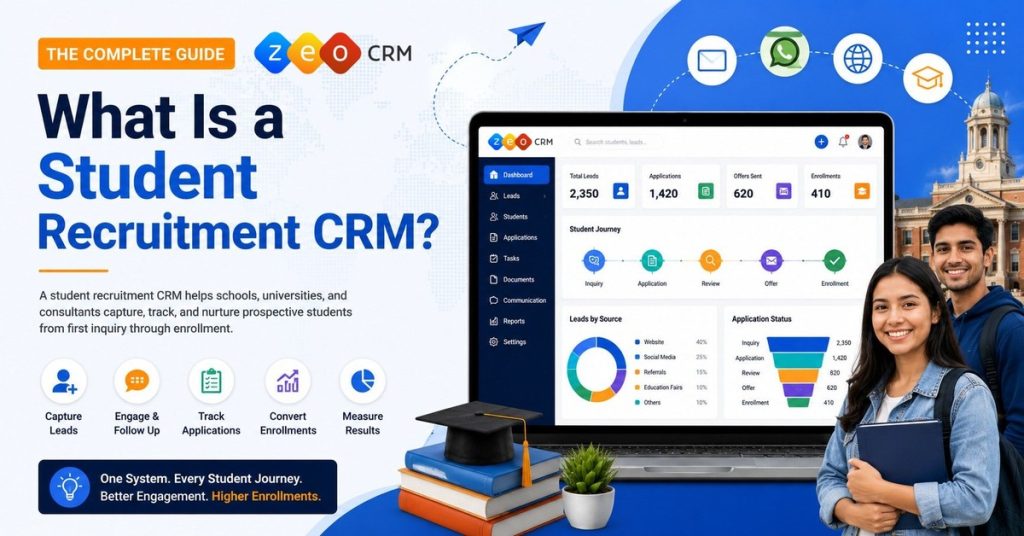
A student recruitment CRM is software that helps schools, universities, and education consultants capture, track, and nurture prospective students from first inquiry through enrollment. It centralizes contact data, automates follow-ups, and gives admissions teams a single view of every applicant’s journey, replacing scattered spreadsheets and inboxes with one organized system.
Every admissions team has felt this pain at some point: a promising student inquiry comes in through a web form, gets forwarded to the wrong inbox, and never receives a follow-up. Multiply that by hundreds or thousands of inquiries a year, across multiple channels like WhatsApp, email, phone calls, and walk-ins, and it’s easy to see why so many institutions and consultancies struggle to keep up.
This is the exact problem a student recruitment CRM was built to solve. Instead of managing prospects through spreadsheets, sticky notes, and shared inboxes, admissions and recruitment teams get one centralized system that tracks every interaction, automates repetitive tasks, and surfaces the leads most likely to enroll.
Platforms like ZeoCRM represent this shift toward purpose-built recruitment technology, offering education-specific workflows rather than a generic sales tool retrofitted for schools. Whether you’re a university admissions office, a college recruitment team, or an education consultant managing applications across multiple countries, understanding what a student recruitment CRM actually does, and doesn’t do, is the first step toward fixing a leaky admissions funnel.
In this guide, we’ll break down what a student recruitment CRM is, how it works, its core features, who uses it, and how to evaluate one for your organization.
A student recruitment CRM is a specialized customer relationship management platform designed to manage the entire student acquisition process, from the moment someone expresses interest to the moment they enroll. It combines lead management, communication automation, application tracking, and reporting into one system tailored to education workflows.
Unlike a general CRM used for sales pipelines, a student recruitment CRM understands concepts unique to education: application cycles, intake periods, document verification, program eligibility, and multi-stage admissions decisions. It’s designed around the student journey rather than a generic sales deal.
At its core, the system does three things:
A regular sales CRM, like a generic contact manager, tracks deals and revenue. A student recruitment CRM tracks something more nuanced: a prospective student’s progress through inquiry, application, document submission, interview, offer, and enrollment. It needs to handle things a sales CRM was never built for, like tracking transcripts, visa documents, or program-specific eligibility rules.
A student recruitment CRM works by pulling in leads from multiple channels, organizing them into a single database, and then guiding each prospect through a defined pipeline using automated tasks, reminders, and communication triggers, until they either enroll or drop off.
Here’s what that process typically looks like in practice:
The real value of a student recruitment CRM isn’t storing data. It’s making sure that data triggers the right action at the right time, automatically.
The core features of a student recruitment CRM include lead management, multi-channel communication, application and document tracking, automated workflows, counselor task management, and analytics dashboards that show recruitment performance in real time.
| Feature | What It Does | Why It Matters |
|---|---|---|
| Lead Capture & Management | Collects inquiries from web forms, social media, fairs, and referrals into one database | Prevents leads from being lost across disconnected channels |
| Lead Scoring | Ranks prospects by likelihood to enroll based on engagement and profile fit | Helps counselors focus time on high-intent students |
| Automated Communication | Sends emails, SMS, and WhatsApp messages triggered by student actions | Keeps students engaged without manual follow-up |
| Application Tracking | Monitors each student’s stage from inquiry to enrollment | Gives teams visibility into where every applicant stands |
| Document Management | Stores and verifies transcripts, test scores, and other required files | Reduces back-and-forth and administrative delays |
| Task & Counselor Management | Assigns follow-ups and reminders to specific staff members | Ensures accountability and prevents dropped leads |
| Reporting & Analytics | Tracks conversion rates, response times, and channel performance | Informs data-driven recruitment strategy |
| Integrations | Connects with websites, payment gateways, and communication tools | Keeps the CRM at the center of your existing tech stack |
Student recruitment CRMs are used by universities, colleges, K-12 schools, education consultants, and study abroad agencies, essentially any organization responsible for converting prospective students into enrolled ones.
For consultancies handling overseas admissions specifically, a student recruitment CRM is typically one component within a more complete system. If you’re evaluating solutions for overseas education businesses, our CRM for Study Abroad Consultants guide covers the complete workflow, including visa tracking, commission management, and multi-country application processes.
A student recruitment CRM focuses on the pre-enrollment journey, covering marketing, inquiries, and applications, while systems like a Student Information System (SIS) or ERP manage post-enrollment operations such as grades, billing, and academic records. Many institutions use both together.
| System | Primary Focus | Used By | Typical Data |
|---|---|---|---|
| Student Recruitment CRM | Lead-to-enrollment journey | Admissions, marketing, consultants | Inquiries, applications, communication history |
| Student Information System (SIS) | Post-enrollment academic records | Registrar, academic staff | Grades, transcripts, attendance |
| ERP (Enterprise Resource Planning) | Institution-wide operations | Finance, HR, operations | Budgets, payroll, procurement |
A common mistake institutions make is trying to force their SIS to handle recruitment, or their CRM to handle academic records. Each system is built for a different stage of the student lifecycle, and stretching one to cover both usually creates more friction than it solves.
The main benefits of a student recruitment CRM are fewer lost leads, faster response times, better team accountability, and clearer visibility into what’s actually driving enrollments, all of which lead to higher conversion rates over time.
AI is increasingly used within student recruitment CRMs to score leads more accurately, predict which students are likely to enroll, and automate personalized communication at scale, reducing manual workload for admissions counselors.
Modern platforms are starting to use AI for tasks like flagging high-intent leads based on browsing behavior, drafting personalized follow-up messages, and identifying patterns in past enrollment data to forecast future outcomes. This doesn’t replace the human relationship-building counselors do, but it does remove a lot of the manual sorting and guesswork that used to eat up their time.
The right student recruitment CRM should match your institution’s actual admissions workflow, not force you to adapt to generic software. Look for education-specific pipeline stages, strong automation, reliable reporting, and integrations with the communication channels your students already use.
When evaluating platforms, it helps to look past the feature list and ask whether the tool actually fits how your team works day to day. A few things worth prioritizing:
Platforms like ZeoCRM are built around this exact combination, bringing lead management, admissions workflows, automation, communication, and reporting into a single system designed for education consultants and institutions rather than adapted from a general business CRM. It’s worth evaluating alongside other options based on your team’s size, workflow complexity, and the countries or programs you recruit for.
What is a student recruitment CRM in simple terms?
It’s software that helps schools and consultants manage prospective students from first inquiry to enrollment, automating follow-ups and keeping all communication and application data in one place instead of scattered across emails and spreadsheets.
Is a student recruitment CRM the same as a student admissions CRM?
They’re closely related and often used interchangeably. Both refer to systems that manage the applicant journey, though admissions CRM sometimes emphasizes the application review and decision stage more specifically.
Can small education consultancies use a student recruitment CRM?
Yes. Many platforms offer plans suited to solo consultants or small teams, not just large universities. The core benefit, organized lead tracking and automated follow-up, applies at any scale.
What’s the difference between a student recruitment CRM and a higher education CRM?
Higher education CRM is often a broader term covering recruitment, alumni relations, and sometimes fundraising, while a student recruitment CRM focuses specifically on the pre-enrollment journey.
Does a student recruitment CRM replace a Student Information System (SIS)?
No. A CRM manages the recruitment and admissions process before enrollment, while an SIS manages academic records, grades, and attendance after a student enrolls. They typically work together rather than replacing one another.
How much does a student recruitment CRM cost?
Pricing varies widely based on features, number of users, and applicant volume, ranging from affordable monthly plans for small consultancies to enterprise pricing for large institutions. It’s best to request a demo or quote directly from vendors for accurate figures.
Do study abroad consultants need a different type of CRM?
Study abroad consultants often need additional features beyond a standard student recruitment CRM, such as visa tracking, multi-country application management, and commission tracking with partner universities. Our Complete Guide to CRM for Study Abroad Consultants covers this in more detail.
A student recruitment CRM isn’t just a database of student contacts. It’s the operational backbone that connects marketing, admissions, and communication into one coordinated system, so no inquiry gets lost and every prospective student gets a timely, personalized response.
To recap: a student recruitment CRM centralizes lead capture, automates follow-up, tracks applications from inquiry to enrollment, and gives teams the reporting they need to improve over time. Whether you’re running admissions for a university, a college, or an education consultancy, the right system removes the manual busywork that slows recruitment down.
If you’re evaluating options, platforms like ZeoCRM are worth a look, offering the lead management, automation, and reporting features education teams need in one connected system. And if your recruitment work involves international students specifically, our Complete Guide to CRM for Study Abroad Consultants is a helpful next read, covering the additional tools and workflows that come into play.
