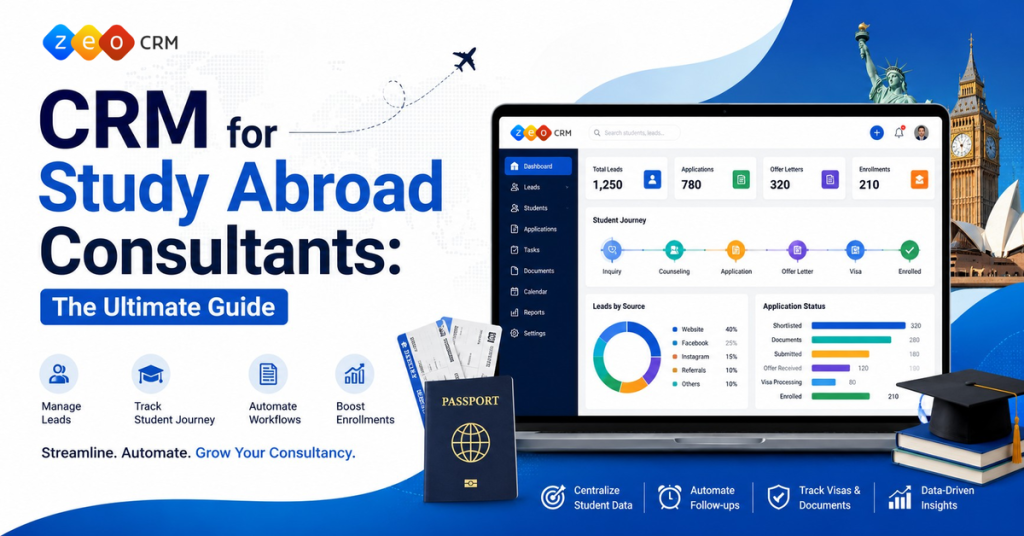
 A study abroad CRM helps consultants manage leads, applications, and student communication in one platform.
If you run a study abroad consultancy, you already know the feeling: forty new inquiries on Monday, half of them buried in a WhatsApp chat by Wednesday, and a counselor asking “wait, did we already send this student their offer letter?” on Friday. It’s not that your team isn’t working hard. It’s that spreadsheets, sticky notes, and scattered chat threads were never built to manage something as complex as the modern student journey.
That’s exactly the gap a CRM for study abroad consultants is meant to close. In this guide, we’ll walk through what this kind of software actually does, why generic CRMs fall short for education businesses, and what to look for before you buy one. We’ll also talk about where we come in, we built ZeoCRM specifically for overseas education agencies, so a lot of what follows comes from conversations with consultants who were dealing with exactly these headaches.
A CRM (Customer Relationship Management) system is software that helps a business track and manage its relationships with people, in this case, students, from the very first inquiry to well after they’ve boarded their flight.
CRM software for study abroad consultants does this with one big difference from ordinary sales CRMs: it’s built around the specific, multi-month journey a student goes through, not a generic sales pipeline.
A regular CRM tracks a deal from “lead” to “closed.” A study abroad CRM tracks a student through counseling, university shortlisting, IELTS/PTE prep, document collection, application submission, offer letters, visa filing, tuition payment, accommodation, and pre-departure support. That’s a fundamentally different and far longer process, and it needs fields, stages, and automations that a plain sales CRM simply doesn’t have out of the box.
Most agencies start with Excel and WhatsApp. It works, until it doesn’t. Here’s where things typically break down:
None of these are small problems. Each one is a leak in your funnel, and leaks compound.
Before picking any software, it helps to map out what you’re actually managing. A student typically moves through:
Lead Generation → Lead Qualification → Counseling → University Shortlisting → IELTS/PTE Guidance → Document Collection → Application Submission → Offer Letter → Visa Filing → Visa Approval → Tuition Payment → Accommodation → Forex → Insurance → Pre-Departure → Post-Arrival Support
A good CRM doesn’t just store data at each stage, it moves the student forward automatically, nudging counselors and students alike so nothing sits idle.
The benefits of CRM in higher education go well beyond “staying organized.” Here’s what agencies actually notice after adopting one:
Benefit | What Changes |
|---|---|
Better lead management | Every inquiry lands in one place, automatically |
Faster response times | Auto-assignment gets leads to counselors within minutes |
Higher conversion rates | Nothing falls through the cracks between stages |
Centralized student records | One file per student, visible to the whole team |
Stronger team collaboration | Any counselor can pick up any file without confusion |
Automated follow-ups | Reminders go out on schedule, every time |
Data-driven decisions | Owners see real numbers, not gut feelings |
Increased revenue | More leads converted, fewer students lost to silence |
Reduced errors | Less manual data entry, fewer typos in critical documents |
Better compliance | Document and visa records stay audit-ready |
Not all CRMs are built equal, and not every “education CRM” was actually designed with study abroad in mind. Here’s what to check for:
Lead Management: automatic capture from your website and social channels, smart lead assignment, and source tracking so you know which marketing spend is actually working.
Student CRM System: a single student profile holding academic history, test scores, passport details, visa status, and every document in one view. This is the backbone of any serious student CRM system.
Student Recruitment CRM: dedicated funnel tracking for inquiry-to-enrollment, with recruitment analytics that show conversion at every stage. A proper student recruitment CRM should tell you exactly where students are dropping off.
Application Management: university and course tracking, deadline alerts, and offer letter management in one dashboard.
Document Management: centralized storage for passports, SOPs, LORs, transcripts, and financial documents, so nobody’s digging through email threads.
Visa Processing: checklists, timelines, and status tracking specific to each destination country.
Automated Communication: email, WhatsApp, and SMS reminders that go out without a human having to remember.
Other essentials worth checking off your list: task management, calendar integration, a counselor dashboard, a university database, commission tracking, financial tracking, reports and analytics, mobile access, multi-branch support, and role-based permissions for larger teams.
This is where things have shifted quickly over the last couple of years. An AI powered CRM platform doesn’t just store information, it acts on it. Some of what this looks like in practice:
None of this replaces your counselors, it just removes the repetitive parts of their job so they can spend more time actually talking to students.
Recruitment and admissions are really two different jobs living under one roof. Marketing and counseling teams need to see inquiry volume, source performance, and campaign ROI, while admissions teams need application status and document readiness. A dedicated student recruitment CRM brings both views together, lead nurturing, campaign tracking, counselor performance, and the full recruitment pipeline, without forcing two departments onto two different systems.
Plenty of agencies start out using a general-purpose CRM for consulting companies because it’s cheaper or more familiar. The problem shows up fast:
Feature | Generic CRM | Study Abroad CRM |
|---|---|---|
Lead Management | Standard | Education-specific |
Student Lifecycle Tracking | Limited | Built-in |
University Database | Manual | Included |
Visa Tracking | Custom setup | Built-in |
IELTS/PTE Tracking | Manual fields | Dedicated |
Application Tracking | Custom workflows | End-to-end |
Offer Letter Management | Manual | Built-in |
Commission Tracking | Limited | Automated |
Intake Management | Manual | Intake-wise |
A generic CRM can hold contact records just fine. What it can’t do is understand that a “deal” here is actually a 6–18 month journey through visas, intakes, and academic requirements.
These terms get used almost interchangeably, but there’s a real difference. A “higher education CRM” often refers to systems built for universities managing their own admissions. An overseas education CRM is built for the agencies and consultants working on the other side — helping students apply to those universities from abroad.
Both manage applications, documents, and communication at scale.
University-side CRMs focus on institutional admissions cycles; overseas education CRMs focus on agent commissions, visa processes, and multi-country, multi-university shortlisting for individual students.
If you’re a consultancy sending students abroad rather than a university receiving them, you want the overseas education variant, the workflows simply match your business better.
When you’re evaluating the best CRM for higher education and overseas recruitment, run through this checklist:
A quick way to see how options typically stack up (higher education CRM software comparison):
| Feature | Generic CRM | Basic Education CRM | ZeoCRM |
|---|---|---|---|
| Student Lifecycle Tracking | Limited | Partial | Advanced |
| University Database | Manual | Partial | Extensive |
| Visa Tracking | Custom Setup | Included | Automated |
| Commission Tracking | Limited | Partial | Automated |
| AI Automation | Basic | Included | AI-Powered |
| WhatsApp Integration | Varies | Varies | Native |
| Document Management | Basic | Partial | Advanced |
We built ZeoCRM around the actual workflow of overseas education agencies, so this isn’t a generic feature checklist we bolted on, it’s the process consultants told us they needed, start to finish.
Website forms, WhatsApp, email, SMS, Zoom, Google Calendar, payment gateways, document storage, accounting software, and your marketing tools should all connect to your CRM. If they don’t, you’re back to manually copying data between systems, the exact problem you were trying to solve.
If your current system can’t show you these numbers in a few clicks, it’s costing you more than it’s saving.
The next few years are likely to bring AI agents handling first-line student queries, deeper predictive analytics for intake planning, conversational and voice-based CRM interfaces, WhatsApp-first communication as the default rather than the exception, student self-service portals, and real-time, hyper-personalized dashboards for both students and staff.
What is a CRM for study abroad consultants?
It’s software built to manage the entire student journey, from first inquiry through visa approval and departure, in one centralized system.
Why do study abroad consultants need a CRM?
Because the student journey is long and multi-stage; without a system, inquiries, documents, and deadlines get lost.
What is the best CRM for higher education?
It depends on your specific workflow, but look for one purpose-built for overseas education rather than a generic sales tool.
How does a student recruitment CRM work?
It tracks leads from first contact through enrollment, with visibility into conversion at each stage.
What is an overseas education CRM?
A CRM designed specifically for consultancies helping students apply and get visas for study abroad, as opposed to universities managing their own admissions.
Can CRM automate student follow-ups?
Yes — automated reminders and messages are one of the core features of a good CRM.
Can CRM manage visa applications?
Yes, a study abroad CRM should include visa checklists, timelines, and status tracking.
Can CRM integrate with WhatsApp?
Most modern education CRMs, including ZeoCRM, support WhatsApp integration for student communication.
What’s the difference between a student CRM system and a generic CRM?
A student CRM system is built around the education-specific journey – academics, tests, visas, documents – rather than a generic sales pipeline.
How much does CRM software for study abroad consultants cost?
Pricing varies widely by features and team size; it’s worth comparing what’s included rather than just the sticker price.
Is AI important in a CRM platform?
Increasingly, yes it saves counselors time on repetitive tasks and helps prioritize the right students.
How long does CRM implementation take?
Typically a few weeks, depending on data volume and team size.
Can small consultancies benefit from a CRM?
Absolutely — even a two-person agency benefits from not losing leads and documents.
How does CRM improve student conversion rates?
By ensuring faster response times, consistent follow-ups, and better visibility into where students are in the funnel.
What features should I look for in a study abroad CRM?
Lead management, student lifecycle tracking, document management, visa tracking, automation, and reporting, at minimum.
At this point, a CRM isn’t really optional for a growing study abroad consultancy, it’s the difference between scaling your business and drowning in your own spreadsheets. A specialized system streamlines the entire student journey, keeps every department on the same page, and gives you the numbers you need to actually run the business instead of just reacting to it day to day.
That’s the exact gap we set out to close with ZeoCRM, a CRM built specifically for overseas education agencies, not adapted from a generic sales tool. If you’re currently juggling Excel sheets, WhatsApp chats, and half a dozen disconnected tools, it’s worth taking a closer look at what a purpose-built system can do for your team. Evaluate your options carefully, but don’t wait too long, every week without a proper CRM is another week of leads and follow-ups quietly slipping through the cracks.
