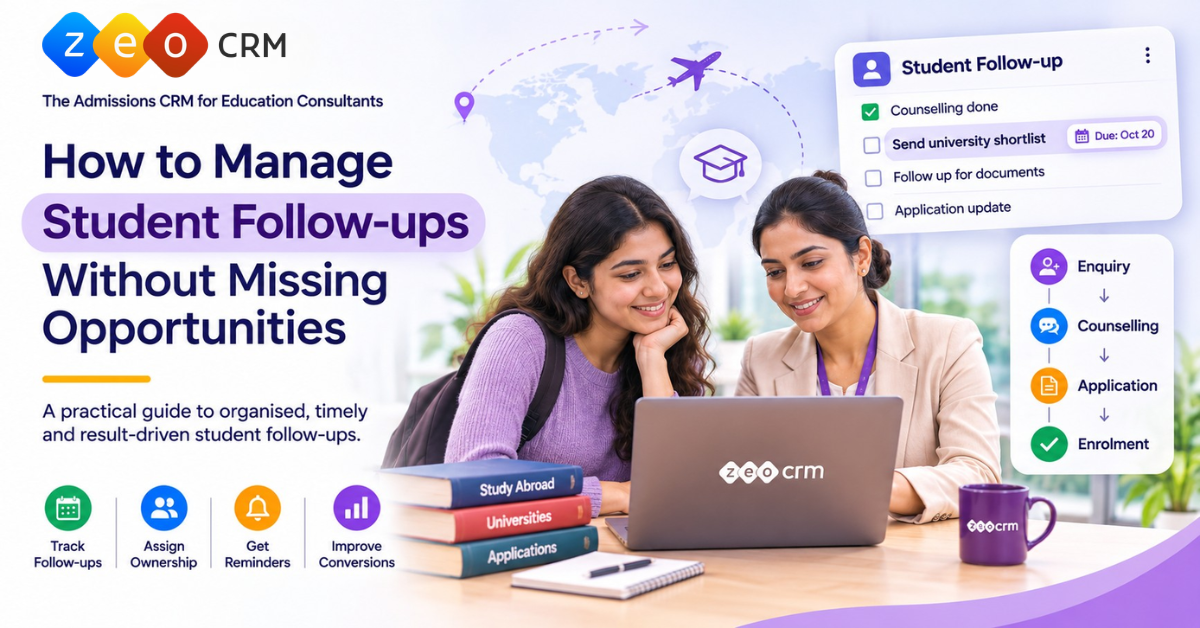
Record every enquiry, assign a responsible counsellor and prioritise students by their admissions stage. Give each student a clear next action and follow-up date. Keep a full communication history, use CRM reminders where they fit and review overdue tasks regularly. This cuts missed enquiries and keeps guidance timely and personal throughout the application journey.
A student enquires about studying in Australia. They have a great first counselling call and the counsellor promises to send a shortlist of universities. Then the week gets busy, nobody writes down the next step and the conversation quietly stalls.
Sound familiar? Good student follow up management isn’t about sending more messages. It’s about knowing exactly what happens after every conversation and who is responsible for it. This guide shows you how to build that system. For the bigger picture, see our guide to CRM for study abroad consultants.
Student follow-up management is the process of organising, scheduling, tracking and reviewing every communication with a prospective student until they make a decision.
It matters because students rarely decide after one call. They need guidance on courses, destinations, documents and deadlines, often over several weeks or months. Recruitment is a process that runs from first awareness all the way to enrolment, and every stage needs attention.
A structured approach helps in a few ways:
Quality matters as much as frequency. One useful, well-timed message beats three generic check-ins.
Before fixing the process, it helps to understand why follow-ups slip in the first place.
Enquiries arrive through website forms, phone calls, emails, WhatsApp, social media and walk-ins. When these don’t feed into one shared record, it’s easy for a student to fall through the gaps. A proper student enquiry management system solves much of this.
When a lead isn’t assigned, everyone assumes someone else is handling it. The result is either silence or two counsellors calling the same student.
Manual notes and separate calendars make follow-up dates hard to keep track of. One forgotten row in a spreadsheet can mean a lost student.
A brand-new enquiry, a student preparing an application and someone looking at next year’s intake all need different things. A one-size-fits-all approach misses the mark for most of them.
If nobody owns the job of checking missed tasks, they simply stay missed. This is a big reason student leads go cold.
Without a full record, counsellors repeat questions, lose context or forget earlier commitments. Students notice, and it erodes trust. Read more on how to reduce student lead leakage.
Here is a seven-step student follow-up workflow you can put into practice straight away.
Every relevant enquiry should be recorded with the key details and assigned to a responsible counsellor. At a minimum, capture:
Whether this happens automatically depends on how your systems and integrations are set up. Example: A student asking about a master’s programme in Australia goes straight to the counsellor who handles that destination. Learn more about assigning student leads to counsellors.
Keep enquiry status and application status separate so you can see where each student really stands. Useful stages include:
Students with approaching deadlines or agreed next actions often need attention first. Just don’t forget those planning for a later intake. Our student counselling workflow explains these stages in more detail.
This is the rule that holds everything together:
Every active student enquiry should have an owner, a specific next action and an appropriate follow-up date.
Here is what a simple follow-up task might look like:
| Field | Example (illustrative) |
|---|---|
| Student | Student A |
| Current stage | Post-counselling |
| Assigned to | Destination counsellor |
| Next action | Send shortlisted university options |
| Due date | Agreed callback date |
| Priority | Based on intake deadline and student needs |
If a task becomes overdue, reschedule it with a reason. If a counsellor leaves or changes roles, reassign their open tasks so nothing is orphaned. Student follow up reminders and CRM follow up reminders make this much easier to manage.
Record counselling notes, questions asked, documents requested, contact attempts and agreed actions in a single shared record. This kind of student communication tracking means anyone on the team can pick up the conversation if a counsellor is away or a student switches advisers.
A quick note on privacy: store only what’s relevant, use proper access controls and always respect student confidentiality.
Student follow up automation works best for repetitive admin. There are two types to consider:
Automated student follow-up should always use accurate context and respect each student’s consent and communication preferences. Personal counselling still needs a human touch. See our guide to CRM automations for education consultancies.
Managers should regularly review overdue tasks, unassigned enquiries and inactive records. A simple escalation process looks like this:
If a student says they no longer want to hear from you, pause or close the record. Handling this well prevents missed admission opportunities without annoying anyone.
Do a quick daily check of urgent and overdue follow-ups. Then hold a regular management review covering counsellor workload, how leads are moving between stages and any recurring problems.
Use what you find to make real changes, such as rebalancing assignments or tightening how notes are recorded.
There’s no universal schedule that works for every student. The right timing depends on their stage, deadlines and what you agreed together.
| Student stage | Follow-up objective | Timing consideration |
|---|---|---|
| New enquiry | Acknowledge and make contact | Your team’s response standards and the student’s availability |
| After counselling | Share the agreed information | The date you promised during counselling |
| Course shortlisting | Clarify preferences and choices | The student’s decision timeline |
| Documents pending | Resolve outstanding requirements | The application deadline |
| Application preparation | Confirm readiness and next steps | The institution’s submission timeline |
| Application submitted | Share relevant updates | Official updates and agreed check-ins |
| Inactive enquiry | Check whether plans have changed | Previous responses and communication preferences |
Let the student’s circumstances, deadlines and consent guide you. For longer-term engagement ideas, read our student lead nurturing strategies.
Here are four short messages you can adapt. Swap in your own details and adjust the tone to suit your consultancy. If you message students on WhatsApp, follow the WhatsApp Business Messaging Policy.
Channel: Email or WhatsApp
Hi [Student Name], thank you for enquiring about studying in [Destination]. We’d be happy to talk through your course preferences and study plans. Would you like to book a counselling session?
Channel: Email
Hi [Student Name],
Following our chat about [Course/Destination], the next step is [Agreed Action]. Please let us know if you have any questions or need more guidance.
Best regards, [Counsellor Name]
Channel: WhatsApp
Hi [Student Name], just following up on the [Document Name] needed for your application. Please let us know when it might be ready, or if you’d like help understanding the requirement.
Channel: WhatsApp or email
Hi [Student Name], we’re checking whether you’re still thinking about studying in [Destination]. If your plans have changed, that’s completely fine. Just let us know if you’d like more guidance or would prefer no further follow-ups.
A well-configured student follow up CRM brings everything covered above into one place. It can support centralised student records, counsellor assignment, pipeline visibility, follow-up tasks, communication history and reporting.
Instead of juggling spreadsheets, calendars and chat threads, your team works from a single view of every student and every open action. If you’re still weighing it up, see our comparison of CRM vs Excel for education consultants.
ZeoCRM is a CRM designed for study abroad consultancies. It helps teams manage leads and pipelines, see counsellor activity, connect email, run marketing automation and build customised reports.
Together these support the habits this guide recommends: clear ownership, recorded next actions and regular review. If you want better visibility across student enquiries and counsellor workflows, explore ZeoCRM for study abroad consultancy lead management.
Measuring your follow-up process shows you where it’s working and where it’s slipping. Track these key metrics:
| KPI | How to measure it | Why it matters |
|---|---|---|
| First-response time | Time from enquiry to first meaningful response | Reveals response delays |
| Follow-up completion rate | Completed tasks ÷ tasks due in the period × 100 | Shows consistency |
| Overdue follow-up count | Incomplete tasks past their due date | Identifies backlog |
| Unassigned lead count | Active enquiries with no responsible counsellor | Highlights ownership gaps |
| Contact rate | Enquiries with meaningful contact ÷ eligible enquiries × 100 | Shows contact effectiveness |
| Lead-stage progression | Movement between stages over a period | Spots stalled stages |
| Enquiry-to-application conversion | Enquiries reaching application ÷ enquiry cohort × 100 | Measures overall progress |
Define your reporting period, cohort, exclusions and what counts as meaningful contact before you start. Remember that student enquiry to admission conversion depends on many factors, not follow-up activity alone. Our guide to admissions reports for consultancies goes deeper.
It’s the process of organising, scheduling, tracking and reviewing communication with prospective students so no enquiry or promised action gets missed.
They assign each student a counsellor, record follow-up tasks with due dates, use clear pipeline stages and keep a full communication history in one system.
It depends on the student’s stage, deadlines, the dates you agreed and their communication preferences. There’s no fixed schedule that suits everyone.
Refer back to what you discussed, share the information you promised and confirm the next step.
Yes. Internal reminders and task creation are easy to automate. Messages to students can be automated too where your system supports it and the student has consented.
Send a respectful, limited re-engagement message. Give them an easy way to say their plans have changed or that they’d prefer no more contact.
Effective student follow-up management comes down to clear ownership, recorded next actions, relevant communication, timely reminders and regular review. Take an honest look at your current process. If you need more visibility across enquiries and counsellor workflows, explore what ZeoCRM can do for your consultancy.
©2026- Zeonix Global All Rights Reserved
