Edit Template

Author: Shruti Arora

  • How to Choose the Best CRM for a Study Abroad Consultancy

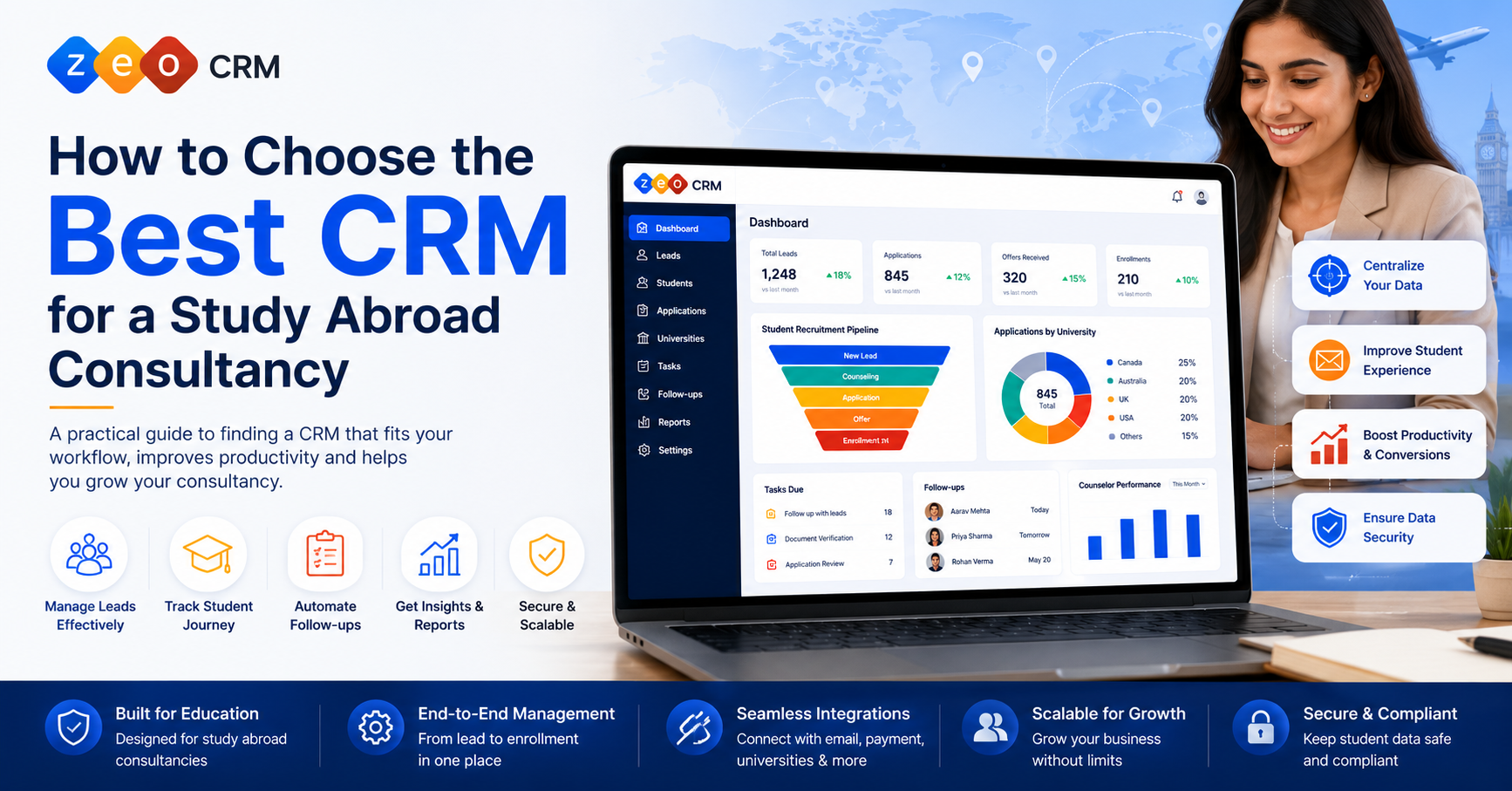
    How to Choose the Best CRM for a Study Abroad Consultancy

    How to Choose the Best CRM for a Study Abroad Consultancy

    Quick Answer

    The best CRM for a study abroad consultancy is not necessarily the one with the most features or the lowest price. It should fit your actual student recruitment workflow, offering lead management, counselor workflows, application tracking, university management, communication, automation, reporting, integrations, security and scalability, all wrapped in a system your team will actually use.

    Introduction

    Picking a CRM feels simple until you actually start comparing vendors. Every website lists dozens of features, every demo looks impressive, and it becomes easy to choose based on whichever platform has the flashiest dashboard rather than the one that actually fits how your consultancy works.

    Don’t choose a CRM by feature count alone. The right CRM depends on your consultancy’s size, student volume, workflow complexity, automation needs and growth plans, not on a generic list of buzzwords. At ZeoCRM we have walked plenty of consultancies through exactly this decision, and this guide lays out a practical framework for choosing a CRM that actually fits your business rather than one that just looks good in a sales pitch.

    TL;DR

    1. Map your current student recruitment workflow before looking at any vendor
    2. Define your must have CRM capabilities upfront
    3. Prioritize education specific functionality over generic sales features
    4. Compare every vendor against the same criteria
    5. Test real workflows during demos, not scripted walkthroughs
    6. Evaluate integrations, security, support, scalability and pricing together
    7. Calculate total value rather than comparing subscription price alone

    Why Choosing the Right CRM Matters for a Study Abroad Consultancy

    A CRM built for study abroad consultancies should centralize student data and support the full journey from lead capture through counseling, application, university selection, documentation, submission, offer and enrollment. When the CRM does not match how your team actually works, counselors end up building workarounds outside the system, defeating the entire purpose of having one.

    Picking the wrong platform does not just waste money on a subscription. It costs you lost leads, inconsistent follow ups, frustrated counselors and a growing pile of workarounds that eventually push everyone back to spreadsheets. Getting this decision right the first time saves months of disruption later.

    What Should a Study Abroad CRM Do?

    A specialized study abroad CRM should manage the complete student recruitment workflow, connecting every stage into a single system rather than leaving it scattered across tools.

    Lead → Counseling → Follow-up → Application → University Selection → Documentation → Submission → Offer → Enrollment

    If a platform cannot support this full journey without heavy customization or manual patching, it is likely built for a different kind of business entirely.

    Essential Features to Look for in a Study Abroad CRM

    Every feature you evaluate should map to a real problem your consultancy faces.

    Lead Management and Lead Capture

    Leads coming in from your website, social media, walk ins and referrals need to land in one place automatically. A study abroad CRM should let counselors see complete lead information immediately and assign leads without manual sorting, since centralized lead management is what prevents prospects from getting lost across spreadsheets, emails and messaging apps.

    Student Profiles and Recruitment Pipeline

    Every student needs a complete, single record rather than scattered notes across different tools. Check whether the platform gives you a visual recruitment pipeline that shows exactly where each student stands, and whether that pipeline can be customized to match your own recruitment stages rather than a generic template.

    Follow-Up, Task and Counselor Management

    Missed follow ups are one of the most common reasons consultancies lose students. A strong CRM for study abroad consultants should let you schedule follow ups, assign tasks, automate reminders and give managers visibility into what each counselor is actually working on.

    Application, University and Course Management

    This is where a specialized education CRM clearly separates itself from a generic one. Confirm the platform can track multiple applications per student, associate specific universities and courses with each application, and show application status clearly enough that nothing falls through the cracks.

    Document and Communication Management

    Passports, SOPs, transcripts and financial documents need a home inside the CRM, not scattered across email and WhatsApp. Look for centralized communication history, integrated email and messaging, and automatic reminders when documents or actions are missing.

    Automation, Marketing and Reporting

    As a consultancy grows, repetitive manual work becomes the biggest bottleneck. Evaluate whether the platform can automate repetitive workflows, connect marketing campaigns directly to lead management, and give managers customizable reports on conversion rates and counselor performance.

    Integrations, API, Security and Role-Based Access

    Your CRM should not exist in isolation. Check what systems it can integrate with, whether an API is available for custom needs, how access is controlled across different roles, and what security measures actually protect sensitive student data like passports and financial records.

    How to Compare Different Study Abroad CRM Platforms

    Rather than relying on marketing pages, score every CRM you evaluate against the same set of criteria so the comparison stays fair.

    CRM Comparison Criteria

    Evaluate education industry specialization, student recruitment functionality, ease of use, customization, automation, integrations, reporting, security, scalability, customer support, implementation, pricing, mobile accessibility and AI capabilities.

    Evaluation FactorQuestions to Ask
    Education specializationDoes it support student recruitment workflows out of the box?
    FeaturesDoes it solve our actual operational problems?
    UsabilityCan counselors use it without unnecessary complexity?
    AutomationCan repetitive tasks actually be automated?
    IntegrationsDoes it connect with the tools we already use?
    ReportingCan managers actually measure performance?
    ScalabilityCan it support the growth we expect over the next few years?
    SupportWhat onboarding and ongoing support are provided?
    PricingWhat is the total cost of ownership, not just the sticker price?

    Does Your Consultancy Need a Specialized Education CRM?

    A generic CRM may work fine for basic contact and sales management, but it quickly starts to strain once your business needs student recruitment pipelines, application tracking, university and course management, counselor workflows, document tracking and education specific reporting.

    If you are a very small operation with a handful of leads and no complex application tracking needs, a basic generic CRM might still get you by for a while. But once you are managing multiple applications per student across different universities, coordinating several counselors, and tracking documents alongside communication, a study abroad CRM software built specifically for this workflow becomes the more practical choice.

    Watch for signs you have outgrown basic tools: leads slipping through the cracks, counselors building their own spreadsheets on the side, no clear visibility into application status across universities, and managers unable to get a clear performance picture from existing reports.

    How AI Can Improve a Study Abroad CRM

    An AI powered CRM platform can genuinely help, but buyers should evaluate the actual workflow and measurable outcome rather than choosing a CRM simply because it markets itself as AI powered.

    • AI powered lead prioritization flags which leads are most likely to convert, helping counselors focus their time where it matters most
    • AI assisted follow ups can suggest or even draft messages based on where a student is in their journey
    • Predictive analytics can help forecast which intake is likely to hit targets, giving managers a head start on planning
    • What to ask vendors about AI: request a specific example of the feature in action during your demo rather than accepting a vague claim. If a vendor cannot show a concrete workflow, treat the AI label with some skepticism

    How Much Does a Study Abroad CRM Cost?

    Pricing commonly depends on the number of users, student and lead volume, feature tiers, automation depth, integrations, customization needs, implementation effort, training and ongoing support, so two platforms with very different price tags may not actually be comparable.

    Looking only at subscription price misses the bigger picture. Total cost of ownership includes implementation time, staff hours spent working around missing features, and the cost of switching platforms later if the cheap option turns out to be the wrong fit.

    Questions to Ask Before Buying a Study Abroad CRM

    Before signing anything, get clear answers in each of these categories.

    CategoryKey Questions
    Product and featuresDoes it support our full recruitment workflow? Can pipelines be customized? Can it track multiple applications per student?
    Integration and technicalWhat integrations are available? Is there an API? How does data migration work?
    Security and dataHow is student data protected? What access controls exist? What happens to our data if the contract ends?
    Pricing and contractWhat is included in the subscription? Are implementation or support charges separate? Are there minimum contract terms?
    Support and implementationWhat onboarding is provided? How long does implementation take? Is ongoing training available?

    Common Mistakes When Choosing a Study Abroad CRM

    Watch out for choosing based only on price and missing gaps in core functionality, picking a generic CRM without testing education workflows first, buying based on feature count rather than actual fit, not involving counselors in the evaluation, ignoring integrations and data migration until after signing, overlooking scalability and outgrowing the platform within a year, skipping a real product test with an actual student scenario, and ignoring ROI and total cost of ownership in favor of the sticker price.

    How to Test a CRM Before Buying

    Rather than sitting through a generic vendor presentation, ask the vendor to walk through a realistic student recruitment scenario from start to finish, including creating a lead, assigning it to a counselor, scheduling a follow up, recording counseling activity, adding university and course preferences, creating an application, tracking documents, communicating with the student, updating application status, and generating a report.

    During the demo, pay attention to ease of use, how many steps common tasks require, how much is actually automated, data visibility across the team, reporting quality and customization options. The key question throughout: can your counselors perform this workflow easily without creating workarounds outside the CRM?

    Best CRM Selection Checklist for Study Abroad Consultancies

    CategoryWhat to Confirm
    FunctionalityLead management, student profiles, application tracking, university and course management
    OperationsFollow ups, tasks, counselor management, automation
    TechnologyIntegrations, API, security, role based access, mobile accessibility
    BusinessReporting, scalability, support, pricing, ROI

    Final Verdict: How to Choose the Best CRM for Your Study Abroad Consultancy

    The right CRM comes down to five variables working together: consultancy size, student volume, workflow complexity, automation requirements and growth plans.

    Small consultancies should prioritize ease of use, essential lead management, affordability and simple implementation. Growing consultancies should prioritize automation, application tracking, reporting, counselor management and integrations. Large or multi-branch consultancies should prioritize scalability, advanced reporting, role based access, automation, API access and centralized management across locations.

    Frequently Asked Questions

    What is the best CRM for study abroad consultants?
    It depends on your consultancy’s size and workflow, but look for one built specifically for student recruitment rather than a generic sales tool.

    What is a Study Abroad CRM?
    It is software built to manage the full student journey, from first inquiry through applications, documents, visas and enrollment.

    What features should a Study Abroad CRM have?
    Lead management, student profiles, application tracking, university management, follow ups, communication, automation and reporting at minimum.

    How much does a Study Abroad CRM cost?
    Pricing varies based on users, volume and features, so it is worth comparing total cost of ownership rather than just the subscription price.

    Is a specialized education CRM better than a generic CRM?
    For most consultancies managing applications and multiple counselors, yes, since generic CRMs lack education specific workflows.

    Can a CRM automate student follow ups?
    Yes, most modern study abroad CRMs support automated reminders and follow up scheduling.

    What is the difference between a Study Abroad CRM and a generic CRM?
    A generic CRM tracks basic sales deals, while a study abroad CRM tracks the full education journey including applications, universities and documents.

    Conclusion

    Choosing the best CRM for a study abroad consultancy is not about picking whichever platform has the longest feature list. It comes down to matching the system to your actual workflow, testing it with a real student scenario, and thinking about total cost rather than just the sticker price.

    Find the CRM that fits your consultancy. Evaluate your current workflow, compare your must have requirements, and see how ZeoCRM can support lead management, student recruitment, applications, automation, communication and reporting in one platform. Book a demo or talk to our team to see how ZeoCRM handles a real student recruitment scenario for your consultancy.
  • CRM vs Excel for Student Recruitment

    CRM vs Excel for Student Recruitment

    CRM vs Excel for Student Recruitment

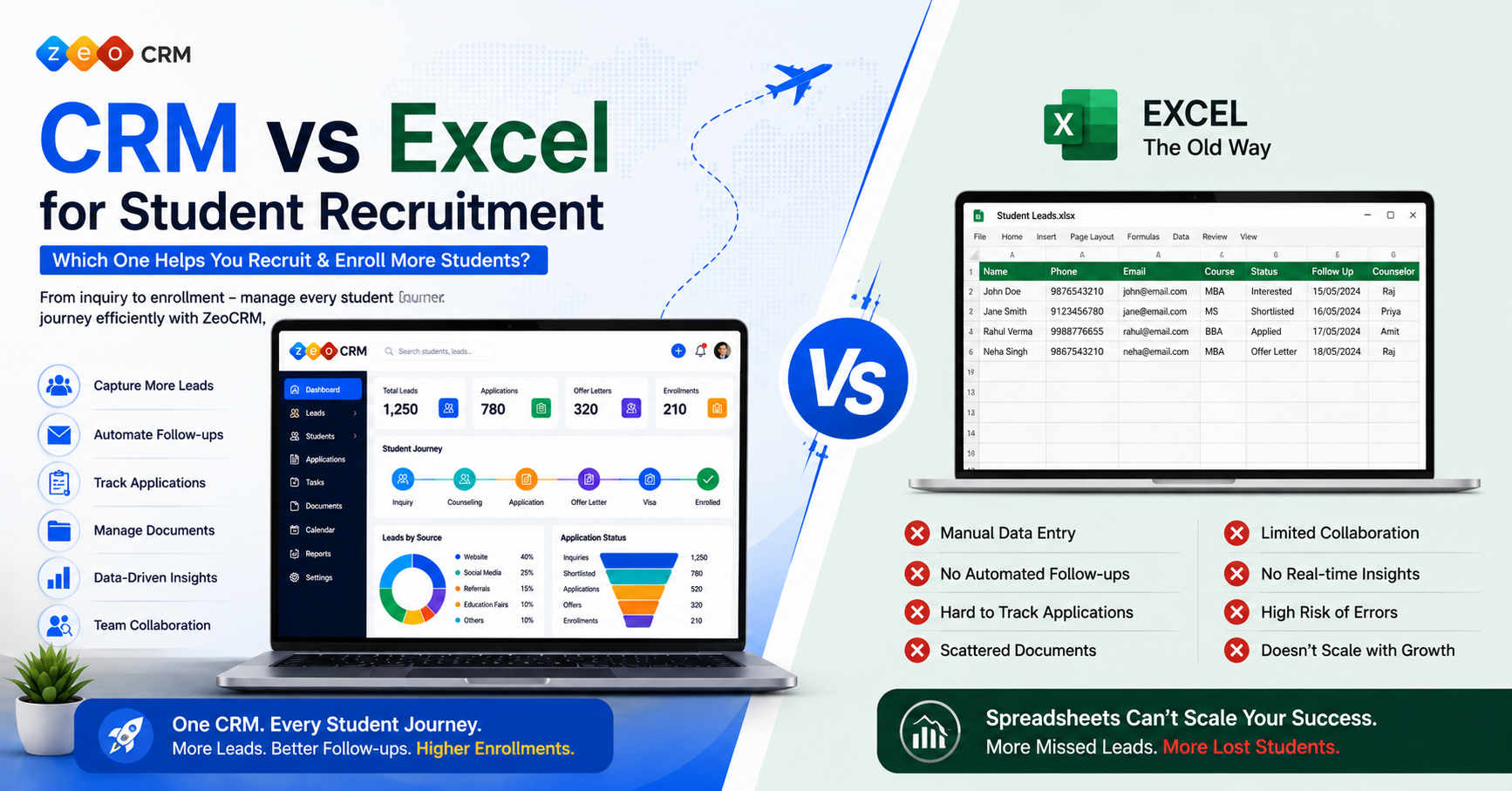
    Comparison of CRM software and Excel spreadsheets for student recruitment management

    Quick Answer

    Excel works fine for a solo consultant handling a handful of leads a week. Once inquiries grow, teams expand or follow ups start slipping, a CRM becomes the better option. A student recruitment CRM automates follow ups, centralizes records and gives visibility that a spreadsheet simply cannot match at scale.

    Introduction

    Most education consultancies start the same way. A founder, a laptop and an Excel sheet with columns for name, phone number and status. It works fine at first. Then the leads start coming in faster than anyone can update the sheet, and the same student ends up on three different rows because nobody noticed the duplicate entry. Excel is excellent for starting out but not for scaling a student recruitment business. At ZeoCRM we have seen this exact pattern play out with dozens of growing consultancies. This article breaks down CRM vs Excel for student recruitment services, where each one actually shines, and how to know when it is time to make the switch.

    TL;DR

    • Excel is affordable and familiar but was never built for a growing student pipeline
    • A student recruitment CRM automates follow ups, centralizes data and scales with your team
    • Feature by feature, CRM outperforms Excel on almost every operational task
    • Solo consultants with low lead volume can still get by with a spreadsheet
    • Seven clear signs tell you when your consultancy has outgrown Excel

    What Is Excel Used for in Student Recruitment?

    Excel or Google Sheets is usually the first tool any consultancy reaches for, mainly because it is already installed and everyone already knows how to use it.
    • Tracking student leads by adding rows manually as inquiries come in through calls, forms or referrals
    • Recording contact details like names, phone numbers, emails and preferred destinations in separate columns
    • Managing application status through a column updated by hand each time a student moves to a new stage
    • Simple reporting using basic counts and filters to get a rough sense of pipeline volume
    • Team sharing with Google Sheets, though conflicts and overwritten rows become common once more than a couple of people are editing it at once

    What Is a Student Recruitment CRM?

    A student crm system is software built specifically to manage the student journey from first inquiry through enrollment, rather than a generic table of rows and columns. A spreadsheet stores data. A CRM acts on it, sending reminders, assigning leads and tracking every interaction automatically without someone having to remember to update a cell. Its job is to make sure no lead gets forgotten and every counselor knows exactly where each student stands, without digging through old chat threads or asking a colleague. Unlike a generic sales tool, a proper CRM for this industry already understands university applications, visa stages and document checklists, so there is no need to build the workflow from scratch.

    CRM vs Excel: What’s the Difference?

    The core difference comes down to how much the tool does for you versus how much you have to do yourself. Excel requires someone to manually update every field, while a CRM automates reminders, assignment and status changes on its own. Excel works reasonably well for one person, but a CRM is built for a whole team working on the same students at the same time. And where Excel simply stores information, a CRM manages the actual relationship, tracking every call, message and follow up tied to a student.

    Feature by Feature Comparison: CRM vs Excel

    Here is how the two options stack up on the tasks that actually matter day to day.
    Feature Excel Student Recruitment CRM
    Lead management Manual entry Automatic capture and assignment
    Student database Basic rows and columns Full student profiles with history
    Follow ups and reminders Manual tracking Automated and scheduled
    Task management Not built in Native task assignment
    Team collaboration Limited, prone to conflicts Built for multiple users
    Pipeline tracking Manual status column Visual pipeline stages
    Email integration None Built in
    WhatsApp communication None Often native or integrated
    Marketing automation None Available
    Document management Separate folders Centralized and linked to profiles
    Application tracking Manual updates Automated status tracking
    Counselor performance Hard to measure Built in dashboards
    Reporting and analytics Manual charts Real time reports
    AI capabilities None Lead scoring, insights, automation

    Advantages of Excel

    To be fair, Excel earns its place for a reason.
    • Low cost since most teams already have access to it
    • Familiar interface that almost everyone already knows how to use
    • Flexible data entry that lets you structure things however you like
    • Ideal for small teams with a handful of leads at a time

    Limitations of Excel for Student Recruitment

    The same flexibility that makes Excel easy to start with becomes a liability as volume grows.

    1. No Automation: Every reminder, every follow up and every status change depends entirely on someone remembering to do it.

    2. Missed Follow Ups: Without automated alerts, leads sit untouched until someone happens to notice them.

    3. Duplicate Records: The same student can end up entered twice by two different counselors, with no system catching the overlap.

    4. Reporting Challenges: Pulling a real performance report means manually building charts and hoping the data was entered consistently.

    5. Limited Collaboration: Multiple people editing the same sheet at once often leads to overwritten data and version confusion.

    6. Data Security Risks:  Sensitive student documents and personal details stored in shared spreadsheets are far easier to lose or leak than data in a proper system.

    Advantages of a Student Recruitment CRM

    A dedicated CRM addresses nearly every gap Excel leaves open.
    • Centralized student records with everything in one place
    • Automated follow ups that go out without manual effort
    • Better team collaboration with every counselor working off the same data
    • Pipeline visibility so owners always know where every student stands
    • Marketing automation that nurtures leads who are not ready yet
    • Scalable operations that support growth instead of slowing it down
    This is exactly why more consultancies are moving toward a best crm for education setup instead of staying with spreadsheets once they cross a certain size.

    When Is Excel Enough?

    Not every consultancy needs a CRM on day one.
    • Solo consultants handling a small number of students personally
    • Low lead volume where a spreadsheet is still manageable by hand
    • Limited team collaboration with only one or two people ever touching the data

    7 Signs You’ve Outgrown Excel

    If any of these sound familiar, it may be time to move on.
    1. Leads are falling through the cracks and nobody notices until a student has already gone elsewhere
    2. Multiple counselors access the same data and keep overwriting each other’s updates
    3. Reporting takes hours just to pull together a basic performance summary
    4. Follow ups are missed because nothing reminds anyone to reach out
    5. Student data is scattered across sheets, email and chat apps
    6. You’re managing multiple branches and cannot see performance across all of them
    7. Growth is slowing because your process cannot keep up with more leads

    Real World Scenario: Growing Consultancy Using Excel vs CRM

    A team of five counselors sharing one spreadsheet often looks like this. Leads come in from three sources and get entered manually. Follow ups depend on memory, and by the time someone checks back a student has often committed elsewhere. After moving to a crm in education industry system, leads from every source land automatically and get assigned to a counselor within minutes. Reminders go out on schedule, response times drop from days to minutes, duplicate entries disappear, and owners can finally see which counselor is converting well and which one needs support.

    Cost Comparison: Excel vs CRM

    Cost Factor Excel CRM
    Software cost Low or free Monthly or annual subscription
    Hidden costs of manual work High, in staff hours Minimal
    Opportunity cost of missed leads Significant Reduced through automation
    Cost of human errors Frequent, hard to trace Rare, easier to catch
    Excel looks cheaper on paper. Once you account for lost leads and wasted staff hours, the real cost often tells a different story.

    ROI Comparison: Why CRM Delivers Long Term Value

    • Improved conversion rates since faster response times and consistent follow ups mean fewer students slip away
    • Increased counselor productivity with less time spent on manual admin and more time actually counseling students
    • Better student experience through consistent communication that builds trust over a long process
    • Business scalability that supports adding more counselors and branches without the process falling apart

    Common Mistakes Agencies Make While Using Excel

    • Relying on manual follow ups instead of any kind of reminder system
    • Poor version control with multiple copies of the same sheet floating around
    • No standardized workflow so every counselor tracks things differently
    • Lack of performance metrics that makes it hard to know what is actually working

    How to Successfully Transition from Excel to a CRM

    1. Audit existing data before moving it
    2. Clean student records to remove duplicates and fix inconsistent entries
    3. Import into CRM using the platform’s migration tools
    4. Train the team so everyone understands the new workflow from day one
    5. Automate key processes like follow ups and lead assignment as soon as possible

    How AI Powered CRM Platforms Improve Student Recruitment

    An ai powered crm platform takes things a step further than basic automation.
    • AI lead prioritization flags which inquiries are most likely to convert so counselors know who to call first
    • Automated communication sends messages and reminders based on where a student is in their journey
    • Predictive insights give managers a sense of which intake is likely to hit targets before it happens
    • Intelligent task automation updates statuses automatically as students move through the pipeline

    Conclusion

    Excel will always have a place for very small teams just getting started. But once leads start slipping through the cracks and counselors start stepping on each other’s work, a spreadsheet stops being a shortcut and starts being the bottleneck. A dedicated student recruitment CRM brings automation, visibility and scale that Excel was simply never designed to offer. This is the exact gap we built ZeoCRM to close, giving growing consultancies a system made for the way student recruitment actually works. If your team is still juggling shared spreadsheets and missed follow ups, it might be time to see what a proper CRM can do. Book a personalized demo of ZeoCRM and see the difference for yourself.

    Frequently Asked Questions

    Is Excel enough for student recruitment?
    For a solo consultant with very few leads, yes. Once volume or team size grows, Excel quickly becomes a bottleneck.

    What is the difference between CRM and Excel?
    Excel stores data manually. A CRM automates follow ups, assigns leads and tracks the full student relationship automatically.

    Why do education consultants need a CRM?
    Because manual tracking cannot keep up once inquiries grow past what one person can manage by hand.

    When should I switch from Excel to a CRM?
    When leads start getting missed, reporting takes too long, or more than one or two people need to access the same data.

    What are the hidden costs of using Excel?
    Lost leads, duplicate work, wasted staff hours and the difficulty of catching human error.

    Is CRM expensive for small consultancies?
    Pricing varies, but many platforms offer plans suited to smaller teams, and the cost is often offset by fewer lost leads.

    What AI features are available in modern CRMs?
    Lead scoring, predictive insights, automated communication and intelligent task automation are common examples.

    Can Excel replace a CRM? Not once a consultancy grows past a small team, since Excel lacks automation and cannot scale collaboration well. How difficult is CRM implementation?
    With clean data and proper training, most teams can get up and running within a few weeks.

    How does CRM improve student conversions?
    Faster response times and consistent follow ups mean fewer students are lost to silence or delay.
  • Why Study Abroad Consultancies Need a CRM to Thrive

    Why Study Abroad Consultancies Need a CRM to Thrive

    Why Study Abroad Consultancies Need a CRM to Thrive

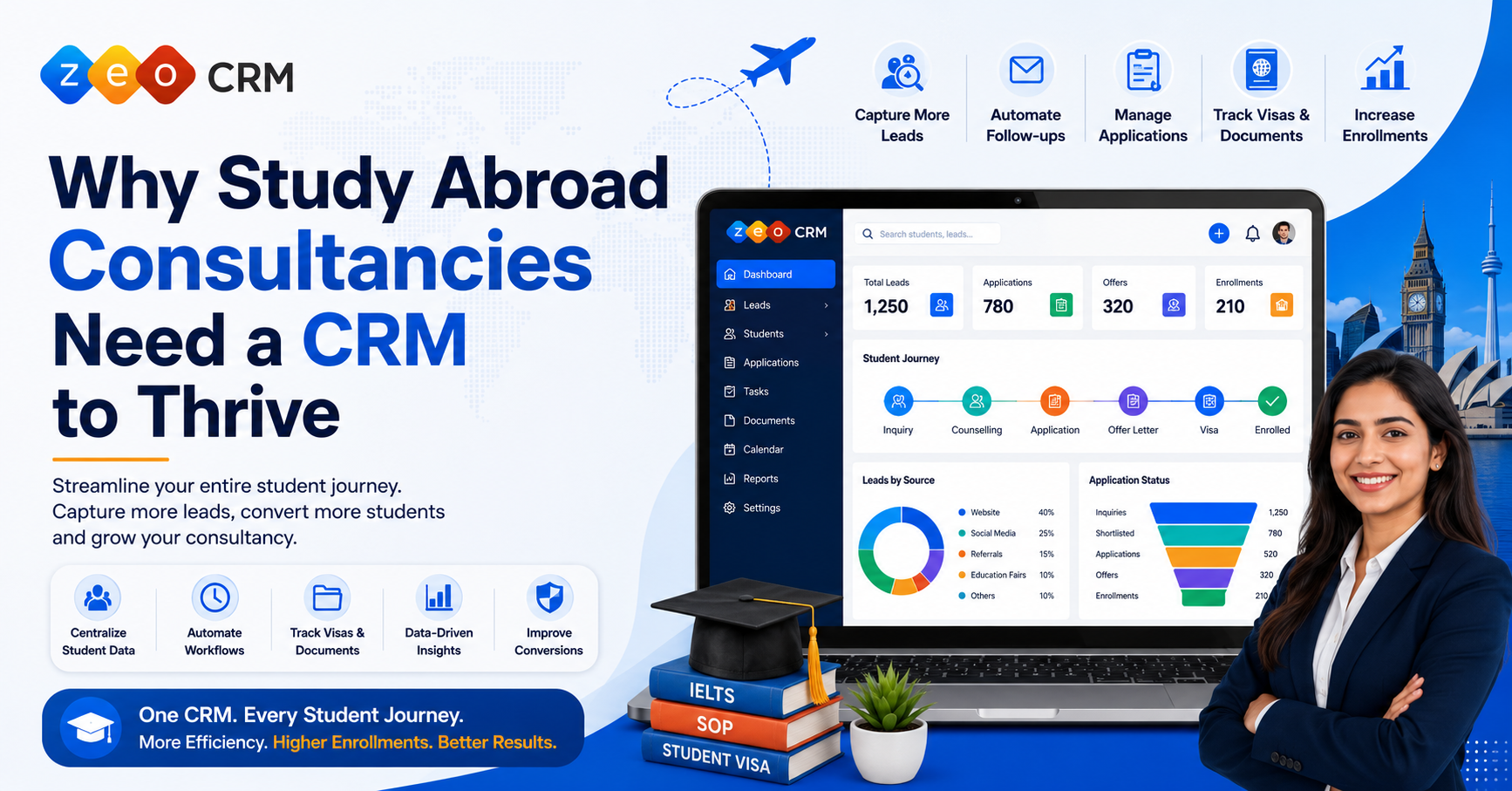
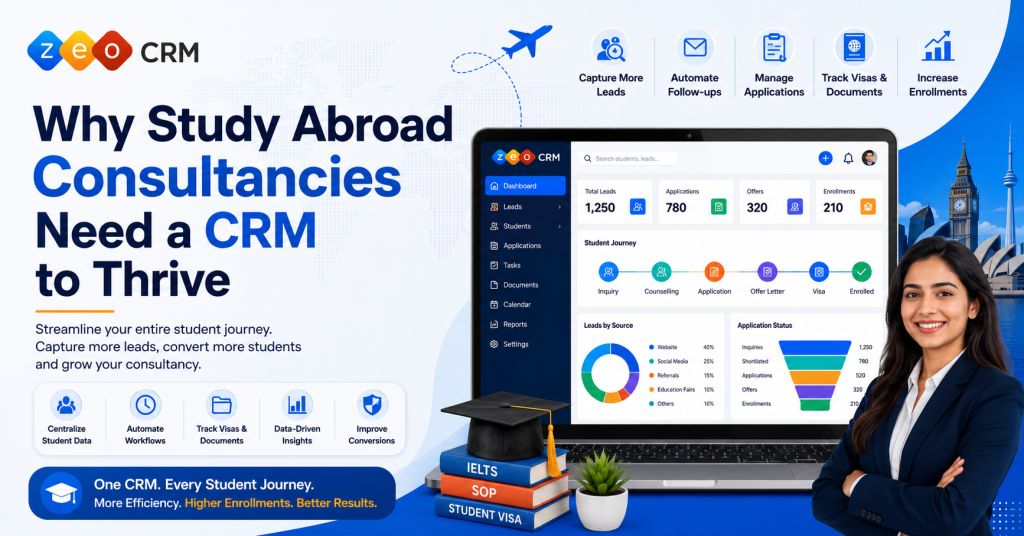
    Study abroad consultancy team using a CRM dashboard to manage student leads and applications

    Quick Answer

    A study abroad CRM is software built to manage the entire student journey from first inquiry to post enrollment support. It helps consultancies capture leads, automate follow ups, track applications and visas, and report on performance in one place instead of scattered spreadsheets and chat apps.

    Introduction

    Running a study abroad consultancy today looks nothing like it did five years ago. Students expect instant replies. Parents want updates without asking twice. Universities keep changing intake deadlines. And your counselors are stuck juggling WhatsApp chats, Excel sheets and half remembered phone calls just to keep a single student’s file on track.

    At ZeoCRM we talk to agency owners every week who are dealing with exactly this. They are not struggling because their counseling is weak. They are struggling because their systems cannot keep up with their growth. This article breaks down why study abroad consultancies need a CRM to thrive, what it actually does, and how to choose one that fits your business.

    TL;DR

    • Manual tools like Excel and WhatsApp break down once lead volume grows
    • A study abroad CRM centralizes leads, documents, applications and communication
    • Automated follow ups and AI features directly improve conversion rates
    • The right CRM scales with you across counselors, branches and intakes
    • Choosing the best study abroad CRM comes down to fit, automation and support

    Why Are Many Study Abroad Consultancies Struggling to Scale?

    Most consultancies do not stay small on purpose. They stay small because their internal process cannot handle more volume without falling apart. Growth without the right systems in place usually creates more problems than it solves.

    Too Many Student Inquiries Too Little Organization

    Leads come in from your website form, Instagram DMs, walk ins and referrals all at once. Without a central system to catch every inquiry the moment it arrives many simply get missed. A student who does not hear back within a day often moves on to the next agency on their list.

    Manual Processes Create Operational Bottlenecks

    When every counselor keeps their own notes and their own spreadsheet there is no shared source of truth. One counselor’s absence can mean a student’s file sits untouched for days.

    Growth Without Systems Leads to Chaos

    Adding more staff to a broken process just multiplies the confusion. More counselors using more spreadsheets means more duplicate entries and more conflicting updates rather than more output.

    The Hidden Cost of Managing Students with Excel and Disconnected Tools

    Spreadsheets feel free. They are not. The real cost shows up in lost students and wasted counselor hours.

    Lost Leads and Missed Follow Ups

    A lead sitting in an inbox with no reminder attached is a lead that gets forgotten. There is no system nudging anyone to call back.

    Duplicate Student Records

    The same student inquires through Instagram and later fills out a website form. Without deduplication two counselors end up contacting the same student with different information.

    Communication Gaps Across Teams

    The counseling team does not know what the visa team already told a student. The student notices the disconnect immediately and it damages trust.

    No Centralized Student History

    When a student calls back after three months nobody can quickly pull up what was discussed last time. Everything has to be reconstructed from memory or old chat threads.

    Limited Visibility into Team Performance

    Owners cannot see which counselor is converting well and which one needs coaching. Decisions get made on gut feeling instead of actual numbers.

    AreaExcel and Chat AppsStudy Abroad CRM
    Lead captureManual entry, easy to missAutomatic, from every source
    Follow upsDepends on memoryScheduled and automated
    Student historyScattered across toolsCentralized in one profile
    Team visibilityAlmost noneReal time dashboards
    ScalabilityBreaks down with growthBuilt to scale

    What Is a Study Abroad CRM?

    A study abroad CRM is customer relationship management software designed specifically for the education consulting workflow. Instead of tracking generic sales deals it tracks students through counseling, university shortlisting, applications, visas and enrollment.

    Definition

    Put simply it is a system that stores every student’s information, documents and communication history in one place while automating the repetitive parts of the follow up process.

    How It Differs from Generic CRM Software

    A generic CRM tracks a deal from lead to closed. A crm for study abroad consultants tracks a much longer and more detailed journey involving test scores, university preferences, offer letters, visa status and tuition payments. Generic tools simply do not have fields or workflows for any of this.

    Why Education Consultancies Need a Specialized CRM

    Trying to force a generic sales CRM to handle student recruitment means constant workarounds. A purpose built system already understands your process from day one, so you spend less time customizing and more time using it.

    How a Study Abroad CRM Works

    Here is what the workflow typically looks like once a CRM is in place.

    1. Lead Capture – inquiries from your website, social media and walk ins land in the system automatically
    2. Lead Assignment – each lead is routed to the right counselor based on rules you set
    3. Student Counseling – counselors log notes, preferences and next steps in one profile
    4. University and Course Shortlisting – options are tracked against the student’s profile and eligibility
    5. Application Management – deadlines, documents and submission status are tracked per university
    6. Document Management – passports, transcripts, SOPs and financial documents live in one secure place
    7. Visa and Offer Tracking – status updates are logged as they happen so nothing gets missed
    8. Post Enrollment Follow Up – accommodation, forex, insurance and pre departure support continue in the same system

    Benefits of Using a Study Abroad CRM

    The benefits of study abroad CRM adoption tend to show up fast once a team actually starts using it consistently.

    • Better lead management – every inquiry is captured and assigned automatically
    • Higher student conversion rates – fewer leads slip through the cracks
    • Faster response times – students hear back within minutes instead of days
    • Improved student experience – consistent communication builds trust
    • Increased counselor productivity – less time on admin, more time counseling
    • Automated follow ups – reminders go out on schedule without manual effort
    • Better reporting and decision making – owners see real performance data
    • Business scalability – the system supports growth instead of slowing it down

    Must Have Features in a Study Abroad CRM

    Before comparing vendors it helps to know what actually matters. Good study abroad crm software should include the following.

    FeatureWhy It Matters
    Lead managementCaptures and organizes every inquiry
    Student CRM profilesOne complete record per student
    Application trackingKeeps deadlines and status visible
    Email and WhatsApp automationKeeps communication consistent
    Task and reminder automationNothing gets forgotten
    Counselor managementAssigns and tracks workload fairly
    Sales pipelineShows where each student stands
    Marketing automationNurtures leads that are not ready yet
    Reporting and analyticsTurns activity into insight
    Revenue forecastingHelps plan ahead financially
    IntegrationsConnects with tools you already use
    Role based accessKeeps data secure by role
    Data securityProtects sensitive student information

    AI Powered CRM: The Next Competitive Advantage

    An ai powered crm platform takes these features further by acting on the data instead of just storing it.

    • AI lead scoring flags which inquiries are most likely to convert
    • Predictive analytics forecasts which intake is likely to hit targets
    • AI powered follow ups suggest the right message at the right time
    • Smart workflow automation moves students through stages without manual updates
    • Conversational AI answers common student questions instantly
    • AI insights for managers turn raw activity into clear recommendations

    None of this replaces your counselors. It just removes the repetitive work so they can spend more time actually talking to students.

    CRM vs Excel vs Generic CRM

    FeatureExcelGeneric CRMStudy Abroad CRM
    ScalabilityPoorModerateStrong
    AutomationNoneBasicBuilt for the student journey
    Student lifecycle managementManualNot supportedFully supported
    ReportingManual chartsGeneric sales reportsEducation specific metrics
    CollaborationDifficultModerateSeamless across teams
    ROILow over timeModerateHigh for education businesses

    Who Should Use a Study Abroad CRM?

    • Small consultancies that are tired of losing leads to disorganization
    • Growing agencies that need to onboard new counselors without chaos
    • Multi branch organizations that need visibility across every location
    • Immigration consultants who also offer education services
    • University recruitment teams managing large volumes of applicants

    How to Choose the Best Study Abroad CRM

    Finding the best study abroad crm for your business comes down to a few practical checks rather than a long feature list.

    Essential Feature Checklist

    Confirm lead management, student profiles, application tracking, document storage, visa tracking and automation are all included, not promised as a future update.

    Questions to Ask Vendors

    Ask how long onboarding takes, whether WhatsApp integration is native, and how their support team handles issues once you are live.

    Pricing Considerations

    Compare what is actually included at each price tier rather than just the headline number.

    Scalability

    Make sure the system can handle more counselors, more branches and more students without needing to switch platforms later.

    Customer Support

    A CRM is only useful if help is available when something breaks or a counselor gets stuck.

    Integration Capabilities

    Check that it connects with your website, WhatsApp, email and payment tools.

    Security and Compliance

    Student data includes passports and financial documents, so proper access controls and data protection matter.

    Common CRM Implementation Mistakes and How to Avoid Them

    • Poor data migration – moving old records over messily creates confusion from day one
    • Lack of staff training – a powerful CRM is useless if counselors do not know how to use it
    • Overcomplicated workflows – too many custom stages slow everyone down
    • Ignoring KPIs – without tracking metrics you cannot tell if the CRM is actually helping
    • Choosing based on price alone – the cheapest option often lacks the features you need most

    Measuring CRM Success: KPIs and ROI

    Once your CRM is live these are the numbers worth watching closely.

    • Lead to application conversion rate
    • Follow up response time
    • Counselor productivity
    • Student satisfaction
    • Revenue per counselor
    • Marketing ROI

    If your current setup cannot show you these numbers in a few clicks you are likely losing more than you realize.

    The Future of Study Abroad CRM

    The next phase of this industry is already taking shape. Expect to see AI powered admissions handling first line student queries, predictive enrollment models forecasting intake performance, intelligent automation reducing manual work even further, omnichannel communication becoming the standard rather than the exception, and hyper personalization making every student interaction feel individually tailored.

    Conclusion

    A CRM is no longer a nice to have for study abroad consultancies. It is the difference between a business that scales smoothly and one that keeps losing students to poor follow up. A specialized system brings your leads, applications, documents and communication into one place so your team can focus on what actually matters, helping students get where they want to go.

    This is exactly why we built ZeoCRM, a CRM designed specifically for study abroad and overseas education consultancies rather than adapted from a generic sales tool. If you are still relying on spreadsheets and scattered chat threads to manage your students, it is worth seeing what a purpose built system can do for your team. Book a personalized demo of ZeoCRM and see how much easier your student journey can be to manage.

    Frequently Asked Questions

    Why do study abroad consultancies need a CRM? Because manual tools cannot keep up once lead volume grows. A CRM keeps every inquiry, follow up and document organized in one place.

    What is a Study Abroad CRM? It is software built specifically to manage the student journey from first inquiry through visa approval and enrollment.

    How does a CRM improve student recruitment? It captures leads automatically, assigns them to counselors instantly and automates follow ups so fewer students are lost to delay.

    What is the best Study Abroad CRM? The right choice depends on your workflow, but look for one built specifically for education rather than a generic sales tool.

    Can small consultancies benefit from a CRM? Yes. Even a small team benefits from not losing leads and having a clear record of every student conversation.

    How does CRM automate follow ups? It schedules reminders and messages based on where a student is in their journey, so counselors do not have to remember manually.

    Does CRM integrate with WhatsApp? Most modern study abroad CRMs, including ZeoCRM, support native WhatsApp integration for student communication.

    Can CRM manage university applications? Yes. A proper study abroad CRM tracks deadlines, documents and submission status for every university a student applies to.

    How does CRM improve counselor productivity? By removing repetitive admin work like manual reminders and data entry, so counselors spend more time actually counseling.

    What features should a Study Abroad CRM include? At minimum look for lead management, student profiles, application tracking, document management, automation and reporting.

    How much does Study Abroad CRM software cost? Pricing varies by features and team size, so it is worth comparing what is included rather than the price alone.

    What is the difference between a generic CRM and a Study Abroad CRM? A generic CRM tracks a simple sales deal. A study abroad CRM tracks the full education journey including visas, universities and documents.

    How long does implementation take? Typically a few weeks depending on how much data needs to be migrated and how large the team is.

    Can CRM support multiple branches? Yes, a good system gives owners visibility across every branch from one dashboard.

    Is CRM worth the investment for growing consultancies? For most growing agencies yes, since the cost of lost leads and missed follow ups usually far outweighs the cost of the software.

  • Student Recruitment CRM Guide

    Student Recruitment CRM Guide

    What Is a Student Recruitment CRM? A Complete Guide

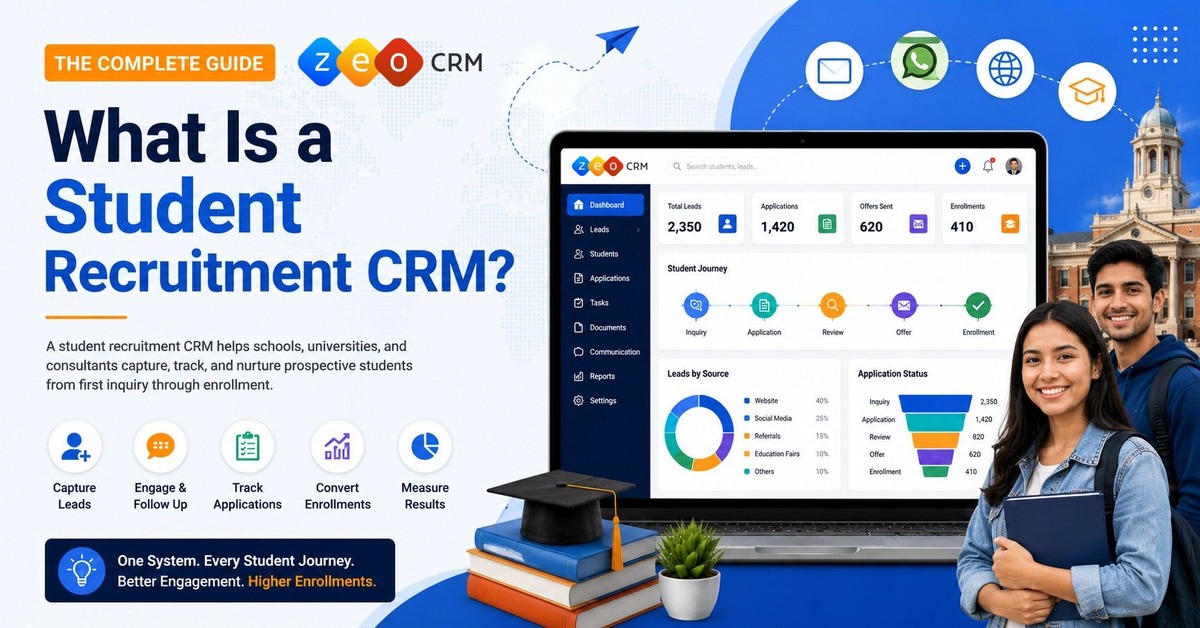
    Student recruitment CRM dashboard showing admissions and lead tracking

    Quick Answer

    A student recruitment CRM is software that helps schools, universities, and education consultants capture, track, and nurture prospective students from first inquiry through enrollment. It centralizes contact data, automates follow-ups, and gives admissions teams a single view of every applicant’s journey, replacing scattered spreadsheets and inboxes with one organized system.

    Overview

    • A student recruitment CRM manages the entire admissions funnel: inquiry, application, follow-up, and enrollment.
    • It’s built specifically for education, unlike generic sales CRMs.
    • Core features include lead capture, automated communication, application tracking, and reporting.
    • It benefits universities, colleges, education consultants, and study abroad agencies alike.
    • The right CRM reduces lost leads, speeds up response times, and improves conversion rates.

    Key Takeaways

    1. Student recruitment CRM software is purpose-built for admissions, not adapted from generic sales tools.
    2. It sits at the center of enrollment management, connecting marketing, admissions, and operations teams.
    3. Automation, not just data storage, is what separates a modern CRM from a basic database or spreadsheet.
    4. For consultancies handling international students, a student recruitment CRM is often one part of a broader recruitment system.
    5. Choosing the right platform depends on your institution’s size, workflow complexity, and integration needs.

    Introduction

    Every admissions team has felt this pain at some point: a promising student inquiry comes in through a web form, gets forwarded to the wrong inbox, and never receives a follow-up. Multiply that by hundreds or thousands of inquiries a year, across multiple channels like WhatsApp, email, phone calls, and walk-ins, and it’s easy to see why so many institutions and consultancies struggle to keep up.

    This is the exact problem a student recruitment CRM was built to solve. Instead of managing prospects through spreadsheets, sticky notes, and shared inboxes, admissions and recruitment teams get one centralized system that tracks every interaction, automates repetitive tasks, and surfaces the leads most likely to enroll.

    Platforms like ZeoCRM represent this shift toward purpose-built recruitment technology, offering education-specific workflows rather than a generic sales tool retrofitted for schools. Whether you’re a university admissions office, a college recruitment team, or an education consultant managing applications across multiple countries, understanding what a student recruitment CRM actually does, and doesn’t do, is the first step toward fixing a leaky admissions funnel.

    In this guide, we’ll break down what a student recruitment CRM is, how it works, its core features, who uses it, and how to evaluate one for your organization.

    What Is a Student Recruitment CRM?

    A student recruitment CRM is a specialized customer relationship management platform designed to manage the entire student acquisition process, from the moment someone expresses interest to the moment they enroll. It combines lead management, communication automation, application tracking, and reporting into one system tailored to education workflows.

    Unlike a general CRM used for sales pipelines, a student recruitment CRM understands concepts unique to education: application cycles, intake periods, document verification, program eligibility, and multi-stage admissions decisions. It’s designed around the student journey rather than a generic sales deal.

    At its core, the system does three things:

    1. Captures leads from every channel, including website forms, social media, fairs, and referrals.
    2. Organizes and scores those leads so counselors know who to prioritize.
    3. Automates follow-up through email, SMS, or WhatsApp so no inquiry goes cold.

    How Is It Different From a Regular CRM?

    A regular sales CRM, like a generic contact manager, tracks deals and revenue. A student recruitment CRM tracks something more nuanced: a prospective student’s progress through inquiry, application, document submission, interview, offer, and enrollment. It needs to handle things a sales CRM was never built for, like tracking transcripts, visa documents, or program-specific eligibility rules.

    How Does a Student Recruitment CRM Work?

    A student recruitment CRM works by pulling in leads from multiple channels, organizing them into a single database, and then guiding each prospect through a defined pipeline using automated tasks, reminders, and communication triggers, until they either enroll or drop off.

    Here’s what that process typically looks like in practice:

    1. Lead capture: A student fills out a form on your website, messages you on WhatsApp, or is referred by a partner agent. The CRM automatically logs this as a new lead.
    2. Lead assignment: The system routes the lead to the right counselor based on program interest, location, or team workload.
    3. Engagement and nurturing: Automated emails, SMS, or WhatsApp messages keep the student informed and engaged, while counselors handle more personal conversations.
    4. Application tracking: As the student moves through the process, including document submission, interviews, and offers, the CRM updates their stage in real time.
    5. Conversion and reporting: Once enrolled, the CRM logs the outcome and feeds data back into reporting dashboards, so teams can see what’s working and what isn’t.

    The real value of a student recruitment CRM isn’t storing data. It’s making sure that data triggers the right action at the right time, automatically.

    Core Features of a Student Recruitment CRM

    The core features of a student recruitment CRM include lead management, multi-channel communication, application and document tracking, automated workflows, counselor task management, and analytics dashboards that show recruitment performance in real time.

    FeatureWhat It DoesWhy It Matters
    Lead Capture & ManagementCollects inquiries from web forms, social media, fairs, and referrals into one databasePrevents leads from being lost across disconnected channels
    Lead ScoringRanks prospects by likelihood to enroll based on engagement and profile fitHelps counselors focus time on high-intent students
    Automated CommunicationSends emails, SMS, and WhatsApp messages triggered by student actionsKeeps students engaged without manual follow-up
    Application TrackingMonitors each student’s stage from inquiry to enrollmentGives teams visibility into where every applicant stands
    Document ManagementStores and verifies transcripts, test scores, and other required filesReduces back-and-forth and administrative delays
    Task & Counselor ManagementAssigns follow-ups and reminders to specific staff membersEnsures accountability and prevents dropped leads
    Reporting & AnalyticsTracks conversion rates, response times, and channel performanceInforms data-driven recruitment strategy
    IntegrationsConnects with websites, payment gateways, and communication toolsKeeps the CRM at the center of your existing tech stack

    Must-Have Features When Evaluating a Student Recruitment CRM

    • Multi-channel lead capture across web, social media, WhatsApp, and referrals
    • Automated follow-up sequences
    • Custom pipeline stages built around your admissions process
    • Document upload and verification
    • Role-based access for counselors and managers
    • Real-time reporting dashboards
    • Mobile access for on-the-go teams

    Who Uses a Student Recruitment CRM?

    Student recruitment CRMs are used by universities, colleges, K-12 schools, education consultants, and study abroad agencies, essentially any organization responsible for converting prospective students into enrolled ones.

    • Universities and colleges use it to manage large volumes of domestic and international applicants across departments.
    • Admissions teams use it to coordinate follow-ups, interviews, and offer letters without losing track of individual applicants.
    • Education consultants use it to manage relationships with students applying to multiple institutions.
    • Study abroad consultants and agencies use it to track applications across countries, universities, and visa requirements, often as part of a broader system built specifically for international recruitment.

    For consultancies handling overseas admissions specifically, a student recruitment CRM is typically one component within a more complete system. If you’re evaluating solutions for overseas education businesses, our CRM for Study Abroad Consultants guide covers the complete workflow, including visa tracking, commission management, and multi-country application processes.

    Student Recruitment CRM vs. Related Systems

    A student recruitment CRM focuses on the pre-enrollment journey, covering marketing, inquiries, and applications, while systems like a Student Information System (SIS) or ERP manage post-enrollment operations such as grades, billing, and academic records. Many institutions use both together.

    SystemPrimary FocusUsed ByTypical Data
    Student Recruitment CRMLead-to-enrollment journeyAdmissions, marketing, consultantsInquiries, applications, communication history
    Student Information System (SIS)Post-enrollment academic recordsRegistrar, academic staffGrades, transcripts, attendance
    ERP (Enterprise Resource Planning)Institution-wide operationsFinance, HR, operationsBudgets, payroll, procurement

    A common mistake institutions make is trying to force their SIS to handle recruitment, or their CRM to handle academic records. Each system is built for a different stage of the student lifecycle, and stretching one to cover both usually creates more friction than it solves.

    Benefits of a Student Recruitment CRM

    The main benefits of a student recruitment CRM are fewer lost leads, faster response times, better team accountability, and clearer visibility into what’s actually driving enrollments, all of which lead to higher conversion rates over time.

    • No lead falls through the cracks: every inquiry is logged automatically, regardless of source.
    • Faster response times: automated triggers mean students hear back within minutes, not days.
    • Better team accountability: managers can see exactly who’s following up on what, and when.
    • Data-driven decisions: reporting shows which channels, campaigns, or programs are converting best.
    • Improved student experience: personalized, timely communication builds trust during a high-stakes decision.

    Mistakes to Avoid When Adopting a Student Recruitment CRM

    1. Skipping the data migration plan: moving from spreadsheets to a CRM without cleaning up old data leads to duplicate or incomplete records.
    2. Underusing automation: many teams set up a CRM and still manually follow up on everything, missing the point of the tool.
    3. Not training counselors properly: a CRM is only as good as the team’s willingness to log activity and update stages consistently.
    4. Choosing a generic sales CRM: tools built for retail or SaaS sales often lack admissions-specific workflows like intake cycles or document tracking.

    How AI Is Changing Student Recruitment CRM

    AI is increasingly used within student recruitment CRMs to score leads more accurately, predict which students are likely to enroll, and automate personalized communication at scale, reducing manual workload for admissions counselors.

    Modern platforms are starting to use AI for tasks like flagging high-intent leads based on browsing behavior, drafting personalized follow-up messages, and identifying patterns in past enrollment data to forecast future outcomes. This doesn’t replace the human relationship-building counselors do, but it does remove a lot of the manual sorting and guesswork that used to eat up their time.

    Why Choose the Right Student Recruitment CRM?

    The right student recruitment CRM should match your institution’s actual admissions workflow, not force you to adapt to generic software. Look for education-specific pipeline stages, strong automation, reliable reporting, and integrations with the communication channels your students already use.

    When evaluating platforms, it helps to look past the feature list and ask whether the tool actually fits how your team works day to day. A few things worth prioritizing:

    • Education-specific workflows, not a repurposed sales pipeline
    • Automation depth, so follow-ups happen without manual effort
    • Multi-channel communication, including WhatsApp and SMS, not just email
    • Reporting that maps to enrollment goals, not just generic sales metrics
    • Scalability, so the system grows with your applicant volume

    Platforms like ZeoCRM are built around this exact combination, bringing lead management, admissions workflows, automation, communication, and reporting into a single system designed for education consultants and institutions rather than adapted from a general business CRM. It’s worth evaluating alongside other options based on your team’s size, workflow complexity, and the countries or programs you recruit for.

    Frequently Asked Questions

    What is a student recruitment CRM in simple terms?

    It’s software that helps schools and consultants manage prospective students from first inquiry to enrollment, automating follow-ups and keeping all communication and application data in one place instead of scattered across emails and spreadsheets.

    Is a student recruitment CRM the same as a student admissions CRM?

    They’re closely related and often used interchangeably. Both refer to systems that manage the applicant journey, though admissions CRM sometimes emphasizes the application review and decision stage more specifically.

    Can small education consultancies use a student recruitment CRM?

    Yes. Many platforms offer plans suited to solo consultants or small teams, not just large universities. The core benefit, organized lead tracking and automated follow-up, applies at any scale.

    What’s the difference between a student recruitment CRM and a higher education CRM?

    Higher education CRM is often a broader term covering recruitment, alumni relations, and sometimes fundraising, while a student recruitment CRM focuses specifically on the pre-enrollment journey.

    Does a student recruitment CRM replace a Student Information System (SIS)?

    No. A CRM manages the recruitment and admissions process before enrollment, while an SIS manages academic records, grades, and attendance after a student enrolls. They typically work together rather than replacing one another.

    How much does a student recruitment CRM cost?

    Pricing varies widely based on features, number of users, and applicant volume, ranging from affordable monthly plans for small consultancies to enterprise pricing for large institutions. It’s best to request a demo or quote directly from vendors for accurate figures.

    Do study abroad consultants need a different type of CRM?

    Study abroad consultants often need additional features beyond a standard student recruitment CRM, such as visa tracking, multi-country application management, and commission tracking with partner universities. Our Complete Guide to CRM for Study Abroad Consultants covers this in more detail.

    Conclusion

    A student recruitment CRM isn’t just a database of student contacts. It’s the operational backbone that connects marketing, admissions, and communication into one coordinated system, so no inquiry gets lost and every prospective student gets a timely, personalized response.

    To recap: a student recruitment CRM centralizes lead capture, automates follow-up, tracks applications from inquiry to enrollment, and gives teams the reporting they need to improve over time. Whether you’re running admissions for a university, a college, or an education consultancy, the right system removes the manual busywork that slows recruitment down.

    If you’re evaluating options, platforms like ZeoCRM are worth a look, offering the lead management, automation, and reporting features education teams need in one connected system. And if your recruitment work involves international students specifically, our Complete Guide to CRM for Study Abroad Consultants is a helpful next read, covering the additional tools and workflows that come into play.

  • CRM for Study Abroad Consultants: The Ultimate Guide

    CRM for Study Abroad Consultants: The Ultimate Guide

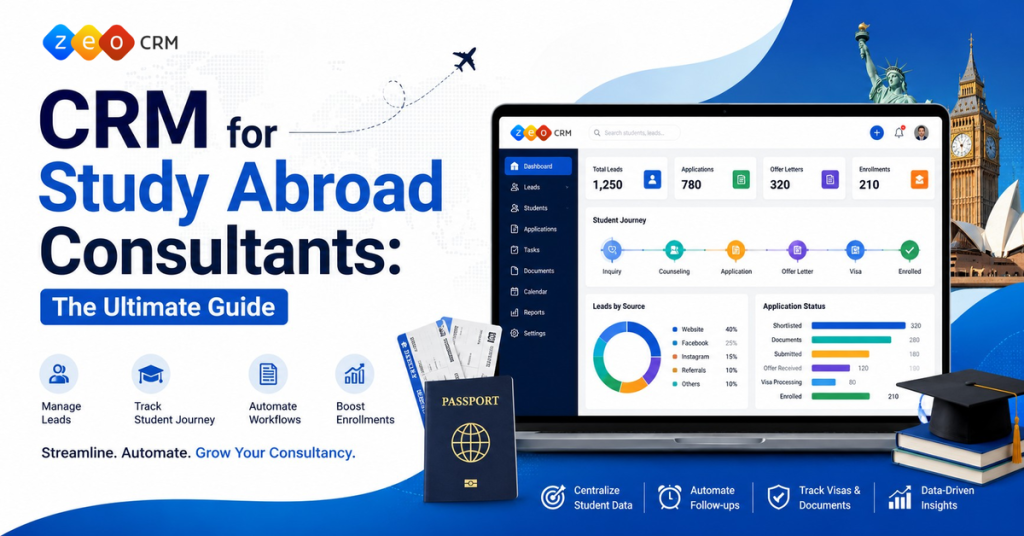
    CRM software dashboard for study abroad consultants managing student applicationsA study abroad CRM helps consultants manage leads, applications, and student communication in one platform.

    If you run a study abroad consultancy, you already know the feeling: forty new inquiries on Monday, half of them buried in a WhatsApp chat by Wednesday, and a counselor asking “wait, did we already send this student their offer letter?” on Friday. It’s not that your team isn’t working hard. It’s that spreadsheets, sticky notes, and scattered chat threads were never built to manage something as complex as the modern student journey.

    That’s exactly the gap a CRM for study abroad consultants is meant to close. In this guide, we’ll walk through what this kind of software actually does, why generic CRMs fall short for education businesses, and what to look for before you buy one. We’ll also talk about where we come in, we built ZeoCRM specifically for overseas education agencies, so a lot of what follows comes from conversations with consultants who were dealing with exactly these headaches.

    What is a CRM for Study Abroad Consultants?

    A CRM (Customer Relationship Management) system is software that helps a business track and manage its relationships with people, in this case, students, from the very first inquiry to well after they’ve boarded their flight.

    CRM software for study abroad consultants does this with one big difference from ordinary sales CRMs: it’s built around the specific, multi-month journey a student goes through, not a generic sales pipeline.

    How is a Study Abroad CRM different from a generic CRM?

    A regular CRM tracks a deal from “lead” to “closed.” A study abroad CRM tracks a student through counseling, university shortlisting, IELTS/PTE prep, document collection, application submission, offer letters, visa filing, tuition payment, accommodation, and pre-departure support. That’s a fundamentally different and far longer process, and it needs fields, stages, and automations that a plain sales CRM simply doesn’t have out of the box.

    Who should use a Study Abroad CRM?

    • Education consultants and overseas education agencies
    • Immigration consultants handling study visas
    • Student recruitment firms and agents
    • University representative offices
    • Admission counselors managing multiple intakes

    Why Traditional Methods Fail for Education Consultants

    Most agencies start with Excel and WhatsApp. It works, until it doesn’t. Here’s where things typically break down:

    • Lost student inquiries:  leads come in from Facebook, Instagram, your website, walk-ins, and referrals, and half of them never make it into one central place
    • Missed follow-ups: no automatic reminders means counselors forget to call back, and students quietly go to a competitor
    • Inefficient counselor collaboration:  when a counselor is on leave, nobody else knows where that student’s file stands
    • Manual application tracking:  deadlines tracked in someone’s head or a notebook
    • Document management issues:  passport copies and SOPs scattered across email, WhatsApp, and Google Drive
    • Poor communication:  students chasing you for updates instead of getting them proactively
    • No visibility into performance: owners can’t tell which counselor, campaign, or branch is actually driving conversions

    None of these are small problems. Each one is a leak in your funnel, and leaks compound.

    Understanding the Complete Student Journey

    Before picking any software, it helps to map out what you’re actually managing. A student typically moves through:

    Lead Generation → Lead Qualification → Counseling → University Shortlisting → IELTS/PTE Guidance → Document Collection → Application Submission → Offer Letter → Visa Filing → Visa Approval → Tuition Payment → Accommodation → Forex → Insurance → Pre-Departure → Post-Arrival Support

    A good CRM doesn’t just store data at each stage, it moves the student forward automatically, nudging counselors and students alike so nothing sits idle.

    Benefits of CRM in Higher Education

    The benefits of CRM in higher education go well beyond “staying organized.” Here’s what agencies actually notice after adopting one:

    Benefit

    What Changes

    Better lead management

    Every inquiry lands in one place, automatically

    Faster response times

    Auto-assignment gets leads to counselors within minutes

    Higher conversion rates

    Nothing falls through the cracks between stages

    Centralized student records

    One file per student, visible to the whole team

    Stronger team collaboration

    Any counselor can pick up any file without confusion

    Automated follow-ups

    Reminders go out on schedule, every time

    Data-driven decisions

    Owners see real numbers, not gut feelings

    Increased revenue

    More leads converted, fewer students lost to silence

    Reduced errors

    Less manual data entry, fewer typos in critical documents

    Better compliance

    Document and visa records stay audit-ready

    Core Features Every CRM for Study Abroad Consultants Should Have

    Not all CRMs are built equal, and not every “education CRM” was actually designed with study abroad in mind. Here’s what to check for:

    Lead Management: automatic capture from your website and social channels, smart lead assignment, and source tracking so you know which marketing spend is actually working.

    Student CRM System: a single student profile holding academic history, test scores, passport details, visa status, and every document in one view. This is the backbone of any serious student CRM system.

    Student Recruitment CRM: dedicated funnel tracking for inquiry-to-enrollment, with recruitment analytics that show conversion at every stage. A proper student recruitment CRM should tell you exactly where students are dropping off.

    Application Management: university and course tracking, deadline alerts, and offer letter management in one dashboard.

    Document Management: centralized storage for passports, SOPs, LORs, transcripts, and financial documents, so nobody’s digging through email threads.

    Visa Processing: checklists, timelines, and status tracking specific to each destination country.

    Automated Communication: email, WhatsApp, and SMS reminders that go out without a human having to remember.

    Other essentials worth checking off your list: task management, calendar integration, a counselor dashboard, a university database, commission tracking, financial tracking, reports and analytics, mobile access, multi-branch support, and role-based permissions for larger teams.

    AI Powered CRM Platform: How AI is Transforming Study Abroad Consulting

    This is where things have shifted quickly over the last couple of years. An AI powered CRM platform doesn’t just store information, it acts on it. Some of what this looks like in practice:

    • AI lead scoring: flagging which inquiries are most likely to convert, so counselors prioritize the right students first
    • AI follow-up suggestions: the system tells a counselor when and how to reach out next
    • AI email and WhatsApp drafting: cutting down the time spent writing repetitive messages
    • AI document verification: catching missing or inconsistent documents before they cause delays
    • AI predictive analytics: forecasting which intake is likely to hit targets, and which isn’t
    • AI dashboards: summarizing performance in plain language instead of raw numbers
    • AI chatbots: answering common student questions instantly, any time of day
    • AI workflow automation: moving students between stages without manual updates

    None of this replaces your counselors, it just removes the repetitive parts of their job so they can spend more time actually talking to students.

    Student Recruitment CRM: Why Recruitment Teams Need Specialized Software

    Recruitment and admissions are really two different jobs living under one roof. Marketing and counseling teams need to see inquiry volume, source performance, and campaign ROI, while admissions teams need application status and document readiness. A dedicated student recruitment CRM brings both views together, lead nurturing, campaign tracking, counselor performance, and the full recruitment pipeline, without forcing two departments onto two different systems.

    CRM for Consulting Companies vs CRM for Study Abroad Consultants

    Plenty of agencies start out using a general-purpose CRM for consulting companies because it’s cheaper or more familiar. The problem shows up fast:

    Feature

    Generic CRM

    Study Abroad CRM

    Lead Management

    Standard

    Education-specific

    Student Lifecycle Tracking

    Limited

    Built-in

    University Database

    Manual

    Included

    Visa Tracking

    Custom setup

    Built-in

    IELTS/PTE Tracking

    Manual fields

    Dedicated

    Application Tracking

    Custom workflows

    End-to-end

    Offer Letter Management

    Manual

    Built-in

    Commission Tracking

    Limited

    Automated

    Intake Management

    Manual

    Intake-wise

    A generic CRM can hold contact records just fine. What it can’t do is understand that a “deal” here is actually a 6–18 month journey through visas, intakes, and academic requirements.

    Higher Education CRM vs Overseas Education CRM

    These terms get used almost interchangeably, but there’s a real difference. A “higher education CRM” often refers to systems built for universities managing their own admissions. An overseas education CRM is built for the agencies and consultants working on the other side — helping students apply to those universities from abroad.

    Similarities

    Both manage applications, documents, and communication at scale.

    Key Differences

    University-side CRMs focus on institutional admissions cycles; overseas education CRMs focus on agent commissions, visa processes, and multi-country, multi-university shortlisting for individual students.

    Which one should agencies choose?

    If you’re a consultancy sending students abroad rather than a university receiving them, you want the overseas education variant, the workflows simply match your business better.

    How CRM Improves Every Department Inside an Education Consultancy

    • Marketing: clear visibility into which channels bring the best leads
    • Admissions: faster, more organized application processing
    • Counselors: one dashboard instead of five different tools
    • Visa team: status tracking without chasing paperwork
    • Finance: accurate commission and payment tracking
    • Management: real-time reporting instead of end-of-month guesswork
    • Branch managers: performance visibility across every location

    How to Choose the Best CRM for Higher Education

    When you’re evaluating the best CRM for higher education and overseas recruitment, run through this checklist:

    • Ease of use for your team, not just for the person doing the demo
    • Real automation, not just reminders you still have to trigger manually
    • Genuine AI features, not a marketing buzzword
    • Integrations with WhatsApp, email, and your website forms
    • Reporting that owners can actually read
    • Data security and access controls
    • Customization for your specific process
    • Scalability as your team and branches grow
    • A usable mobile app
    • Responsive customer support
    • Transparent pricing
    • Proper onboarding and training, not just a login link

    Higher Education CRM Software Comparison

    A quick way to see how options typically stack up (higher education CRM software comparison):

    FeatureGeneric CRMBasic Education CRMZeoCRM
    Student Lifecycle TrackingLimitedPartialAdvanced
    University DatabaseManualPartialExtensive
    Visa TrackingCustom SetupIncludedAutomated
    Commission TrackingLimitedPartialAutomated
    AI AutomationBasicIncludedAI-Powered
    WhatsApp IntegrationVariesVariesNative
    Document ManagementBasicPartialAdvanced

    We built ZeoCRM around the actual workflow of overseas education agencies, so this isn’t a generic feature checklist we bolted on, it’s the process consultants told us they needed, start to finish.

    Step-by-Step CRM Implementation Guide

    1. Define your goals: what problem are you actually solving first?
    2. Import existing data: bring your student records over cleanly
    3. Configure pipelines: map your real stages, not a default template
    4. Add team members: set up roles and permissions
    5. Set automations: follow-ups, reminders, assignment rules
    6. Integrate your website: so leads flow in automatically
    7. Train your employees: a CRM only helps if people use it
    8. Measure performance: review and adjust monthly

    Best Practices for Using a Student CRM System

    • Update student records regularly, not just when something’s urgent
    • Automate the repetitive work, reminders, confirmations, status updates
    • Track KPIs weekly, not once a quarter
    • Follow up consistently, even with “cold” leads
    • Use dashboards instead of asking staff for manual reports
    • Monitor counselor performance to spot coaching opportunities
    • Segment students by destination, intake, or course
    • Keep every document centralized in one place
    • Review reports weekly so problems get caught early, not late

    CRM Integrations Every Study Abroad Consultancy Needs

    Website forms, WhatsApp, email, SMS, Zoom, Google Calendar, payment gateways, document storage, accounting software, and your marketing tools should all connect to your CRM. If they don’t, you’re back to manually copying data between systems, the exact problem you were trying to solve.

    Key Metrics Every Overseas Education CRM Should Track

    • Lead volume and lead sources
    • Inquiry-to-counseling rate
    • Counseling-to-application rate
    • Offer letter rate
    • Visa approval rate
    • Enrollment rate
    • Revenue per counselor
    • Cost per lead
    • Student lifetime value

    If your current system can’t show you these numbers in a few clicks, it’s costing you more than it’s saving.

    Common Mistakes to Avoid When Choosing CRM Software

    • Buying the cheapest option without checking if it fits your workflow
    • Ignoring automation and treating the CRM as just a digital filing cabinet
    • Picking a generic CRM instead of one built for education
    • Skipping proper onboarding
    • Choosing a system with no real reporting
    • Not planning for growth or multiple branches
    • Overlooking mobile access
    • Rolling it out without training your team properly

    Future Trends in CRM for Study Abroad Consultants

    The next few years are likely to bring AI agents handling first-line student queries, deeper predictive analytics for intake planning, conversational and voice-based CRM interfaces, WhatsApp-first communication as the default rather than the exception, student self-service portals, and real-time, hyper-personalized dashboards for both students and staff.

    Frequently Asked Questions

    What is a CRM for study abroad consultants?

    It’s software built to manage the entire student journey, from first inquiry through visa approval and departure, in one centralized system.

    Why do study abroad consultants need a CRM?

    Because the student journey is long and multi-stage; without a system, inquiries, documents, and deadlines get lost.

    What is the best CRM for higher education?

    It depends on your specific workflow, but look for one purpose-built for overseas education rather than a generic sales tool.

    How does a student recruitment CRM work?

    It tracks leads from first contact through enrollment, with visibility into conversion at each stage.

    What is an overseas education CRM?

    A CRM designed specifically for consultancies helping students apply and get visas for study abroad, as opposed to universities managing their own admissions.

    Can CRM automate student follow-ups?

    Yes — automated reminders and messages are one of the core features of a good CRM.

    Can CRM manage visa applications?

    Yes, a study abroad CRM should include visa checklists, timelines, and status tracking.

    Can CRM integrate with WhatsApp?

    Most modern education CRMs, including ZeoCRM, support WhatsApp integration for student communication.

    What’s the difference between a student CRM system and a generic CRM?

    A student CRM system is built around the education-specific journey – academics, tests, visas, documents – rather than a generic sales pipeline.

    How much does CRM software for study abroad consultants cost?

    Pricing varies widely by features and team size; it’s worth comparing what’s included rather than just the sticker price.

    Is AI important in a CRM platform?

    Increasingly, yes it saves counselors time on repetitive tasks and helps prioritize the right students.

    How long does CRM implementation take?

    Typically a few weeks, depending on data volume and team size.

    Can small consultancies benefit from a CRM?

    Absolutely — even a two-person agency benefits from not losing leads and documents.

    How does CRM improve student conversion rates?

    By ensuring faster response times, consistent follow-ups, and better visibility into where students are in the funnel.

    What features should I look for in a study abroad CRM?

    Lead management, student lifecycle tracking, document management, visa tracking, automation, and reporting, at minimum.

    Conclusion

    At this point, a CRM isn’t really optional for a growing study abroad consultancy, it’s the difference between scaling your business and drowning in your own spreadsheets. A specialized system streamlines the entire student journey, keeps every department on the same page, and gives you the numbers you need to actually run the business instead of just reacting to it day to day.

    That’s the exact gap we set out to close with ZeoCRM, a CRM built specifically for overseas education agencies, not adapted from a generic sales tool. If you’re currently juggling Excel sheets, WhatsApp chats, and half a dozen disconnected tools, it’s worth taking a closer look at what a purpose-built system can do for your team. Evaluate your options carefully, but don’t wait too long, every week without a proper CRM is another week of leads and follow-ups quietly slipping through the cracks.