Edit Template

Author: Shruti Arora

  • How to Use AI in Your Business Without Compromising Data Privacy

    How to Use AI in Your Business Without Compromising Data Privacy

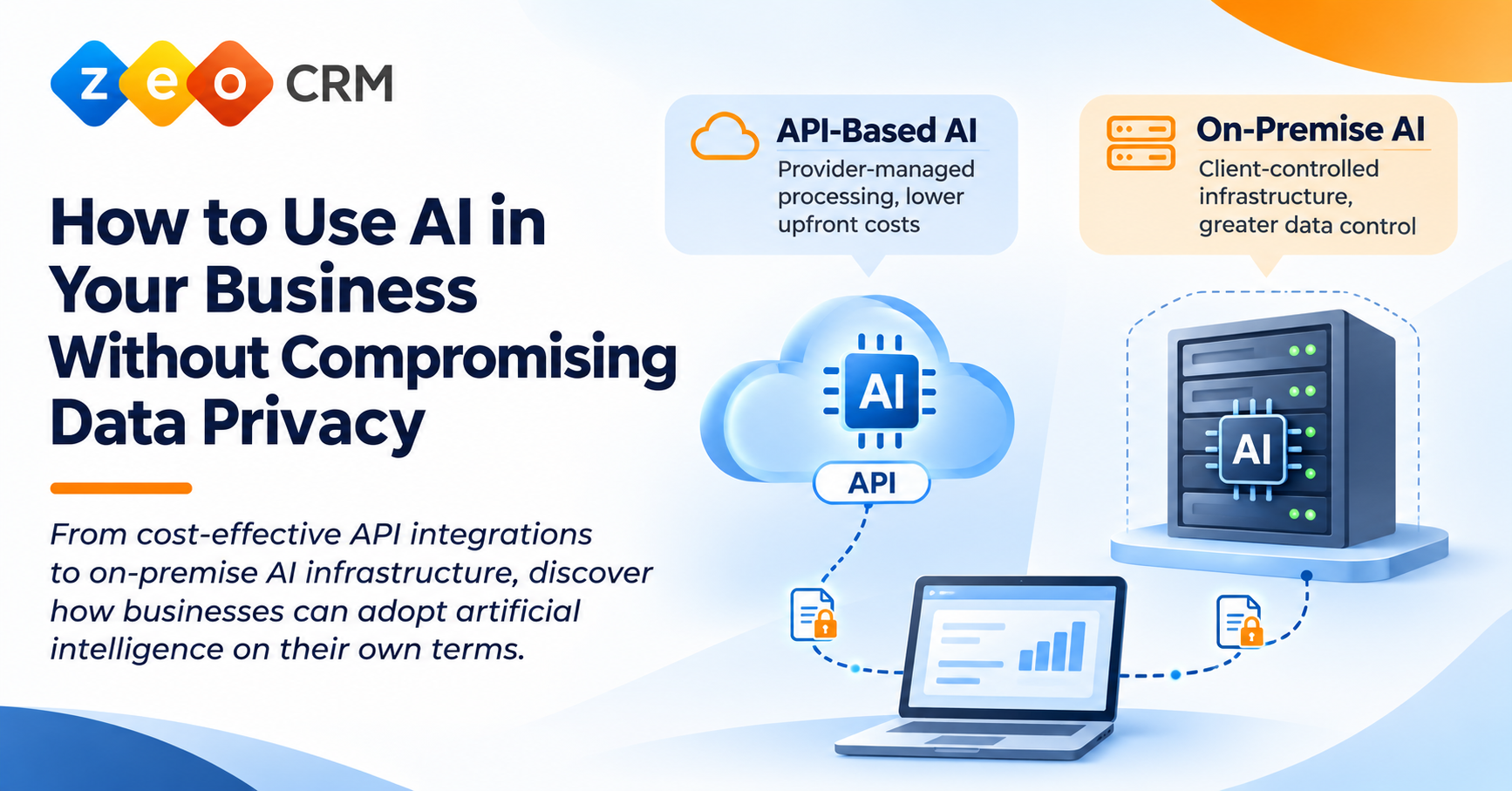
    From cost-effective API integrations to on-premise AI infrastructure, discover how businesses can adopt artificial intelligence on their own terms.

    Introduction: The AI Adoption Dilemma

    If artificial intelligence can make your business more efficient, why should adopting it mean giving up control over your data?

    Businesses now use AI for document processing, customer management, workflow automation, analytics and decision support. At the same time, they hold some of their most sensitive information in the same systems: customer records, financial documents, internal communications and personal details.

    That creates a real dilemma. You want the benefits of AI, but you don’t want to lose sight of where your data goes.

    The good news is that you have options. Broadly, there are two ways to bring AI into your business:

    • API-based AI integration for cost-effective adoption
    • On-premise AI deployment for greater data control

    This guide explains both, so you can choose how AI interacts with your data.

    Why Data Privacy Is Becoming a Major Concern in Business AI Adoption

    Many businesses hesitate to adopt AI not because they doubt its value, but because they’re unsure what happens to their information.

    Where Does Your Data Go When You Use AI?

    When you use an externally hosted AI service, the relevant data is usually sent to the provider’s infrastructure for processing. The result comes back to your system. What happens to that data in between depends on the provider’s policies on storage, retention, access and model training.

    What Types of Business Data Require Protection?

    Most businesses handle at least some of the following:

    • Customer and client information
    • Financial records
    • Proprietary business information
    • Identity documents
    • Employee records
    • Confidential communications

    Data Privacy Is Not the Same as Data Security

    These terms are often used interchangeably, but they mean different things:

    ConceptWhat it means
    Data privacyWho can access and use your data
    Data securityHow your data is protected
    Data ownershipWho holds the rights to the data
    Data sovereigntyWhich jurisdiction’s laws govern the data
    Data controlWho manages access, processing and retention

    Understanding these differences helps you ask better questions when evaluating any AI solution.

    Do Businesses Have to Share Their Data to Use AI?

    Not necessarily. API-based AI services typically process relevant information on provider-managed infrastructure, so some data does leave your systems. On-premise AI solutions, on the other hand, can let you run AI workloads inside infrastructure you control.

    The real answer depends on the deployment architecture, the integrations involved and the data processing arrangements you agree to. Let’s look at both models in detail.

    Model 1: API-Based AI, a Cost-Effective Way to Adopt Artificial Intelligence

    What Is API-Based AI?

    API-based AI lets you plug AI capabilities into your existing systems, such as your CRM, without hosting the AI models yourself. Your system sends a request to the provider, the provider processes it and the result comes back.

    Benefits of API-Based AI

    • Lower upfront infrastructure investment
    • Faster implementation
    • Fewer in-house technical requirements
    • Infrastructure managed by the provider
    • Ongoing usage and integration support
    • An easier first step into AI-powered operations

    What Are the Data Privacy Considerations?

    With API-based AI, the relevant data is shared with the service provider for processing. That isn’t automatically a problem, but you should understand:

    • How long the provider retains your data
    • Who can access it
    • Whether your data is used to train models
    • How data is encrypted in transit and at rest
    • What contractual data protection terms apply

    Who Should Consider API-Based AI?

    Startups, SMEs, growing consultancies and any business that wants to start using AI without investing heavily in dedicated infrastructure. It’s a practical way to test use cases and see results quickly. ZeoCRM offers an API-based option for exactly this kind of cost-conscious adoption.

    Model 2: On-Premise AI, Keeping Your Business Data Within Your Own Infrastructure

    What Is On-Premise AI?

    On-premise AI means deploying AI models and their processing capabilities on infrastructure your organisation controls. Your data is processed and stored within your own environment instead of being sent to an external AI provider.

    Benefits of On-Premise AI

    • Greater control over business data
    • Less dependence on external AI processing services
    • Access permissions set by your organisation
    • More flexibility to apply your own data governance policies
    • A better fit for stricter confidentiality requirements
    • Greater control over infrastructure and deployment

    What Are the Trade-Offs?

    On-premise AI comes with real responsibilities. You’ll need suitable hardware, people to manage the infrastructure, technical expertise, ongoing maintenance, model updates and a plan for scaling.

    It’s also worth being clear about one thing. On-premise deployment does not automatically guarantee security or regulatory compliance. It gives you more control, but you still need strong security practices and good governance.

    Who Should Consider On-Premise AI?

    Enterprises, universities, financial organisations, privacy-conscious consultancies and any business that handles sensitive customer information. You don’t have to start with an API-based solution first. If data control is your top priority, on-premise AI can be your starting point.

    API-Based AI vs On-Premise AI: A Detailed Comparison

    FactorAPI-based AIOn-premise AI
    Initial investmentGenerally lowerGenerally higher
    InfrastructureProvider-managedClient-controlled
    ImplementationTypically fasterNeeds dedicated setup
    Data processingProvider infrastructureClient infrastructure
    External data sharingRequired for relevant processingCan be avoided with fully local deployment
    Data controlDepends on service termsGreater direct control
    Technical requirementsGenerally lowerGenerally higher
    MaintenanceLargely provider-managedClient responsibility or agreed support
    SupportOngoing usage supportInitial implementation support
    Cost structureRecurring or usage-basedInfrastructure and operating costs
    Best suited forCost-conscious adoptionData control-first adoption

    Neither model is better in every situation. The right choice depends on your budget, infrastructure, data sensitivity and growth plans.

    Your AI Strategy Can Evolve as Your Business Grows

    Choosing an AI deployment model doesn’t have to be a permanent, one-time decision. Businesses tend to follow one of two journeys:

    JourneyTypical path
    Cost-first adoptionStart with API, scale AI usage, then explore on-premise
    Privacy-first adoptionSet up on-premise, adopt AI internally, then scale infrastructure

    Neither journey is mandatory. Your starting point should reflect your current needs.

    Start With AI APIs and Evaluate Future Infrastructure Needs

    Many businesses begin with APIs to keep costs low and prove which AI use cases actually deliver value. Once AI becomes central to operations, they can reassess whether private infrastructure makes sense.

    Build a Privacy-First AI Environment From Day One

    Some organisations can’t or would rather not share sensitive information with external providers. For them, starting on-premise avoids that concern from the outset.

    When Should Businesses Consider Moving to On-Premise AI?

    Signs it may be time to look at on-premise AI include:

    • The data you process is becoming more sensitive
    • Your AI usage is growing significantly
    • Internal governance requirements are tightening
    • Your infrastructure and team are ready to manage it
    • Long-term total cost of ownership starts to favour it

    Any move between models should be planned carefully with your technology partner.

    Real-World AI Use Cases Where Data Privacy Matters

    Business use caseData involved
    Student recruitment and admissionsStudent profiles and academic records
    Immigration consultingPassports, visa documents and personal information
    Customer relationship managementContact details and communication history
    AI-powered document processingConfidential business documents
    Financial operationsTransaction and financial information
    Business analyticsInternal performance and operational data
    HR automationEmployee records and personal information

    Example: An Education Consultancy Adopting AI

    Imagine a growing education consultancy that wants to automate repetitive CRM workflows and work more efficiently. To keep initial costs down, it chooses API-based AI.

    Another consultancy handles large volumes of sensitive student records and prefers to keep everything in-house. It chooses an on-premise setup from the start.

    Both benefit from AI. Their infrastructure choices simply reflect different priorities. You can read more about AI-powered workflow automation for consultancies.

    7 Questions to Ask Before Choosing an AI Deployment Model

    Use these questions to evaluate any AI solution:

    1. What type of business data will the AI system process?
    2. Where will the data be processed and stored?
    3. Who can access the data?
    4. Is submitted data retained or used for model training?
    5. What are the upfront and long-term operating costs?
    6. Who will manage the infrastructure, security and maintenance?
    7. Can the deployment model evolve with your future needs?

    Clear answers to these questions will tell you far more than any feature list.

    How ZeoCRM Helps Businesses Adopt AI on Their Own Terms

    Your Business. Your Data. Your Choice.

    At ZeoCRM, we know every business has different priorities when it comes to AI. Some want to start using AI while keeping their initial investment manageable. Others want greater control over their data and infrastructure from day one. That’s why we offer two approaches.

    Cost-Effective AI Adoption Through API Integration

    Our API-based option suits businesses that want:

    • Lower initial infrastructure costs
    • AI capabilities without hosting models themselves
    • Usage and integration support
    • Processing managed by the provider

    To be transparent, with this option the relevant data is shared with the provider for processing.

    Privacy-Focused AI Adoption Through On-Premise Deployment

    Our on-premise option suits businesses that want:

    • AI infrastructure under their own control
    • Local processing of business data
    • Greater control over data access
    • Initial setup and implementation support
    • An AI environment aligned with internal privacy requirements

    Whether you’re taking your first step into AI or building a privacy-focused environment, you can choose the approach that fits your business. Explore our AI-powered CRM solutions.

    Frequently Asked Questions

    Can businesses use AI without sharing their data?

    Yes. With an on-premise AI deployment, AI workloads can run inside your own infrastructure, so data doesn’t need to go to an external AI provider. API-based AI, by contrast, sends relevant data to the provider for processing.

    What is on-premise AI?

    On-premise AI is artificial intelligence deployed on infrastructure your organisation controls. Your data is processed and stored within your own environment rather than on an external provider’s servers.

    What is the difference between API-based AI and on-premise AI?

    API-based AI uses a provider’s infrastructure and usually costs less upfront. On-premise AI runs on your own infrastructure, offering more data control but needing more investment and technical resources.

    Is on-premise AI more secure than cloud-based AI?

    Not automatically. On-premise AI gives you more control, but security depends on how well the infrastructure is configured, maintained and governed. Cloud and API services can also be secure with the right safeguards.

    Is API-based AI suitable for small businesses?

    Yes. It’s often the most practical choice for small businesses because it needs less upfront investment and less in-house expertise. Just review the provider’s data handling terms first.

    Can a business start with on-premise AI directly?

    Yes. If data control is a priority, you can start on-premise without first using an API-based solution.

    Can businesses move from API-based AI to on-premise AI?

    Many businesses consider this as their AI usage and data needs grow. Plan any move carefully with your technology partner.

    How can education consultants protect student data while using AI?

    Understand where student data is processed, limit access to authorised staff, review provider retention and training policies and consider on-premise AI for highly sensitive records. See our guide to managing student data.

    Conclusion: AI Adoption Should Not Mean Giving Up Control

    AI adoption should fit your business priorities, not the other way round. Affordability and data control are both valid concerns, and the right deployment model depends on which matters most to you right now. Whatever you choose, make sure you understand exactly how your information is processed.

    Ready to adopt AI without losing sight of your data privacy priorities? Whether you’re looking for cost-effective API integration or an on-premise AI environment, ZeoCRM can help you find the right approach.
  • Appointment Scheduling for Education Consultants: An 8-Step Guide

    Appointment Scheduling for Education Consultants: An 8-Step Guide

    Quick Answer: What Is Appointment Scheduling for Education Consultants?

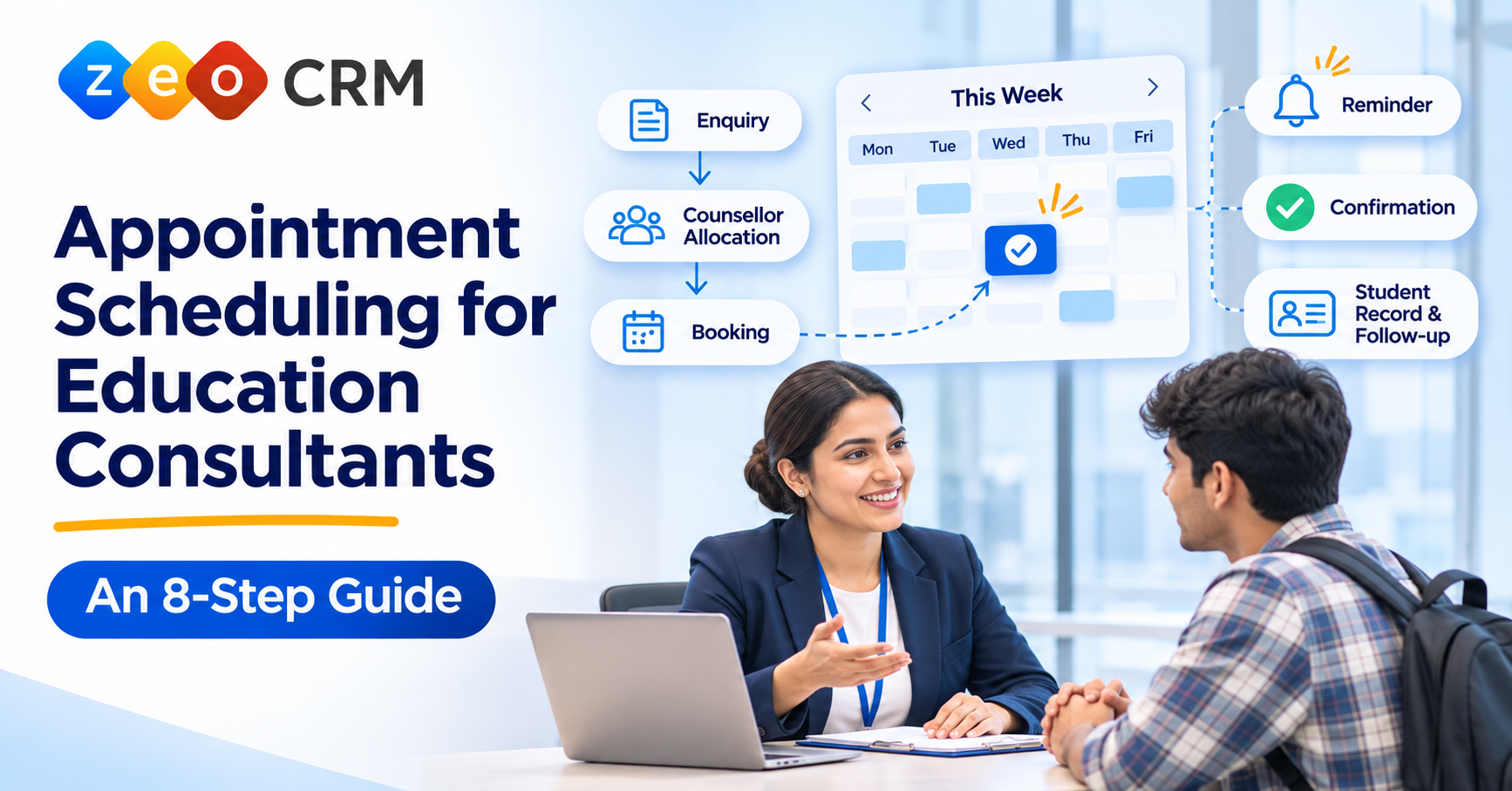
    Appointment scheduling for education consultants is the process of organising student counselling sessions, allocating suitable counsellors, managing availability and handling confirmations, reminders, cancellations and rescheduling. A structured workflow also records attendance and outcomes, so every consultation connects to the next step in the student’s recruitment journey.

    Introduction

    A study abroad consultancy gets enquiries through its website, by phone and on WhatsApp. Each counsellor keeps their own calendar. Bookings clash, notes end up in different places and some students never hear back after their first session.

    Good student appointment management fixes this. This guide walks through an eight-step appointment lifecycle that turns scattered bookings into an organised process. For the wider picture, see our guide to CRM for study abroad consultants.

    Why Is Appointment Scheduling Important for Education Consultants?

    In a consultancy, an appointment isn’t just a calendar entry. It’s often the moment an enquiry becomes a real conversation about a student’s future. Student appointment scheduling done well helps you:

    • Turn enquiries into counselling opportunities
    • Match each student with the right counsellor
    • See who is available and when
    • Give students a more organised experience
    • Keep recruitment moving through recorded outcomes and next actions

    A typical journey runs from student enquiry to appointment booking, then the counselling session, the next recruitment action and finally the application journey.

    Example: A student interested in Australia is booked with a counsellor who knows Australian admissions, not just whoever happens to be free.

    Common Appointment Scheduling Challenges in Education Consultancies

    Manual Booking and Scheduling Conflicts

    Phone bookings, spreadsheets and separate calendars make double bookings easy. Without shared availability, nobody has the full picture.

    Missed Appointments and Inconsistent Reminders

    Students forget appointments, receive unclear instructions or can’t easily reschedule. Reminders depend on whoever remembers to send them.

    Disconnected Counselling Records and Follow-ups

    When appointment details, counselling notes and student records live in different places, it’s hard to know who owns the next step.

    Scheduling challengePotential impact
    Double bookingsConflicting counsellor commitments
    Uneven allocationOverloaded or underused counsellors
    Missing confirmationsConfusion about appointment details
    Inconsistent remindersStudents forget appointments
    Unrecorded outcomesLittle visibility into progress
    Unassigned next actionsDelayed or missed follow-ups
    Separate branch calendarsHard to coordinate shared resources

    These gaps are a common source of student lead leakage.

    How to Manage Student Appointments: An 8-Step Appointment Scheduling Workflow

    Here’s a practical appointment scheduling workflow you can adapt to your consultancy:

    1. Capture the student enquiry
    2. Allocate the right counsellor
    3. Check availability and book
    4. Confirm the appointment
    5. Send appointment reminders
    6. Manage scheduling exceptions
    7. Record attendance and outcomes
    8. Assign the next recruitment action

    Step 1. Capture the Student Enquiry

    Every appointment should link to a student record. Create a new record or update an existing one, avoiding duplicates. Capture the basics:

    InformationWhy it matters
    Name and contact detailsTo reach the student
    Preferred destinationTo choose a suitable counsellor
    Intended intakeTo understand urgency
    Consultation purposeTo pick the appointment type
    Preferred meeting modeTo arrange online or in-person sessions

    Only collect what you need at this stage. There’s no reason to ask for passports or financial documents just to book a first consultation. Read more on student lead management.

    Step 2. Allocate the Right Counsellor

    Availability alone shouldn’t decide who takes the appointment. Consider destination expertise, programme knowledge, branch and language preferences, any existing relationship with the student, current workload and how close the intake deadline is.

    Example: A student planning to study in New Zealand goes to a counsellor with New Zealand expertise and an open slot. Good counsellor workload management keeps the load fair across the team. See counsellor allocation for more.

    Step 3. Check Counsellor Availability and Book the Appointment

    Shared visibility of time slots is the best defence against clashes. When booking, think about:

    • Appointment duration and buffer time between sessions
    • Working hours and leave
    • Online or in-person meetings
    • Time zones for international students
    • Whether staff book appointments or students book themselves

    A clear appointment record includes the student, counsellor, date, time, time zone, duration, branch, appointment type and status. Strong counsellor calendar management and a reliable student appointment booking system make this much easier.

    Step 4. Confirm the Student Appointment

    Send a confirmation straight away so everyone knows what’s happening. Here’s a template you can adapt:

    Hi [Student Name],

    Your study abroad counselling appointment with [Counsellor Name] is booked for [Date] at [Time and Time Zone].

    Meeting location or link: [Details]

    Please have your academic background and preferred study destinations ready to discuss.

    If you need to cancel or reschedule, contact us at [Contact Details].

    Step 5. Send Student Appointment Reminders

    Student appointment reminders help people remember and prepare. Use email, SMS or WhatsApp based on each student’s preferences and the rules that apply to you. Here’s an example timeline:

    WhenWhat to send
    Straight after bookingConfirmation and preparation details
    24 hours beforeA reminder with a way to reschedule
    1 to 2 hours beforeOptional final reminder with meeting details
    After a missed appointmentA friendly check-in offering another time

    This is a starting point, not a perfect formula. Adjust it to how far ahead appointments are booked and how students respond. Automated appointment reminders can help where your system supports them. See education CRM automation.

    Step 6. Manage Cancellations, Rescheduling and No-Shows

    Not every appointment goes to plan. Set clear rules for each situation:

    EventWhat to do
    Student cancelsUpdate the status and free up the slot
    Counsellor cancelsTell the student and offer an alternative
    Rescheduling requestConfirm a new slot and update records
    No-showRecord it after a set grace period
    Repeated no-showsReview the student’s interest and contact preferences

    Link rescheduled appointments to the original so history stays intact and reports stay accurate. Remember, a missed appointment isn’t automatically a lost lead.

    Step 7. Record Appointment Attendance and Counselling Outcomes

    Appointments should leave a useful record, not just vanish from the calendar. Use clear statuses: Booked, Confirmed, Attended, Completed, Cancelled, Rescheduled, No-show and Pending outcome.

    Note that attended and completed aren’t the same. Attended means the student joined. Completed means the planned session was finished. Record the outcome, key notes, outstanding requirements and the responsible counsellor. Good CRM appointment tracking keeps this tidy. See our student counselling workflow.

    Step 8. Connect the Appointment With the Next Recruitment Action

    Every session should lead somewhere. Map outcomes to next steps:

    Counselling outcomePossible next action
    Still exploring optionsBook another session
    Destination chosenPrepare a course shortlist
    Courses shortlistedRequest application documents
    Parent involvement neededArrange a joint consultation
    Not ready yetSet a check-in date
    No longer interestedRecord the outcome and update the lead status

    Give each next action an owner and a due date. This is where your appointment follow up process links into structured student follow-ups.

    How Can Education Consultants Reduce Missed Student Appointments?

    Prevent Missed Appointments Before They Occur

    Send clear confirmations, offer sensible booking times, use well-timed reminders, include accurate meeting details and make rescheduling easy.

    Recover Missed Appointments Through Structured Follow-ups

    When a no-show happens, record it, reach out politely, try to understand why and offer a new time. Then update the student’s record. If there’s no response, follow a reasonable contact policy before changing their lead status. This approach helps reduce missed student appointments without giving up on students too early.

    Manual vs Standalone vs CRM-Based Appointment Management

    Different approaches suit different consultancies.

    CriterionManual schedulingStandalone scheduling softwareCRM-based appointment management
    BookingStaff coordinationDedicated booking toolBuilt-in or integrated, where supported
    AvailabilityManual calendar checksShared availabilityConnected availability, where supported
    RemindersUsually manualOften configurableDepends on automation features
    Student informationSeparate filesBasic records or integrationsConnected student records
    Follow-up ownershipManually assignedMay need extra toolsCan link to CRM tasks
    ReportingCompiled by handBooking-focusedPotentially appointment and recruitment reporting
    Best forSmall, low-volume teamsDedicated booking needsConsultancies wanting connected workflows

    A standalone booking tool integrated with a CRM can also work well for some teams.

    What Features Should Education Consultants Evaluate?

    Look at availability management, conflict prevention, links to student records, notifications, attendance tracking, cancellation and rescheduling, reporting, calendar integrations and access controls. Compare CRM versus spreadsheet management if you’re still deciding.

    Managing Appointments Across Multiple Branches and Peak Intake Periods

    Multi-Branch Appointment Coordination

    Appointment scheduling for multiple branches needs shared visibility of each branch’s counsellors, students’ location preferences, destination specialisms and sensible access permissions.

    Managing Counsellor Capacity During Peak Intakes

    Peak intake appointment management means forecasting demand, planning slots, keeping some capacity free for urgent cases and spreading work across suitable counsellors.

    Hypothetical capacity example: Four counsellors each have six consultation hours a day. Appointments last 30 minutes with a 10-minute buffer, so each slot takes 40 minutes. That gives each counsellor nine slots and the team 36 slots a day.

    How to Measure Appointment Scheduling Performance

    Essential Student Appointment Scheduling KPIs

    KPIFormula
    Enquiry-to-appointment conversionUnique enquiries that booked ÷ eligible enquiries × 100
    Attendance rateAttended ÷ due appointments (excluding advance cancellations and replaced bookings) × 100
    No-show rateNo-shows ÷ the same due appointments × 100
    Completion rateCompleted ÷ attended appointments × 100
    Cancellation rateCancelled ÷ scheduled appointments due × 100
    Counsellor utilisationCounselling minutes used ÷ available minutes × 100
    Appointment-to-next-stage conversionStudents progressing to a defined stage ÷ eligible counselled students × 100

    Hypothetical example: 200 eligible enquiries lead to 120 booked students, an enquiry-to-appointment conversion of 60%. Of 120 due appointments, 100 are attended (83.3%) and 20 are no-shows (16.7%). Of those attended, 90 are completed (90%). These figures are illustrative, not benchmarks.

    How Appointment Data Can Improve Recruitment Operations

    Reports can reveal high no-show rates, overloaded counsellors, low booking conversion or weak progress after counselling. A branch with strong bookings but low attendance might need to review timing, communication or reminders. Compare against your own history rather than invented industry averages. See essential admissions reports.

    How ZeoCRM Can Support Student Recruitment and Appointment Management

    ZeoCRM is an education recruitment CRM for study abroad consultancies. It offers lead management, enquiry management, branch management, client management, email integration, marketing automation, customised reports and calendar management on applicable plans.

    These features help you manage student enquiries, keep client information connected, organise branches and track pipeline activity. To see how ZeoCRM’s calendar management fits your appointment workflow, explore it during a demo. Request a ZeoCRM Demo

    Frequently Asked Questions About Appointment Scheduling for Education Consultants

    What is the best way to manage student appointments?

    Keep central student records, book suitable slots with the right counsellor and record a clear next action after every session.

    How can education consultants reduce appointment no-shows?

    Send clear confirmations and timely reminders, offer convenient times and make rescheduling easy.

    Can a CRM help education consultants manage appointments?

    Yes. Depending on the CRM, scheduling may be built in or integrated and linked to student records.

    How should counsellor availability be managed?

    Track working hours, existing bookings, specialisms, appointment length and overall capacity in one shared view.

    When should student appointment reminders be sent?

    A common approach is a confirmation at booking, a reminder the day before and an optional one shortly beforehand.

    What appointment scheduling KPIs should education consultants track?

    Track booking conversion, attendance, no-shows, completion, counsellor utilisation and progression after counselling.

    Conclusion: Connect Student Appointments With the Recruitment Journey

    Effective appointment scheduling for education consultants connects the right student with the right counsellor at the right time and makes every session count. Request a ZeoCRM Demo to see how it fits your consultancy.

  • Student Follow-Up Management: How to Avoid Missing Admissions Opportunities

    Student Follow-Up Management: How to Avoid Missing Admissions Opportunities

    Student Follow-Up Management: How to Avoid Missing Admissions Opportunities

    Quick Answer: How Can Education Consultancies Manage Student Follow-Ups?

    Student follow-up management means recording every enquiry, assigning a responsible counsellor, prioritising students by stage and intent and scheduling a clear next action. Consultancies can reduce missed follow-ups by documenting conversations, using suitable reminders, reviewing overdue tasks and tracking performance. A structured workflow keeps every student moving through the admissions journey.

    Introduction

    Your consultancy gets enquiries from the website, WhatsApp, phone calls and Instagram. Five counsellors are juggling dozens of students each. Somewhere in that mix, a promising student who asked about the next intake never hears back because nobody scheduled a follow-up.

    It happens more often than most teams admit. Study abroad decisions take several conversations and intake deadlines don’t wait. This guide gives you a six-step workflow to make sure every enquiry gets the attention it deserves. For the bigger picture, read our guide to CRM for study abroad consultants.

    Why Student Follow-Up Management Matters

    Good student lead follow up keeps a student’s journey moving from first enquiry to application. It makes sure promised actions actually happen and that someone is accountable for each student.

    Consider a student exploring universities in Australia. They may need separate conversations about course options, eligibility, documents and application timing. If any one of those threads drops, the student can lose momentum or move on to another consultancy.

    Consistent prospective student follow up helps you:

    • Respond to new enquiries while interest is high
    • Keep continuity after counselling sessions
    • Track every action you agreed to take
    • Give managers clear visibility across the admissions pipeline

    Learn more about the full lead lifecycle in our guide to student lead management.

    Why Education Consultancies Miss Student Follow-Ups

    Missed student enquiries usually come from small gaps in how work is organised.

    CauseWhat happens as a result
    Enquiries scattered across channelsMessages are hard to track in one place
    No assigned counsellorNobody is clearly responsible
    Reliance on spreadsheets or memoryCallbacks get forgotten
    No standard processNext actions vary from counsellor to counsellor
    Poor prioritisationTime-sensitive students get overlooked
    No review of overdue or inactive leadsUnresolved enquiries sit untouched

    Each of these contributes to student lead leakage and explains why student leads go cold. See how to reduce student lead leakage across your wider funnel.

    How to Build an Effective Student Follow-Up Workflow

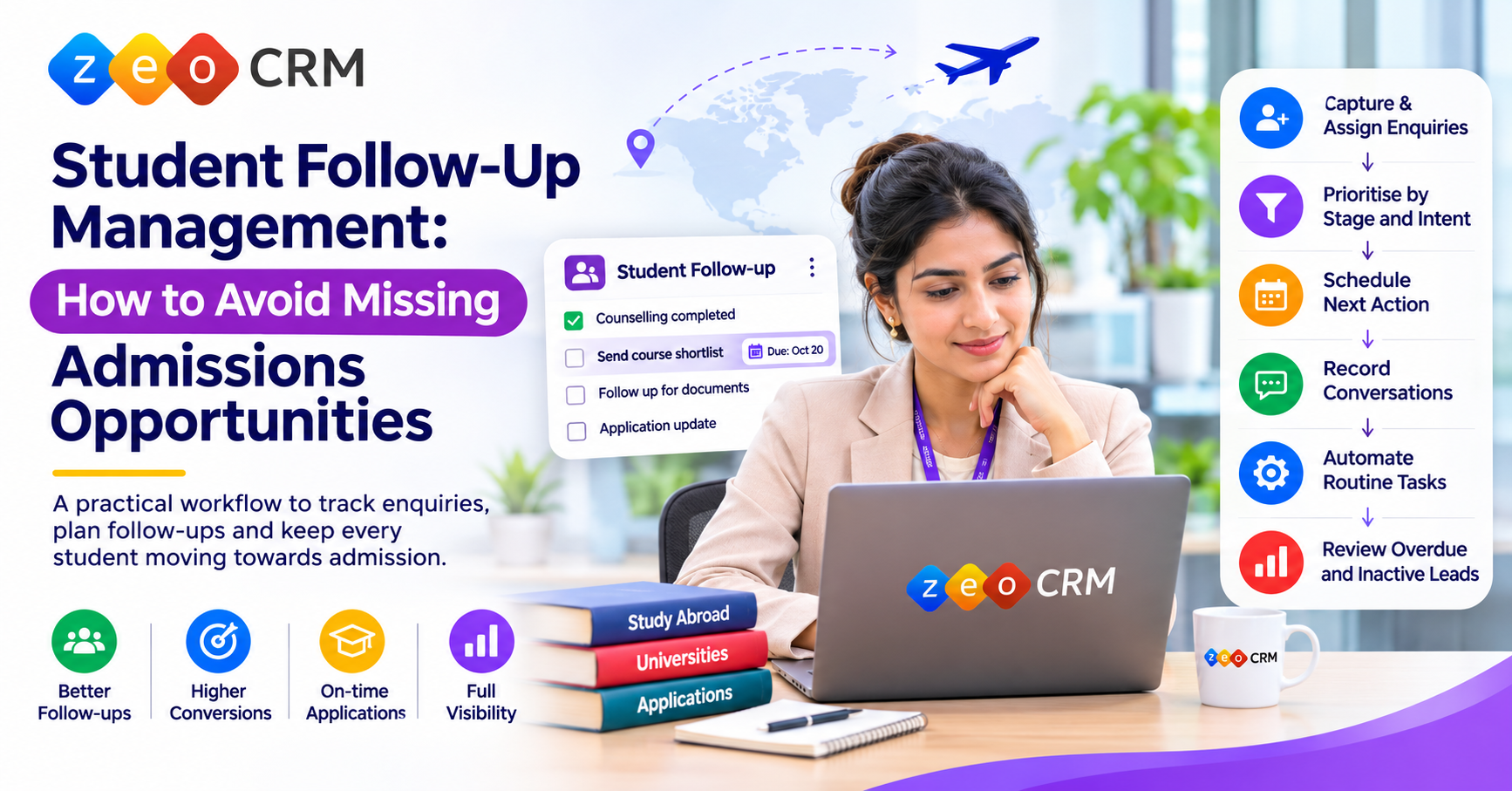
    Here is a six-step student follow-up workflow you can run with a shared tracker or a suitable CRM:

    1. Capture and assign every enquiry
    2. Prioritise by stage and intent
    3. Schedule the next action
    4. Record conversations
    5. Automate suitable routine tasks
    6. Review overdue and inactive leads

    Step 1. Capture and Assign Every Student Enquiry

    Every admission follow up process starts with a complete record. For each new enquiry, capture the student’s contact details, enquiry source, preferred destination, course interest, intended intake and any specific counselling needs.

    Then assign a responsible counsellor straight away. Agree on who owns the student during handoffs, for example when a lead moves from a front-desk team to a destination specialist.

    Example: A website enquiry about the February 2027 intake is logged with its source and assigned to a counsellor the same day.

    Automatic capture depends on which integrations you have, so some manual entry may still be needed. Our guides on the student enquiry management system and assigning student leads to counsellors go further.

    Step 2. Prioritise Students by Stage and Intent

    Not every student needs the same attention at the same time. Separate students who are just researching from those waiting for counselling, collecting documents or facing a confirmed deadline.

    Useful criteria for deciding who comes first include:

    • How close the student’s intake or application deadline is
    • Whether actions are pending on your side
    • How ready the student is to move forward
    • How engaged they have been so far

    Example: A student with an application deadline next week comes before one exploring next year’s intake, but neither should be forgotten.

    Step 3. Set Clear Follow-Up Dates and Responsibilities

    This is the rule that holds the whole system together. Every active enquiry needs an owner, a defined next action and a due date.

    Here is what a simple task record might look like:

    FieldIllustrative entry
    StudentStudent A
    StagePost-counselling
    OwnerAssigned counsellor
    Next actionSend course shortlist
    Due dateAgreed date
    StatusPending

    Overdue tasks should be visible to the counsellor and their manager, not hidden in someone’s notebook. Student follow up reminders and CRM follow up reminders make this far easier to manage.

    Step 4. Record Conversations and Next Steps

    Keep a clear record of counselling notes, contact attempts, student questions, course preferences, pending documents and agreed actions. Good student communication tracking means nobody has to start from scratch.

    Example: A counsellor goes on leave. A colleague opens the record and sees the student has already discussed eligibility and is waiting for a document checklist. The conversation carries on without the student repeating themselves.

    Limit access to student information based on each person’s role and the privacy rules that apply to you. Our student counselling workflow explains how these records fit into each counselling stage.

    Step 5. Automate Routine Follow-Up Tasks

    Student follow up automation works best for repetitive admin. It helps to separate two kinds:

    • Internal automation: Task reminders, notifications and stage-based follow-up prompts for your team, where your system supports them.
    • Student-facing automation: Appointment confirmations and simple acknowledgements, where supported and appropriate.

    Complex questions, counselling decisions and sensitive conversations still need a real person. Automated student follow up should always respect consent, communication preferences and messaging rules. Explore our guide to CRM automations for more ideas.

    Step 6. Review Overdue and Inactive Student Leads

    Set aside time every day to review overdue tasks, unresolved enquiries and students who have stopped responding. Assign an escalation owner when something has slipped. Record each re-engagement attempt and agree on clear rules for pausing or closing a record.

    Example: A counsellor missed a promised callback. The task appears in the overdue queue and the team lead follows up the same morning.

    Inactive students shouldn’t receive endless follow-ups. A respectful check-in followed by a pause is usually the right approach.

    How Often Should You Follow Up with Prospective Students?

    There’s no single schedule that suits every student. The right timing depends on their stage, their deadlines and how they prefer to be contacted.

    Student stageFollow-up objectiveNext actionTiming consideration
    New enquiryMake contactAcknowledge and arrange a discussionPromptly, based on team capacity
    After counsellingKeep continuityShare the agreed informationBy the date you promised
    Course shortlistingSupport the decisionDiscuss shortlisted optionsWhen the student is ready
    Documents pendingComplete requirementsClarify missing documentsBefore confirmed deadlines
    Application preparationKeep tasks movingReview pending application actionsBased on official deadlines
    Inactive enquiryConfirm interestSend a respectful check-inBased on past contact and preferences

    The best student follow up strategies let urgency, outstanding tasks and the student’s preferences guide timing. For longer-term engagement, read our guide to student lead nurturing.

    Student Follow-Up Email and WhatsApp Message Examples

    Here are four short messages you can adapt. Personalise them, use confirmed deadlines only and never promise admission or visa outcomes.

    Example 1: Initial enquiry follow-up

    Hello [Student Name], thank you for enquiring about studying in [Destination]. We’d be happy to talk about your course and intake preferences. Would you like to book a counselling session?

    Example 2: Follow-up after counselling

    Hi [Student Name],

    Thank you for speaking with us. As discussed, the next step is to review your shortlisted courses and universities.

    Please let us know if you have any questions.

    Best regards, [Counsellor Name]

    Example 3: Pending documents

    Hi [Student Name], we’re following up on the documents we discussed for your application. Please share the pending items when convenient or let us know if anything needs clarifying. We can also confirm any deadline that applies.

    Example 4: Re-engaging an inactive student

    Hello [Student Name], we wanted to check whether you’re still considering your study abroad plans. If your preferences have changed or you’d like to pause communication, just let us know.

    These work as a student enquiry follow up email or a WhatsApp follow up for student enquiries.

    Student Follow-Up Checklist for Education Consultancies

    Use this quick audit to see how well your current process holds up:

    • Every enquiry has a record
    • Every active enquiry has an assigned counsellor
    • Student stage and intent are recorded
    • The next action and follow-up date are defined
    • Previous conversations are documented
    • Pending student actions are visible
    • Overdue follow-ups are reviewed
    • Inactive enquiries have a clear next step
    • Communication preferences are respected
    • Managers can review follow-up performance

    Start with the gaps that affect the most students.

    How CRM Software Helps Manage Student Follow-Ups

    A CRM won’t fix a broken process on its own. Once the process is clear, though, a student follow up CRM makes it much easier to run day to day. It brings together centralised student records, counsellor assignment, pipeline visibility, follow-up tracking, communication history and management reporting.

    How ZeoCRM Supports Student Follow-Up Management

    ZeoCRM is a CRM designed for study abroad consultants and education consultancies. It supports student lead management, counsellor assignment, application tracking, pipeline visibility and reporting. These match the habits covered in this guide: clear ownership, visible next actions and regular review.

    If you want more consistency in how your team handles student enquiries, explore ZeoCRM for student lead and follow-up management.

    KPIs to Measure Student Follow-Up Performance

    These numbers show whether your process is working.

    KPIHow to measure itWhat it tells you
    First-response timeTime from enquiry to first meaningful responseWhere response delays happen
    Follow-up completion rateCompleted tasks ÷ tasks due × 100How consistently tasks get done
    Overdue follow-up rateOverdue tasks ÷ tasks due × 100How many actions are slipping
    Unassigned enquiry countEnquiries without an ownerGaps in accountability
    Contact rateEnquiries with meaningful contact ÷ eligible enquiries × 100How well you reach students
    Lead-stage progressionStudents moving to the next stageWhere the pipeline stalls
    Enquiry-to-application rateEnquiries reaching application ÷ eligible cohort × 100Overall funnel progress

    Keep reporting periods, cohorts and status rules consistent. Student enquiry to admission conversion depends on many factors, so follow-up activity is only one part of the picture. See our guide to admissions reports for more.

    Frequently Asked Questions About Student Follow-Up Management

    What is student follow-up management?

    It’s the process of organising, assigning, scheduling and tracking communication with prospective students so no enquiry is forgotten.

    How can education consultancies manage student follow-ups?

    Capture and assign every enquiry, prioritise by stage, set next actions with dates, record conversations, automate routine tasks and review overdue leads daily.

    How often should you follow up with prospective students?

    It depends on the student’s stage, deadlines and communication preferences rather than a fixed schedule.

    What is the best way to follow up after counselling?

    Refer back to what you discussed, share what you promised and agree on the next step.

    Can CRM software prevent missed student enquiries?

    It can make missed follow-ups far less likely by giving you visibility and reminders, but it still depends on a clear process and an engaged team.

    How do you follow up with students who stop responding?

    Send a respectful check-in, give them an easy way to pause and stop after a reasonable number of attempts.

    Conclusion: Make Every Student Follow-Up Accountable

    Reliable student follow-up management comes down to clear ownership, sensible timing, documented conversations, visible next actions and daily overdue reviews. Review your current process using the checklist above. If you need a system to support it, ZeoCRM is built for study abroad consultancies like yours.

  • How to Manage Student Follow-ups Without Missing Opportunities

    How to Manage Student Follow-ups Without Missing Opportunities

    How to Manage Student Follow-ups Without Missing Opportunities

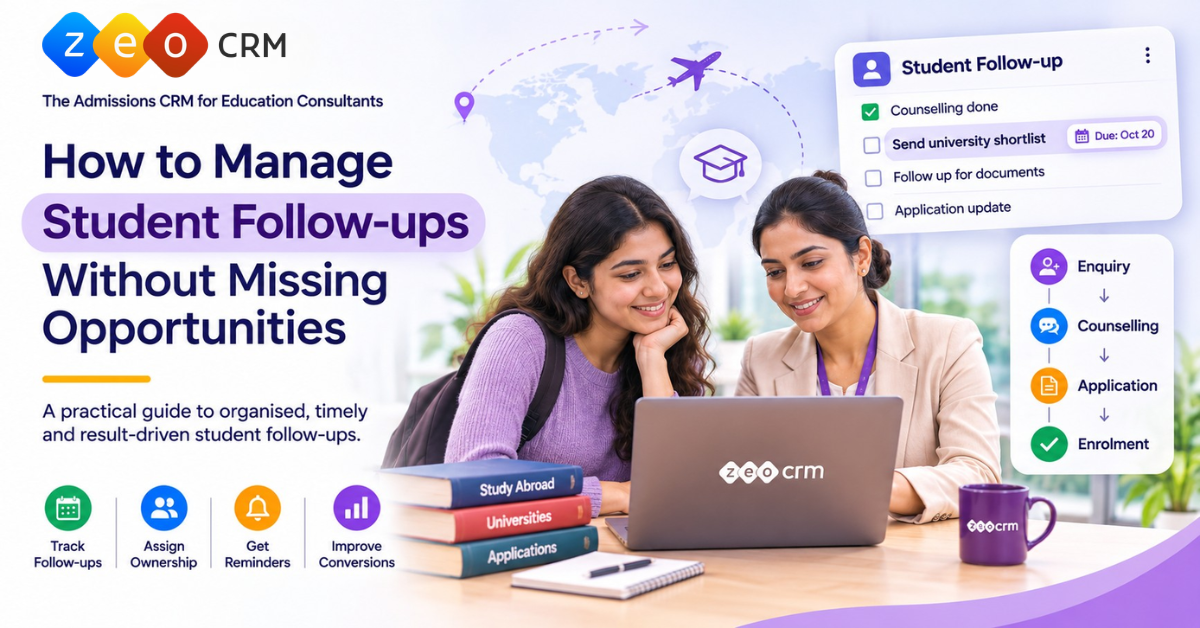
    Education counsellor and student reviewing study abroad options on a ZeoCRM laptop, with a student follow-up checklist and admissions pipeline beside them.

    Quick Answer: How Can Education Consultancies Manage Student Follow-ups Effectively?

    Record every enquiry, assign a responsible counsellor and prioritise students by their admissions stage. Give each student a clear next action and follow-up date. Keep a full communication history, use CRM reminders where they fit and review overdue tasks regularly. This cuts missed enquiries and keeps guidance timely and personal throughout the application journey.

    Introduction

    A student enquires about studying in Australia. They have a great first counselling call and the counsellor promises to send a shortlist of universities. Then the week gets busy, nobody writes down the next step and the conversation quietly stalls.

    Sound familiar? Good student follow up management isn’t about sending more messages. It’s about knowing exactly what happens after every conversation and who is responsible for it. This guide shows you how to build that system. For the bigger picture, see our guide to CRM for study abroad consultants.

    Why Student Follow-up Management Matters

    Student follow-up management is the process of organising, scheduling, tracking and reviewing every communication with a prospective student until they make a decision.

    It matters because students rarely decide after one call. They need guidance on courses, destinations, documents and deadlines, often over several weeks or months. Recruitment is a process that runs from first awareness all the way to enrolment, and every stage needs attention.

    A structured approach helps in a few ways:

    • Counsellors keep context and follow through on what they promised.
    • Missed callbacks and unclear responsibilities stop interrupting a student’s progress.
    • Managers can see which actions are still outstanding.

    Quality matters as much as frequency. One useful, well-timed message beats three generic check-ins.

    Common Reasons Education Consultancies Miss Student Follow-ups

    Before fixing the process, it helps to understand why follow-ups slip in the first place.

    1. Student Enquiries Are Scattered Across Channels

    Enquiries arrive through website forms, phone calls, emails, WhatsApp, social media and walk-ins. When these don’t feed into one shared record, it’s easy for a student to fall through the gaps. A proper student enquiry management system solves much of this.

    2. No Counsellor Is Clearly Responsible

    When a lead isn’t assigned, everyone assumes someone else is handling it. The result is either silence or two counsellors calling the same student.

    3. Teams Rely on Spreadsheets or Memory

    Manual notes and separate calendars make follow-up dates hard to keep track of. One forgotten row in a spreadsheet can mean a lost student.

    4. Every Student Receives the Same Follow-up

    A brand-new enquiry, a student preparing an application and someone looking at next year’s intake all need different things. A one-size-fits-all approach misses the mark for most of them.

    5. Overdue or Inactive Leads Are Not Reviewed

    If nobody owns the job of checking missed tasks, they simply stay missed. This is a big reason student leads go cold.

    6. Communication History Is Incomplete

    Without a full record, counsellors repeat questions, lose context or forget earlier commitments. Students notice, and it erodes trust. Read more on how to reduce student lead leakage.

    How to Build an Effective Student Follow-up Process

    Here is a seven-step student follow-up workflow you can put into practice straight away.

    Step 1. Capture and Assign Every Student Enquiry

    Every relevant enquiry should be recorded with the key details and assigned to a responsible counsellor. At a minimum, capture:

    • Student name and contact information
    • Lead source
    • Preferred destination and course interest
    • Intended intake
    • Assigned counsellor
    • Current status

    Whether this happens automatically depends on how your systems and integrations are set up. Example: A student asking about a master’s programme in Australia goes straight to the counsellor who handles that destination. Learn more about assigning student leads to counsellors.

    Step 2. Prioritise Students by Intent and Application Stage

    Keep enquiry status and application status separate so you can see where each student really stands. Useful stages include:

    • New enquiry
    • Counselling scheduled
    • Course shortlisting
    • Documents pending
    • Application preparation
    • Application submitted

    Students with approaching deadlines or agreed next actions often need attention first. Just don’t forget those planning for a later intake. Our student counselling workflow explains these stages in more detail.

    Step 3. Set Clear Follow-up Dates and Responsibilities

    This is the rule that holds everything together:

    Every active student enquiry should have an owner, a specific next action and an appropriate follow-up date.

    Here is what a simple follow-up task might look like:

    Field Example (illustrative)
    Student Student A
    Current stage Post-counselling
    Assigned to Destination counsellor
    Next action Send shortlisted university options
    Due date Agreed callback date
    Priority Based on intake deadline and student needs

    If a task becomes overdue, reschedule it with a reason. If a counsellor leaves or changes roles, reassign their open tasks so nothing is orphaned. Student follow up reminders and CRM follow up reminders make this much easier to manage.

    Step 4. Track Every Conversation in One Place

    Record counselling notes, questions asked, documents requested, contact attempts and agreed actions in a single shared record. This kind of student communication tracking means anyone on the team can pick up the conversation if a counsellor is away or a student switches advisers.

    A quick note on privacy: store only what’s relevant, use proper access controls and always respect student confidentiality.

    Step 5. Automate Routine Reminders and Tasks

    Student follow up automation works best for repetitive admin. There are two types to consider:

    • Internal automation: Creating tasks, sending due-date reminders, notifying counsellors and updating workflows, where your system supports it.
    • Student-facing automation: Enquiry acknowledgements, appointment confirmations and appropriate reminders, where supported and permitted.

    Automated student follow-up should always use accurate context and respect each student’s consent and communication preferences. Personal counselling still needs a human touch. See our guide to CRM automations for education consultancies.

    Step 6. Escalate Overdue and Inactive Student Leads

    Managers should regularly review overdue tasks, unassigned enquiries and inactive records. A simple escalation process looks like this:

    1. Identify the missed action.
    2. Confirm who owns the record.
    3. Decide whether contacting the student is still appropriate.
    4. Reschedule or reassign the task.
    5. Record the outcome.

    If a student says they no longer want to hear from you, pause or close the record. Handling this well prevents missed admission opportunities without annoying anyone.

    Step 7. Review and Improve the Follow-up Process

    Do a quick daily check of urgent and overdue follow-ups. Then hold a regular management review covering counsellor workload, how leads are moving between stages and any recurring problems.

    Use what you find to make real changes, such as rebalancing assignments or tightening how notes are recorded.

    How Often Should You Follow Up with Prospective Students?

    There’s no universal schedule that works for every student. The right timing depends on their stage, deadlines and what you agreed together.

    Student stage Follow-up objective Timing consideration
    New enquiry Acknowledge and make contact Your team’s response standards and the student’s availability
    After counselling Share the agreed information The date you promised during counselling
    Course shortlisting Clarify preferences and choices The student’s decision timeline
    Documents pending Resolve outstanding requirements The application deadline
    Application preparation Confirm readiness and next steps The institution’s submission timeline
    Application submitted Share relevant updates Official updates and agreed check-ins
    Inactive enquiry Check whether plans have changed Previous responses and communication preferences

    Let the student’s circumstances, deadlines and consent guide you. For longer-term engagement ideas, read our student lead nurturing strategies.

    Student Follow-up Email and WhatsApp Message Examples

    Here are four short messages you can adapt. Swap in your own details and adjust the tone to suit your consultancy. If you message students on WhatsApp, follow the WhatsApp Business Messaging Policy.

    Example 1. First Follow-up After a New Enquiry

    Channel: Email or WhatsApp

    Hi [Student Name], thank you for enquiring about studying in [Destination]. We’d be happy to talk through your course preferences and study plans. Would you like to book a counselling session?

    Example 2. Follow-up After Student Counselling

    Channel: Email

    Hi [Student Name],

    Following our chat about [Course/Destination], the next step is [Agreed Action]. Please let us know if you have any questions or need more guidance.

    Best regards, [Counsellor Name]

    Example 3. Documents Pending

    Channel: WhatsApp

    Hi [Student Name], just following up on the [Document Name] needed for your application. Please let us know when it might be ready, or if you’d like help understanding the requirement.

    Example 4. Re-engaging an Inactive Student

    Channel: WhatsApp or email

    Hi [Student Name], we’re checking whether you’re still thinking about studying in [Destination]. If your plans have changed, that’s completely fine. Just let us know if you’d like more guidance or would prefer no further follow-ups.

    How CRM Software Helps Manage Student Follow-ups

    A well-configured student follow up CRM brings everything covered above into one place. It can support centralised student records, counsellor assignment, pipeline visibility, follow-up tasks, communication history and reporting.

    Instead of juggling spreadsheets, calendars and chat threads, your team works from a single view of every student and every open action. If you’re still weighing it up, see our comparison of CRM vs Excel for education consultants.

    How ZeoCRM Fits Into Student Follow-up Management

    ZeoCRM is a CRM designed for study abroad consultancies. It helps teams manage leads and pipelines, see counsellor activity, connect email, run marketing automation and build customised reports.

    Together these support the habits this guide recommends: clear ownership, recorded next actions and regular review. If you want better visibility across student enquiries and counsellor workflows, explore ZeoCRM for study abroad consultancy lead management.

    KPIs to Track Student Follow-up Performance

    Measuring your follow-up process shows you where it’s working and where it’s slipping. Track these key metrics:

    KPI How to measure it Why it matters
    First-response time Time from enquiry to first meaningful response Reveals response delays
    Follow-up completion rate Completed tasks ÷ tasks due in the period × 100 Shows consistency
    Overdue follow-up count Incomplete tasks past their due date Identifies backlog
    Unassigned lead count Active enquiries with no responsible counsellor Highlights ownership gaps
    Contact rate Enquiries with meaningful contact ÷ eligible enquiries × 100 Shows contact effectiveness
    Lead-stage progression Movement between stages over a period Spots stalled stages
    Enquiry-to-application conversion Enquiries reaching application ÷ enquiry cohort × 100 Measures overall progress

    Define your reporting period, cohort, exclusions and what counts as meaningful contact before you start. Remember that student enquiry to admission conversion depends on many factors, not follow-up activity alone. Our guide to admissions reports for consultancies goes deeper.

    Frequently Asked Questions About Student Follow-ups

    What is student follow-up management?

    It’s the process of organising, scheduling, tracking and reviewing communication with prospective students so no enquiry or promised action gets missed.

    How do education consultancies track student follow-ups?

    They assign each student a counsellor, record follow-up tasks with due dates, use clear pipeline stages and keep a full communication history in one system.

    How often should you follow up with prospective students?

    It depends on the student’s stage, deadlines, the dates you agreed and their communication preferences. There’s no fixed schedule that suits everyone.

    What is the best way to follow up after counselling?

    Refer back to what you discussed, share the information you promised and confirm the next step.

    Can student follow-up reminders be automated?

    Yes. Internal reminders and task creation are easy to automate. Messages to students can be automated too where your system supports it and the student has consented.

    How do you follow up with students who stop responding?

    Send a respectful, limited re-engagement message. Give them an easy way to say their plans have changed or that they’d prefer no more contact.

    Conclusion: Build a Follow-up Process That Keeps Every Student Visible

    Effective student follow-up management comes down to clear ownership, recorded next actions, relevant communication, timely reminders and regular review. Take an honest look at your current process. If you need more visibility across enquiries and counsellor workflows, explore what ZeoCRM can do for your consultancy.

  • Student Counseling Workflow Explained: From Inquiry to Enrollment

    Student Counseling Workflow Explained: From Inquiry to Enrollment

    Student Counseling Workflow Explained: From Inquiry to Enrollment

    A student counseling workflow is a structured sequence that generally moves from inquiry to consultation, profile assessment, recommendations, university shortlisting, eligibility review, application, follow-up and finally admission or enrollment. The exact stages can vary by agency, destination, institution and service model, but the underlying journey tends to follow this same general shape.

    A quick note before we go further: student counseling here refers to education and study abroad counseling, meaning the guidance process consultants provide around courses, universities and applications. It has nothing to do with mental health counseling.

    A study abroad journey usually involves a lot of decisions happening one after another, and the initial inquiry is really just the starting point. Counsellors need to understand a student’s academic profile, goals, budget and preferences before any meaningful recommendation can be made. From there, things move into course selection, university shortlisting, application and often continued support through admission. Having a structured workflow in place helps everyone involved understand what has already happened, what is still pending and what needs to happen next.

    What Is a Student Counseling Workflow?

    A student counseling workflow is a structured sequence of activities that an education or study abroad consultancy follows to manage a prospective student’s journey, from the initial inquiry through counseling, recommendations, application and admission or enrollment support.

    It typically includes stages such as:

    • Lead capture
    • Counsellor assignment
    • Initial consultation
    • Profile assessment
    • Goal identification
    • Course and destination recommendations
    • University shortlisting
    • Eligibility review
    • Application
    • Follow-up
    • Admission and enrollment support

    It’s worth being clear that this workflow is not just one counseling session. It is the broader operational journey that surrounds multiple counseling interactions, decisions, tasks and follow-ups over time, often spanning weeks or months.

    At its simplest, the workflow looks like this:

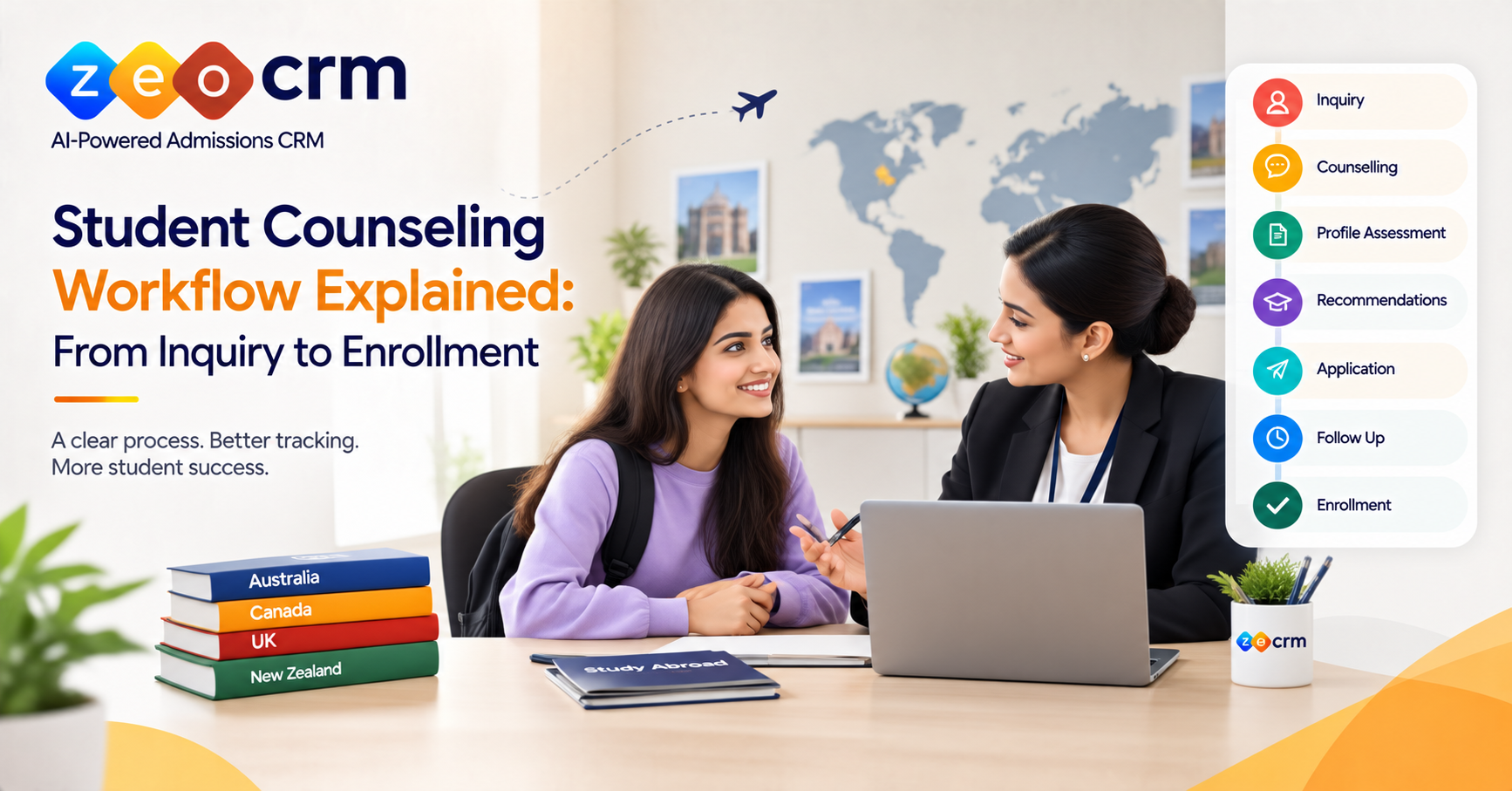
    Inquiry → Consultation → Profile Assessment → Recommendation → Shortlisting → Application → Follow-Up → Admission

    Is a Student Counseling Workflow the Same as a Counseling Session? Not quite. These two terms get used interchangeably sometimes, but they mean different things.

    TermMeaning
    Counseling sessionA specific interaction between a student and counsellor
    Counseling workflowThe broader sequence of activities surrounding the student’s recruitment and admissions journey

    A counseling session is one conversation. The workflow is everything that happens before, between and after those conversations, including all the tracking, follow-up and coordination that keeps the student moving forward.

    Why Is a Structured Student Counseling Workflow Important?

    Having a defined process brings a handful of real operational benefits, even if it doesn’t guarantee any particular outcome on its own.

    Creates Process Consistency: Different counsellors can follow the same general framework while still personalizing their actual recommendations to each student.

    Improves Student Information Management: Academic details, financial information, preferences and communication history can all be recorded systematically instead of living in someone’s head or personal notes.

    Reduces Missed Next Steps: Counsellors are better able to spot pending actions, whether that’s a document still needed, an application deadline coming up, a follow-up call, or a decision the student needs to make.

    Clarifies Ownership: Teams know exactly who is responsible for a student’s next action, rather than assuming someone else has it covered.

    Improves Progress Visibility: Managers can actually see where students stand within the recruitment and application journey instead of guessing.

    Supports a Better Student Experience: When the process is properly documented, students are less likely to repeat the same information multiple times or feel unsure about what comes next.

    It’s worth being careful here though. A structured workflow does not guarantee higher enrollment numbers. It simply makes the operational side of counseling more consistent and manageable.

    What Are the Steps in a Student Counseling Workflow?

    The following represents a generalized study abroad counseling workflow. Agencies may combine stages, reorder them, or add their own steps depending on their destination mix, institution relationships and internal processes. Think of this as a model to adapt rather than a rigid template.

    1. Capture the Student Inquiry: Enquiries can come in through website forms, phone calls, WhatsApp, social media, referrals, walk-ins, events, paid campaigns or email. At this stage, basic information gets recorded, such as the student’s name, contact details, intended destination, course interest, intake and lead source. The goal here is simple: turn a loose enquiry into an identifiable student record.

    2. Assign the Student to a Counsellor: Once captured, the student needs a responsible counsellor assigned to them, ideally one with relevant destination or course expertise where that applies. This ownership gets recorded clearly, so multiple people don’t end up assuming someone else is handling the student.

    3. Schedule the Initial Consultation: This involves contacting the student, scheduling a session, recording the appointment details, and preparing any relevant information beforehand. It also helps to define what happens if the student doesn’t show up. Not every consultancy works through formal appointments though. Walk-in consultations or immediate conversations can follow a somewhat different process.

    4. Assess the Student Profile: This is where the counsellor starts building a real picture of who the student is. Relevant information includes academic qualifications, grades, previous education, work experience, English-language proficiency, budget, career interests, preferred countries, intended intake and any relevant personal circumstances. The objective is to gather enough context to make recommendations that actually fit the student.

    5. Understand Goals and Preferences: Beyond the basic profile, counsellors need to identify career goals, course interests, destination preferences, budget expectations, intake timing, location preferences, institution preferences and longer-term objectives. Good recommendations connect the student’s profile, goals and constraints together, rather than starting the conversation with something as narrow as “which country do you want to go to?”

    6. Recommend Courses and Destinations: This step connects everything gathered so far: profile, goals, eligibility and budget all feed into suitable course and destination options. The counsellor might discuss relevant academic fields, destination choices, program types, alternative pathways and practical constraints the student should be aware of.

    7. Shortlist Universities: With a direction set, specific universities get shortlisted based on entry requirements, program fit, location, budget, course structure, intake timing and the student’s own preferences. This shortlist, along with the reasoning behind it, gets recorded for reference going forward.

    8. Check Eligibility and Requirements: Depending on the destination and program, this can involve academic requirements, English-language requirements, course prerequisites, documentation, financial considerations and institution-specific criteria. It’s important to note that exact requirements vary significantly by institution and destination, so these should always be checked against current, authoritative sources rather than assumed.

    9. Plan and Submit the Application: This stage moves things from a counseling decision into an actual application plan. It covers required documents, application deadlines, specific tasks, who is responsible for each one, document collection, submission and tracking the application’s status.

    10. Follow Up and Track Progress: Follow-up isn’t a single activity that happens once after counseling. It continues throughout the student’s entire journey. This includes counseling notes, communication history, pending documents, application status, student decisions, next actions and follow-up dates, all tracked consistently over time.

    11. Support Admission and Enrollment: Depending on the consultancy’s specific service model, support can extend into the offer stage, additional documentation, visa preparation, enrollment and pre-departure guidance. Not every consultancy handles every one of these later stages, since service models vary quite a bit across the industry.

    Student Counseling Workflow at a Glance

    Here’s the complete journey laid out as a simple sequence:

    Student Inquiry
           ↓
    Initial Consultation
           ↓
    Profile Assessment
           ↓
    Goals & Preferences
           ↓
    Course / Destination Recommendation
           ↓
    University Shortlisting
           ↓
    Eligibility Check
           ↓
    Application
           ↓
    Follow-Up & Progress Tracking
           ↓
    Admission / Enrollment
    

    This is a generalized study abroad counseling workflow. Exact stages may vary by consultancy, destination, institution and student.

    What Does a Student Counseling Workflow Look Like in Practice?

    It helps to see this as a real, if simplified, example.

    A student reaches out with an inquiry, sharing their academic background, intended course, budget and preferred destination. During counseling, the counsellor works through the student’s goals, constraints and relevant eligibility considerations. From there, suitable courses and destination options get discussed, followed by shortlisting a handful of potential universities. Once that’s settled, required documents and application actions get identified and planned out. The counsellor then tracks pending actions and application progress over the following weeks. Eventually, the student receives further support through admission, according to whatever the consultancy’s service model covers.

    This example is meant to illustrate how the stages connect in practice, not to suggest any particular university, score or outcome, since those details depend entirely on the individual student’s situation.

    Common Problems in Student Counseling Workflows

    Even with a reasonably good process in place, a few recurring issues tend to show up.

    Incomplete Student Information: Missing academic, budget, preference or contact information makes later counseling and follow-up noticeably harder.

    Inconsistent Counseling Notes: Important details sometimes stay stuck in individual counsellors’ personal notes, emails or memory, rather than being accessible to the wider team.

    Missed Follow-Ups: A student might need another consultation, a document reminder, an application update, or help with a decision. Without a tracked next action, these things slip through easily.

    Unclear Ownership: When more than one counsellor or team interacts with the same student, it becomes genuinely important to know who is responsible for what.

    Scattered Communication: Information can end up spread across email, WhatsApp, phone calls, spreadsheets and personal notes. The real issue usually isn’t the channel itself. It’s whether that information stays accessible and connected to the student’s actual record.

    Duplicate Student Records: When the same student ends up with multiple records, histories get fragmented and information becomes inconsistent across them.

    Difficulty Tracking Application Progress: A workflow can quietly fall apart if counsellors can’t see what happened after a recommendation or application was submitted.

    How Can a CRM Improve the Student Counseling Workflow?

    A CRM can support a student counseling workflow by centralizing student information, assigning ownership, tracking pipeline stages, recording activity, creating follow-up tasks, integrating communication and providing reporting.

    That said, installing CRM software doesn’t automatically create an effective workflow on its own. The actual outcome depends on process design, proper configuration, data quality, staff adoption and consistent day-to-day usage. A CRM is a tool that supports the workflow, not a replacement for having a thought-out process in the first place.

    Counseling Workflow ChallengeCRM CapabilityPotential Workflow Benefit
    Student information is scatteredCentralized student profileEasier access to student history
    Ownership is unclearLead managementClearer responsibility
    Follow-ups are missedTasks and remindersMore consistent next actions
    Student stages are unclearPipeline managementBetter progress visibility
    Communication is fragmentedEmail integrationMore connected communication records
    Managers lack visibilityReportsEasier workflow monitoring
    Repetitive communicationMarketing automationMore consistent outreach
    University-related processes are disconnectedUniversity integrationBetter coordination where applicable

    How ZeoCRM Supports the Student Counseling Workflow

    ZeoCRM is an admissions-focused CRM built around education and study abroad workflows. Here’s where its capabilities map onto the process described above.

    Centralized activity and lead visibility brings together student information, customer activities and the lead or sales pipeline, so counsellors and managers aren’t piecing together a student’s history from scattered sources.

    Lead and pipeline management supports tracking students from inquiry through the later admissions stages, giving teams a clearer view of where each student actually stands. This supports visibility into the process, though it’s not a claim that pipeline tracking alone improves enrollment outcomes.

    Email integration connects email communication directly into the broader counseling workflow, keeping conversations tied to the student’s record.

    Marketing automation supports more structured ongoing communication and nurturing where that’s appropriate for a given student.

    Customized reports and real-time insights help with pipeline visibility, operational monitoring, tracking student progress and reviewing counseling activity overall.

    University integration supports coordination around university-related workflows where applicable.

    It’s worth being upfront here. ZeoCRM does not guarantee higher enrollment, faster counseling, or improved conversion rates, and it doesn’t automate away the need for a human counsellor. What it does is give a consultancy the tools to organize, track and manage the counseling workflow more consistently.

    Student Counseling Workflow Checklist

    • Capture the student enquiry
    • Record lead source
    • Create or update the student profile
    • Assign a counsellor
    • Schedule or conduct the consultation
    • Record academic information
    • Understand goals and preferences
    • Assess relevant eligibility
    • Recommend courses and destinations
    • Shortlist universities
    • Record counseling notes
    • Identify required documents
    • Track application progress
    • Schedule follow-ups
    • Update student status
    • Record the next action
    • Track admission and enrollment progress where applicable

    Frequently Asked Questions About Student Counseling Workflows

    What is a student counseling workflow?
    It’s the structured sequence an education or study abroad consultancy follows to manage a student’s journey, from initial inquiry through counseling, recommendations, application and eventual admission or enrollment.

    What are the steps in student counselling?
    Generally: inquiry capture, counsellor assignment, consultation, profile assessment, goal identification, recommendations, shortlisting, eligibility review, application, follow-up and admission support.

    What is the student counselling process for studying abroad?
    It follows the same general sequence, starting with an inquiry and moving through profile assessment, course and destination recommendations, university shortlisting, application and follow-up.

    What happens during a study abroad counselling session?
    A counsellor typically discusses the student’s academic background, goals, budget and preferences, then works toward suitable course and destination recommendations based on that information.

    What information should a student counsellor collect?
    Academic qualifications, grades, work experience, English-language proficiency, budget, career interests, preferred destinations, intended intake and relevant personal circumstances.

    Why is a structured student counselling workflow important?
    It creates consistency across counsellors, improves information management, reduces missed follow-ups, clarifies ownership and gives managers better visibility into student progress.

    How does a CRM improve student counselling?
    By centralizing student information, clarifying ownership, tracking pipeline stages, automating follow-up reminders, and providing reporting on where students stand in the process.

    What is a student counselling CRM?
    It’s a CRM built around managing student enquiries, counseling activity, application tracking and communication specifically for education or study abroad consultancies.

    How do education consultants track student counselling?
    Many use a CRM or structured system to record profile details, counseling notes, pipeline stage, follow-up dates and application status for each student.

    How can counsellors manage student follow-ups?
    By tracking pending actions, follow-up dates and communication history consistently, ideally within a shared system rather than relying on individual memory.

    What should be included in a student counselling workflow?
    Inquiry capture, counsellor assignment, consultation, profile assessment, recommendations, shortlisting, eligibility review, application, follow-up and admission support.

    Does every study abroad consultancy follow the same counselling process?
    No. While the general stages are similar, the exact sequence, depth and scope vary by consultancy, destination, institution and service model.


    Last reviewed: September 2026

  • How to Reduce Lead Leakage in Study Abroad Agencies

    How to Reduce Lead Leakage in Study Abroad Agencies

    How to Reduce Lead Leakage in Study Abroad Agencies

    Quick Answer

    Lead leakage happens when student inquiries are lost because they are not captured, assigned, contacted, followed up, nurtured or tracked properly. Study abroad agencies can reduce leakage by centralizing inquiries, assigning clear ownership, setting response time standards, automating follow-up reminders, tracking pipeline stages, monitoring inactive leads and reviewing where prospects drop off.

    What Is Lead Leakage?

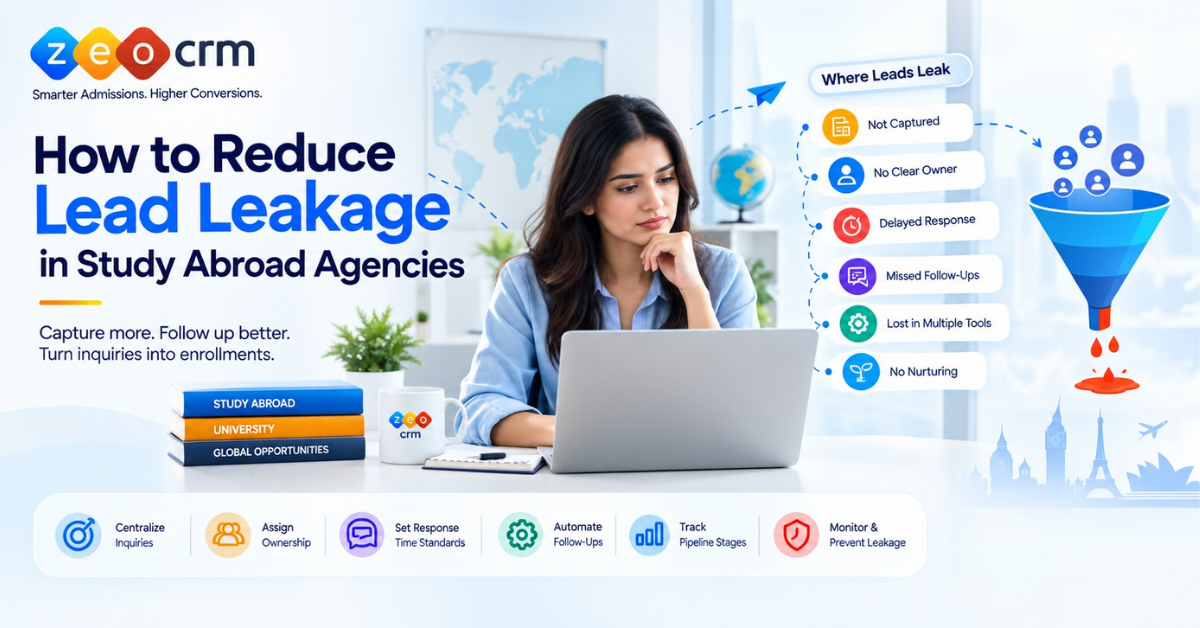
    Lead leakage occurs when a potential student enters an agency’s inquiry pipeline but is subsequently lost because a process gap prevents the lead from progressing. A useful way to picture this is a chain: captured, assigned, contacted, followed up, nurtured, progressed, enrolled. A lead can leak whenever one of those links breaks.

    This is different from non-conversion, and the distinction matters. Non-conversion is when a student was properly handled but ultimately chose not to proceed. Lead leakage is when the agency loses visibility, ownership, contact or follow-up before the student ever reaches a clear outcome. Not every lost inquiry represents preventable leakage, but a surprising number do.

    This matters more in study abroad than in most other industries because the relationship can stretch across months rather than ending after one call. Destination selection, course research, university comparison, intake planning, academic requirements, parent involvement, financial planning, applications, offers and visa processing all stretch the timeline out, and every one of those stages is another place for a lead to quietly disappear.

    Where Does Lead Leakage Occur in the Student Recruitment Journey?

    The full journey generally runs: inquiry, capture, assignment, first contact, qualification, counselling, university and course shortlisting, application, offer, visa, enrollment. Leakage can happen at virtually any transition along the way.

    Recruitment StagePotential Leakage
    InquiryInquiry never captured
    AssignmentNo clear owner
    First contactResponse delayed
    QualificationLead not prioritized correctly
    CounsellingFollow-up missed
    ShortlistingStudent becomes inactive
    ApplicationApplication stalls
    OfferAcceptance follow-up missed
    VisaCommunication gap
    EnrollmentFinal status not tracked

    This table is not meant to suggest every drop-off is leakage. It is a map of the points worth actively monitoring.

    Why Do Study Abroad Agencies Lose Leads?

    Lead leakage is a process problem with several possible causes, not something you can blame on counsellors or lead quality alone.

    Slow Response Times

    A new inquiry that sits untouched for even a day gives the student time to contact another consultancy, and inquiries arriving outside working hours are especially vulnerable. Agencies should set an internal response time standard and actually measure how quickly leads get contacted rather than assuming it happens fast.

    Missed Follow-Ups

    Follow-up commitments that live in someone’s memory rather than a system tend to disappear during busy intake periods. A counsellor might contact a student once and never create a defined next action, and from that point the lead has effectively gone quiet without anyone noticing.

    Poor Lead Assignment

    Leads that remain unassigned, or that multiple counsellors assume someone else is handling, fall through the cracks easily. Manual assignment introduces inconsistency, and routing can instead consider destination, specialization, workload, branch or whatever rules fit the agency’s actual operating model. See our guide on lead assignment and distribution strategies for more.

    Leads Tracked Across Multiple Tools

    Information scattered across spreadsheets, email, WhatsApp, phone calls, website forms, ad platforms and personal notes makes it hard to answer simple questions like who owns this lead, when they were last contacted, or what stage they are at. Fragmented tracking is one of the most consistent culprits behind lost student leads.

    Lack of Lead Nurturing

    Students are frequently not ready to apply the moment they inquire. They might still be researching destinations, waiting on a parent’s decision, waiting for the next intake, preparing for an English test or working out financing. Not ready now does not mean lost, but the lead needs ongoing, relevant contact rather than being written off after one unanswered message. Our guide on lead nurturing for student recruitment covers this in more depth.

    No Visibility Into the Pipeline

    Managers need to see new inquiries, uncontacted leads, leads awaiting follow-up, inactive leads, counselling stage leads, stalled applications, offer stage leads and visa stage leads at a glance. Without that visibility, leakage happens quietly and nobody notices until enrollment numbers come in lower than expected.

    How to Reduce Lead Leakage in Study Abroad Agencies

    Lead leakage is best addressed as a process problem. Agencies need a system that makes capture, ownership, follow-up, progression and review visible rather than relying on memory and good intentions.

    1. Capture Every Student Inquiry

    Website forms, landing pages, phone calls, WhatsApp, social campaigns, paid ads, referrals, walk-ins and email can all generate inquiries. The goal is not necessarily connecting every channel automatically, but making sure every legitimate inquiry enters the agency’s defined lead management process rather than sitting in someone’s personal inbox.

    2. Centralize Lead Information

    A shared record should hold the student’s name, contact details, destination, course interest, preferred intake, academic background, lead source, owner, current stage, last interaction, next follow-up and relevant notes. When this lives in one place instead of five, information gaps close on their own.

    3. Assign Leads Automatically or Systematically

    Routing can follow round robin, destination expertise, counsellor specialization, workload, geography, lead source or lead score, and the right logic depends on how your agency actually operates. See our guide on lead assignment and distribution strategies for a full breakdown.

    4. Set Response Time Standards

    Define an expected response window, then measure actual first response time against it. Identify untouched inquiries and set escalation rules for anything that slips past the deadline, accounting for business hours and the channel the inquiry came through.

    5. Automate Follow-Up Reminders

    Scheduled follow-ups, pending task alerts, overdue reminders and appropriate automated communications reduce how much depends on any one person’s memory. Automation should close administrative gaps, not replace actual human counselling conversations.

    6. Track Every Lead Stage

    A typical pipeline runs new, contacted, qualified, counselling, university shortlisting, application, offer, visa, enrolled, though the exact stages vary by agency. The point is making progression, and stagnation, visible to everyone who needs to see it.

    7. Nurture Leads That Aren’t Ready

    Students researching destinations, waiting for an intake, comparing universities, discussing options with parents, waiting on finances or preparing academically all need nurture communication relevant to where they actually are, not a generic monthly newsletter.

    8. Monitor Inactive Leads

    Watch for no recent activity, overdue follow-up, no next action defined, or a lead stuck at one stage for an unusually long time. Inactive does not automatically mean lost, but it deserves a second look.

    9. Track Counsellor Activity

    Leads assigned, leads contacted, follow-ups completed, overdue activities, counselling sessions held and applications initiated or progressed give managers real operational visibility. This is about accountability in the process, not surveillance of individual counsellors.

    10. Analyze Where Leads Drop Off

    Use the framework: lead volume, stage progression, drop-off, root cause, corrective action. Look at stage level drop-off, source level performance, counsellor workload, follow-up gaps and destination or course specific patterns to find where the real problems hide.

    How to Identify Lead Leakage in Your Study Abroad Agency

    A simple audit reveals a lot. Ask your team: are all inquiries captured, does every inquiry have an owner, how long does first response actually take, are follow-ups scheduled rather than just remembered, are overdue follow-ups visible to anyone, is complete lead history available in one place, can managers identify inactive leads easily, are pipeline stages clearly defined, can lead sources be compared against each other, and can the agency identify exactly where drop-off happens by stage?

    The audit maps to the same cycle: capture, assign, contact, follow up, nurture, track, analyze.

    How to Measure Lead Leakage

    MetricWhat It Helps Identify
    Inquiry capture rateWhether inquiries are entering the process at all
    First response timeSpeed of initial engagement
    Contact rateWhether new inquiries are actually being reached
    Follow-up completion rateWhether planned actions happen
    Overdue follow-up ratePotential process gaps
    Lead inactivity rateStalled engagement
    Lead to counselling rateProgression into actual counselling
    Counselling to application rateProgression after counselling
    Application to enrollment rateLater stage drop-off
    Lead to enrollment rateOverall journey outcome

    There is no universal benchmark percentage worth quoting here. Establish your own baseline first, then track whether it improves over time.

    How a CRM Helps Reduce Lead Leakage

    A CRM addresses several of these mechanisms directly: centralized lead capture creates one common location for inquiries, lead ownership makes responsibility visible instead of assumed, follow-up management surfaces upcoming and overdue actions, pipeline management shows where every lead actually sits, interaction history gives context for the next conversation, lead nurturing supports the longer decision cycles typical of study abroad, inactive lead identification makes stalled records easy to find, and reporting reveals patterns by source, counsellor or stage.

    It is worth being honest here: a CRM can reduce process related lead leakage, but it does not automatically eliminate leakage. Results depend on implementation, data quality, workflow design and whether the team actually adopts it consistently.

    Is Lead Leakage the Same as Poor Lead Quality?

    Not quite, and mixing the two up leads to the wrong fix.

    Lead Quality ProblemLead Leakage Problem
    Inquiry may not be a suitable prospectPotentially viable inquiry is lost in the process
    Problem begins with fit or intentProblem begins with process execution
    May be correctly handled but not convertMay never receive proper follow-up at all
    Requires better qualification or targetingRequires better capture, ownership, follow-up or tracking

    Agencies should not automatically blame lead quality when the real issue is lead management execution.

    How ZeoCRM Helps Study Abroad Agencies Reduce Lead Leakage

    ZeoCRM includes lead management, inquiry management, a bird’s eye view of customer activity and sales pipelines, real time insights, customized reports, marketing automation, email integration, university integration and agent commission management, all built around the same inquiry through enrollment workflow.

    Lead Leakage ProblemZeoCRM Capability
    Poor visibilityBird’s eye view of activities, leads and pipelines
    Lead tracking gapsManage leads and manage inquiries
    Lack of pipeline visibilitySales pipeline visibility
    Reporting gapsCustomized reports
    Communication fragmentationEmail integration
    Marketing follow-upMarketing automation
    University workflow gapsUniversity integration
    Team and agent managementAgent commission management


    None of this guarantees a specific reduction in leakage or a particular conversion improvement. What it does is give your agency the structure to see where leads actually stand, so the leakage that is happening becomes visible instead of invisible. If your team is curious how this fits your current process, it is worth exploring how a structured CRM workflow could sit on top of what you already do.

    Common Mistakes That Cause Lead Leakage

    Relying entirely on spreadsheets, leaving ownership unclear, contacting leads without recording the activity, treating one missed follow-up as the end of the road, using unclear pipeline stages, ignoring inactive leads, not tracking lead sources, failing to analyze drop-off, over-automating communication until it feels robotic, and having a CRM in place but never enforcing consistent use of it are the recurring culprits.

    A Practical Example of Lead Leakage in a Study Abroad Agency

    Without a structured process: an ad generates an inquiry, it lands in a spreadsheet, nobody claims clear ownership, the response gets delayed, the follow-up gets missed, and the lead quietly goes inactive.

    With a structured process: the same ad generates an inquiry, it gets captured properly, a lead gets assigned, a response task is created, counselling happens, follow-up continues, nurturing keeps the relationship warm, and the lead moves into application and eventually enrollment.

    The structured workflow does not guarantee enrollment. Its purpose is to make ownership, follow-up, progression and potential leakage visible, so someone can actually act on it.

    Frequently Asked Questions

    What is lead leakage?
    It is the loss of a potential student from an agency’s pipeline due to a process gap, such as missed follow-up or unclear ownership, rather than a genuine decision not to proceed.

    What causes lead leakage?
    Slow response times, missed follow-ups, poor lead assignment, fragmented tracking tools, weak nurturing and poor pipeline visibility are the most common causes.

    How do you reduce lead leakage?
    Capture every inquiry, centralize lead data, assign ownership clearly, set response time standards, automate follow-up reminders, track pipeline stages, nurture leads that aren’t ready yet, and regularly analyze where drop-off happens.

    How can a CRM reduce lead leakage?
    A CRM centralizes inquiries, assigns clear ownership, surfaces overdue follow-ups, tracks pipeline stages and reports on patterns by source or counsellor, though results still depend on consistent adoption.

    What is the difference between lead leakage and poor lead quality?
    Lead quality is about whether the inquiry was ever a good fit, while lead leakage is about a viable inquiry being lost due to a process failure.

  • Lead Nurturing for Student Recruitment

    Lead Nurturing for Student Recruitment

    Lead Nurturing for Student Recruitment

    ZeoCRM lead nurturing journey from inquiry to enrollment for a student, with a student profile list showing counseling, follow-up, in-progress, and applied stages

    Quick Answer

    Student lead nurturing is the process of staying in consistent, relevant contact with a prospective student from their first inquiry until they are ready to apply and enroll. It involves regular follow-ups, personalized communication based on the student’s destination and course interest, and timely re-engagement when a lead goes quiet, so fewer students are lost simply because nobody kept in touch.

    Introduction

    Most student inquiries do not convert on the first call. A student might reach out about studying in Canada, go quiet for three weeks while they think it over, then come back ready to move forward, if someone actually stayed in touch during that gap. Lead nurturing is what fills that gap.

    At ZeoCRM we see consultancies lose genuinely interested students all the time, not because the counseling was bad, but because nobody followed up consistently enough to stay top of mind. This guide covers what student lead nurturing actually looks like, the strategies that work, and how a CRM can make the whole process a lot less dependent on memory.

    TL;DR

    • Student lead nurturing means staying in relevant contact from inquiry through enrollment, not just during the first call
    • The nurturing journey follows a clear path: inquiry, qualification, counseling, shortlisting, application, offer and visa, and enrollment
    • Eight practical strategies, from segmentation to multi-channel outreach, keep leads warm without overwhelming them
    • A CRM automates reminders and personalization so nurturing does not depend entirely on a counselor’s memory
    • Cold leads are often recoverable with the right re-engagement approach rather than being written off entirely

    What Is Lead Nurturing in Student Recruitment?

    Student lead nurturing is the ongoing process of building a relationship with a prospective student through relevant communication, useful information and consistent follow-up, from their first inquiry until they are ready to apply.

    This is different from a single follow-up call. Lead nurturing in education is a sustained effort, since most students take weeks or months to decide on a destination, course and timeline, and they need touchpoints along the way that actually match where they are in that decision. Student recruitment lead nurturing done well feels less like being chased and more like being genuinely supported through a long, sometimes confusing process.

    Why Lead Nurturing Matters for Student Recruitment

    Student recruitment is a long game. A student rarely decides on a country, university and course in one conversation, and the consultancies that stay engaged throughout that decision window are the ones who end up with the enrollment when the student is finally ready.

    Education lead nurturing matters because most inquiries are not lost due to a bad first impression. They are lost to silence. A student who does not hear from anyone for a month naturally starts looking elsewhere, even if their first conversation went well.

    The lead nurturing benefits tend to show up in a few consistent ways: higher counseling conversion since students remember who actually stayed in touch, fewer leads going completely cold, better use of counselor time since nurturing can be partly automated, and a stronger student experience overall, since consistent communication builds trust during what is often a stressful decision.

    The Student Lead Nurturing Journey

    Nurturing looks different at each stage of a student’s journey, and matching your communication to the right stage matters more than the volume of messages you send.

    New Inquiry:
    The first days matter most here. A quick, warm response that acknowledges the inquiry and sets expectations for next steps does more to build trust than any amount of follow-up later can undo.

    Lead Qualification:
    Once basic details are gathered, communication should start narrowing toward the student’s actual situation, destination interest, academic background and timeline, rather than staying generic.

    Counseling:
    This is where nurturing becomes most personal, with communication built around the student’s specific goals, preferred countries and course options, ideally reinforced with helpful information between actual counseling sessions.

    University and Course Shortlisting:
    As options narrow, nurturing shifts toward sharing relevant details about the shortlisted universities and courses, keeping the student engaged with concrete choices rather than abstract possibilities.

    Application:
    Nurturing here looks more practical: reminders about documents, deadlines and next steps, since momentum can stall easily if a student feels lost in the paperwork.

    Offer and Visa Stage:
    Communication should stay steady through this stage, since the wait for an offer or visa decision is often the most anxious part of the journey for a student and their family.

    Enrollment:
    Even after enrollment, a bit of continued contact around pre-departure details and settling in helps close the loop well and can lead to referrals down the line.

    8 Lead Nurturing Strategies for Student Recruitment

    1. Segment Leads by Destination and Course

    Grouping students by their country and course interest lets you send communication that actually feels relevant, rather than generic updates that could apply to anyone.

    2. Personalize Every Follow-Up

    A message referencing a student’s specific goals, previous conversation or shortlisted universities lands very differently than a copy-paste template, even when the underlying content is similar.

    3. Use a Multi-Channel Approach

    Email, WhatsApp and phone calls each suit different moments. A quick WhatsApp nudge might work better for a deadline reminder, while a call suits a more substantial counseling update.

    4. Share Useful Content, Not Just Sales Messages

    Information about visa processes, scholarship opportunities or what life is actually like in a particular city keeps a student engaged even when they are not ready to move forward yet.

    5. Set a Consistent Follow-Up Cadence

    A defined rhythm, whether that is every few days early on or less frequently as the relationship matures, keeps leads warm without tipping into being annoying.

    6. Time Communication Around Key Decision Points

    Intake deadlines, application windows and scholarship cutoffs are natural moments to reach out with a relevant nudge rather than a generic check-in.

    7. Involve the Right Counselor at the Right Time

    A student’s country or course preference should route their nurturing communication to a counselor who actually knows that destination well, not whoever happens to be free.

    8. Track Engagement and Adjust

    Watching which messages actually get opened, clicked or replied to tells you what is working and what to change, rather than running the same nurturing sequence forever on autopilot.

    How a CRM Automates Student Lead Nurturing

    CRM lead nurturing takes the manual guesswork out of staying in touch. Instead of a counselor trying to remember who needs a follow-up today, the system tracks it automatically and prompts the right action at the right time.

    Automated lead nurturing through an education CRM typically includes scheduled follow-up reminders, templated but personalized messaging, automatic segmentation by destination or course, and a full communication history so any counselor can pick up a conversation with proper context. A student recruitment CRM connects this nurturing directly to the pipeline, so a lead moving from counseling to shortlisting automatically shifts into the next stage’s communication pattern rather than staying stuck on outdated messaging.

    None of this replaces the human side of counseling. It just makes sure nothing falls through the cracks while a counselor focuses on the conversations that actually need a person.

    How to Re-Engage Cold Student Leads

    Cold lead nurturing is worth taking seriously, since a lead that has gone quiet is not necessarily a lost one. Life gets busy, priorities shift, and a student who stopped responding three months ago might just need a reason to pick the conversation back up.

    Student lead reactivation tends to work best with a fresh angle rather than a repeat of the same old message. A new intake opening up, a scholarship deadline, or simply checking in with something genuinely useful can restart the conversation. Lead re-engagement campaigns that segment cold leads by how long they have been inactive, and by their original destination interest, tend to perform better than a single generic “just checking in” blast sent to everyone at once.

    How to Measure Student Lead Nurturing

    Nurturing efforts are only useful if you can tell whether they are actually working, and a few core lead nurturing KPIs make that visible.

    Metric What It Shows
    Response rate to nurturing messages Whether your outreach is actually landing
    Time to re-engagement How quickly a cold lead responds once contacted again
    Counseling conversion rate Movement from inquiry to an actual counseling session
    Application conversion rate Movement from counseling to a submitted application
    Nurturing to enrollment rate The full journey from ongoing nurturing to a final enrollment
    Cold lead reactivation rate How many previously inactive leads come back into the pipeline

    These student recruitment metrics and broader lead nurturing metrics work best when reviewed regularly rather than checked once and forgotten, since patterns in what works tend to shift as intakes and destinations change throughout the year.

    Conclusion

    Lead nurturing is really just consistent, relevant follow-up done well over the length of a student’s decision journey. Most lost students were not lost to a bad conversation. They were lost to silence somewhere between the first inquiry and the moment they were finally ready to move forward.

    At ZeoCRM we built our platform to make that consistency easier, connecting segmentation, automated follow-ups and full communication history directly into your recruitment pipeline so nurturing does not depend entirely on any one counselor’s memory. If your team is losing good leads simply because nobody stayed in touch, it might be worth seeing how a proper nurturing workflow could change that.

    Frequently Asked Questions

    What is lead nurturing in student recruitment?
    It is the ongoing process of staying in relevant contact with a prospective student from their first inquiry through enrollment, rather than a single follow-up.

    Why does lead nurturing matter for education consultancies?
    Because most students take weeks or months to decide, and consultancies that stay engaged throughout that period are the ones who end up with the enrollment.

    What are some effective lead nurturing strategies?
    Segmenting leads by destination, personalizing follow-ups, using multiple communication channels, and timing outreach around key deadlines all tend to work well.

    Can a CRM automate student lead nurturing?
    Yes, a CRM can schedule follow-ups, personalize messaging by segment, and track communication history so nurturing continues consistently across the team.

    How do you re-engage a cold student lead?
    A fresh angle, such as a new intake opening or a relevant update, tends to work better than repeating the same generic check-in message.

    What metrics should be tracked for lead nurturing?
    Response rate, time to re-engagement, counseling and application conversion rates, and cold lead reactivation rate are all worth monitoring regularly.

  • Lead Assignment & Distribution Strategies for Study Abroad Consultants

    Lead Assignment & Distribution Strategies for Study Abroad Consultants

    Lead Assignment & Distribution Strategies for Study Abroad Consultants

    Quick Answer

    Lead assignment is the process of allocating a new lead to a specific counselor who becomes responsible for following up with that inquiry. For study abroad consultants, assignment can be based on destination, counselor specialization, workload, geography, lead source, lead score, or other predefined rules. The goal is not simply to distribute leads, it is to get the right lead to the right counselor at the right time.

    Introduction

    Study abroad consultancies get inquiries from everywhere: website forms, WhatsApp, phone calls, social media, paid advertising, education fairs, referrals, university partnerships and walk-ins. But generating a lead is only half the job. If that lead does not reach the right counselor quickly, the consultancy ends up dealing with delayed responses, uneven workloads, missed follow-ups, unclear ownership, and leads that quietly go cold.

    At ZeoCRM we see this exact pattern play out with growing consultancies constantly. This guide walks through what lead assignment actually means, how it differs from distribution, and seven practical strategies for routing student leads to the right counselor every time.

    What Is Lead Assignment?

    Lead assignment is the process of allocating a newly captured lead to a specific counselor, salesperson or team member who becomes responsible for following up with that inquiry. It matters because a lead without a clear owner tends to sit untouched, and assigning ownership is what turns a raw inquiry into an active, accountable follow-up.

    Assignment can happen manually, with someone deciding case by case, or through automated rules built into a CRM. Either way, the general flow looks like this:

    Lead Generated → Lead Captured → Lead Qualified → Assignment Rule Applied → Counselor Assigned → Follow-Up

    For a broader look at how this fits into the full CRM picture, see our complete guide to CRM for study abroad consultants.

    What Is Lead Distribution?

    Lead distribution and lead assignment often get used interchangeably, but the distinction is genuinely useful operationally. Distribution determines how leads get allocated across a team. Assignment determines who actually owns each individual lead once it lands. Picture 100 new student inquiries arriving in a week: distribution rules decide how those inquiries spread across the team, while assignment determines exactly which counselor becomes responsible for each one.

    Lead DistributionLead Assignment
    Determines allocationDetermines ownership
    Focuses on routingFocuses on responsibility
    Can spread leads across teamsUsually identifies a specific owner
    Driven by allocation rulesCreates accountability

    Why Lead Assignment Matters for Study Abroad Consultants

    Effective lead assignment helps study abroad consultancies route inquiries quickly, balance counselor workloads, establish ownership, and connect students with counselors who are appropriate for their destination, course or other requirements.

    Faster lead response matters because the gap between an inquiry and a counselor actually picking it up is exactly where students start looking elsewhere, though a fast response alone does not guarantee a conversion. Better workload management prevents a situation where some counselors drown in leads while others sit underutilized, and fewer unattended leads happen naturally once ownership is clear. A better student experience follows when inquiries reach counselors who understand that student’s destination or course, and clear accountability means every lead has an identifiable owner and a defined next action, rather than sitting in a vague “someone will get to it” state.

    The relationship worth remembering: right lead, right counselor, right time, consistent follow-up.

    7 Lead Assignment Strategies

    There is no universally best lead assignment strategy. The right approach depends on your consultancy’s size, counselor expertise, destinations served, lead volume, workload and organizational structure.

    1. Round-Robin Assignment

    Round robin lead distribution sends new leads sequentially to available counselors: Lead 1 to Counselor A, Lead 2 to Counselor B, Lead 3 to Counselor C, Lead 4 back to Counselor A, and so on.

    This works best for small teams with relatively similar counselor skill levels who want equal allocation above all else. It is simple to implement, though it does not account for specialization, destination expertise, workload or lead quality. A consultancy receiving 30 general inquiries might distribute them evenly across five counselors this way, regardless of what each student actually needs.

    2. Assignment by Counselor Specialization

    Lead assignment by specialization routes leads based on counselor expertise, whether that is country knowledge, course type, visa experience, student segment or specific university familiarity. A UK postgraduate inquiry, for example, would route straight to your UK postgraduate specialist rather than whichever counselor happens to be free.

    This works well for consultancies with clearly defined counselor expertise, since it connects students with genuinely relevant knowledge. The catch is that it requires accurate mapping of who specializes in what, and it can create uneven workloads if one specialty gets far more inquiries than another.

    3. Assignment by Destination

    Destination-based routing sends leads to counselors based on the student’s preferred study country: Australia inquiries go to your Australia counselor, UK inquiries to your UK counselor, and so on for Canada, USA and New Zealand.

    This creates clear destination ownership and tends to simplify workflows for multi-country consultancies. The limitation is that one destination might generate substantially more inquiries than another, creating a real workload imbalance if you are not watching for it.

    4. Assignment by Workload

    Workload based lead assignment, sometimes called capacity based lead assignment, factors in each counselor’s current active workload before routing a new lead.

    CounselorActive Leads
    Counselor A15
    Counselor B7
    Counselor C4

    A new inquiry here would likely go toward Counselor C, provided they are otherwise a suitable match. This prevents counselor overload, though workload alone does not account for expertise, so capacity should complement expertise rather than replace it.

    5. Assignment by Geography

    Geographic lead routing sends inquiries to counselors based on city, state, region, office or time zone. A Chandigarh region inquiry, for instance, would route to your Chandigarh counseling team. This suits multi-office consultancies well, though it is less useful for a centralized team serving students nationally.

    6. Assignment by Lead Source

    Lead assignment by source routes inquiries based on where they originated: website, referral, paid campaign, social media, education fair, university partnership or walk-in. A lead coming through a university partnership might route specifically to your partnership counseling team.

    This creates clearer ownership for specialized acquisition channels, though having too many source-specific teams can create unnecessary silos if you are not careful.

    7. Assignment by Lead Score

    Lead scoring and assignment uses a defined score, built from criteria like academic eligibility, destination preference, course interest, intake, budget, engagement and readiness to apply, to influence where a lead goes. A high intent lead might route straight to an experienced counselor, while a lower intent lead goes into a general nurturing workflow instead.

    This helps align counselor effort with actual lead priority, but it requires a reliable scoring model that gets reviewed regularly, or the routing starts making bad calls.

    Which Lead Assignment Strategy Is Best?

    The best lead assignment strategy depends on what your consultancy is actually trying to optimize. Round-robin works when equal distribution is the priority, while destination, specialization, workload, source, geography or lead score routing may fit better when the characteristics of your leads actually matter.

    StrategyBest ForMain Limitation
    Round RobinEqual distributionIgnores expertise
    SpecializationExpert teamsRequires expertise mapping
    DestinationMulti-country teamsPotential imbalance
    WorkloadHigh volume teamsNeeds accurate workload data
    GeographyMulti-office teamsLimited use for centralized teams
    Lead SourceChannel based teamsPotential silos
    Lead ScoreDifferent lead prioritiesRequires reliable scoring

    Mature consultancies often combine multiple rules rather than picking just one, for example destination first, then specialization, then workload, then lead score. The right hierarchy depends entirely on your own consultancy’s structure.

    How to Build an Effective Lead Assignment Process

    Start by defining your assignment criteria, deciding which factors actually matter for your team, then map counselor expertise by documenting country, course, visa and other relevant knowledge. Define counselor capacity so workload has an actual measurement behind it, then turn your criteria into clear assignment rules and establish ownership rules for who is responsible once a lead is assigned. From there, monitor assignment performance over time and review and optimize the rules as lead volumes, destinations or priorities shift.

    The mini framework worth remembering: criteria, rules, assignment, ownership, monitoring, optimization.

    Manual vs Automated Lead Assignment

    Manual assignment can work fine for smaller teams with lower lead volumes, while automated assignment becomes more useful once a consultancy receives larger or more complex volumes of inquiries.

    StrategyBest ForMain Limitation
    Round RobinEqual distributionIgnores expertise
    SpecializationExpert teamsRequires expertise mapping
    DestinationMulti-country teamsPotential imbalance
    WorkloadHigh volume teamsNeeds accurate workload data
    GeographyMulti-office teamsLimited use for centralized teams
    Lead SourceChannel based teamsPotential silos
    Lead ScoreDifferent lead prioritiesRequires reliable scoring

    It is worth being clear here: automation executes a well-designed assignment rule. It does not replace the need for a sound routing strategy in the first place.

    How CRM Software Automates Lead Assignment

    CRM lead assignment allows incoming inquiries to be captured, evaluated against predefined rules, assigned to an appropriate counselor, and tracked through subsequent follow-up.

    Lead Captured → Assignment Rules → Counselor Assigned → Notification → Follow-Up → Tracking → Reporting

    A CRM built for this typically offers centralized lead capture, clear lead ownership, configurable assignment rules, counselor notifications, follow-up tracking, lead source tracking and performance reporting, with workflow automation layered on top where supported.

    Common Lead Assignment Mistakes to Avoid

    Relying only on round-robin for every lead, ignoring counselor specialization, overloading your most experienced counselors, and not defining clear ownership are some of the most common issues. Others include delaying assignment, having no reassignment process when a counselor is unavailable, not tracking lead aging, ignoring how different sources actually perform, and never reviewing routing rules once they are set.

    A lead assignment process becomes ineffective when ownership exists on paper but there is no clear rule for response time, reassignment, follow-up or escalation.

    How to Measure Lead Assignment Performance

    Metrics should help improve your routing rules, not simply rank counselors against each other. Worth tracking: lead assignment time, lead response time, active leads per counselor, unassigned lead count, lead aging, follow-up completion, and downstream counseling, application and enrollment conversion.

    Assignment Time → Response Time → Follow-Up → Counseling → Application → Enrollment

    Downstream conversion metrics provide useful context, but they should not be treated as proof that one routing strategy alone caused a particular outcome.

    How ZeoCRM Helps Automate Lead Assignment

    Study abroad consultancies often need more than a place to store student inquiries. They need a structured way to capture leads, establish ownership, manage follow-ups and monitor the recruitment pipeline as it grows.

    Consultancy ProblemCRM CapabilityOperational Benefit
    Unassigned inquiriesCentralized lead managementClear ownership
    Manual routingLead assignment workflowsLess manual intervention
    Uneven workload visibilityLead and pipeline visibilityBetter workload management
    Missed follow-upsFollow-up managementMore consistent engagement
    Limited source visibilityLead source trackingBetter understanding of channels


    ZeoCRM brings centralized lead management, clear lead ownership, a visible student recruitment pipeline, follow-up management, lead source tracking and counselor performance reporting into one place. If your consultancy is managing growing student inquiry volumes, ZeoCRM can help you bring lead management, counselor ownership, follow-ups and recruitment workflows into one system. Talk to an expert to see how it fits your team.

    Key Takeaways

    Lead assignment determines who owns a lead, while lead distribution determines how leads get allocated in the first place. Round-robin works for simple equal distribution, specialization and destination routing align students with relevant expertise, and workload based routing helps manage counselor capacity. Geography and lead source support specific organizational structures, and lead scoring helps prioritize higher intent inquiries. CRM automation reduces manual routing work, but assignment rules still need to be monitored and refined over time.

    The goal is not simply to distribute every inquiry. It is to build a routing process that consistently connects each student with the most appropriate counselor while keeping ownership clear and workloads manageable.

    Frequently Asked Questions

    What is lead assignment?
    It is the process of allocating a new lead to a specific counselor who becomes responsible for following up with that inquiry.

    What is the difference between lead assignment and lead distribution?
    Distribution determines how leads get allocated across a team, while assignment determines who specifically owns each individual lead.

    What is round-robin lead assignment?
    It is a method that sends new leads sequentially to available counselors in rotation, regardless of expertise or workload.

    Can CRM software automate lead assignment?
    Yes, most modern CRMs let you set predefined rules that automatically route leads to the right counselor based on your chosen criteria.

    What is the best lead assignment strategy for an education consultancy? There is no single best strategy. The right choice, or combination of strategies, depends on your consultancy’s size, counselor expertise and lead volume.

    How does lead scoring affect lead assignment?
    It lets consultancies route higher intent leads to more experienced counselors while sending lower intent leads into a nurturing workflow instead.

  • Inquiry Management System for Education Consultants: Complete Guide

    Inquiry Management System for Education Consultants: Complete Guide

    Inquiry Management System for Education Consultants: Complete Guide

    Quick Answer

    An inquiry management system for education consultants is a centralized system used to capture, organize, qualify, assign, track, follow up with and manage student inquiries throughout the consultancy’s recruitment process. It gives counselors and managers visibility into inquiry status, communication history, ownership, follow-ups and conversion progress.

    Introduction

    Student inquiries show up from everywhere at once. A website form here, a WhatsApp message there, a phone call from someone who saw your booth at an education fair last week. The challenge was never really about receiving these inquiries. It is about keeping continuity from that first contact all the way through counseling and application, without anything slipping through a gap.

    At ZeoCRM we talk to consultancies every week who are drowning in exactly this kind of fragmentation. This guide covers what an inquiry management system for education consultants actually is, how it works, and what to look for if you are evaluating one for your team.

    TL;DR

    • Capture inquiries from every relevant source, not just your website
    • Maintain one centralized inquiry record instead of scattered notes
    • Qualify and assign inquiries so ownership is never in question
    • Track follow-ups and inquiry stages consistently
    • Connect inquiries to counseling, applications and enrollment
    • Use reporting to understand which sources actually convert

    What Is an Inquiry Management System?

    An inquiry management system is software built to capture, organize and actively manage student inquiries, rather than just storing them somewhere and hoping someone remembers to follow up.

    The difference between storing an inquiry and actually managing it comes down to a few things: a centralized record instead of scattered notes, clear inquiry status at every stage, structured follow-up management, defined counselor ownership, and a full history of everything that has happened with that student so far. A spreadsheet can technically hold an inquiry. It cannot remind anyone to call back, flag when a student has gone quiet, or show a manager where things stand across the whole team. That gap is exactly what this kind of system exists to close.

    Why Education Consultants Need an Inquiry Management System

    Manual inquiry handling tends to break down in the same predictable ways once volume grows even a little.

    ProblemOperational Impact
    Inquiries across multiple channelsFragmented records that never get consolidated
    Manual entryMissing or inconsistent information
    No clear ownershipNobody actually responsible for the follow-up
    Delayed responsesSlower engagement, students move on
    No follow-up scheduleMissed next actions
    No inquiry historyRepeated questions, poor continuity
    No source trackingImpossible to judge which marketing is working
    No pipeline visibilityManagers cannot see where inquiries actually stand

    None of these problems are dramatic on their own. A missed follow-up here, a duplicate record there. But they add up quietly, and by the time a consultancy notices the pattern, a fair number of students have already gone elsewhere.

    How Does a Student Inquiry Management System Work?

    The general lifecycle looks like this:

    Inquiry Captured → Inquiry Recorded → Inquiry Qualified → Counselor Assigned → Follow-Up → Counseling → Application → Enrollment

    Inquiry Captured

    Inquiries can come from a website form, a phone call, WhatsApp, email, social media, a walk-in, an education fair or a referral. Every one of these should feed into the same process rather than living in separate inboxes and notebooks.

    Inquiry Recorded

    Once captured, the inquiry needs a proper record: the student’s name and contact details, course interest, destination, intake, academic profile, budget, where the inquiry came from, the date, and who it has been assigned to.

    Inquiry Qualified

    Not every inquiry is equally ready to move forward. Consultants typically look at study destination fit, course fit, academic background, intake timing, budget, general readiness and documentation status to figure out how to prioritize their time.

    Counselor Assigned and Follow-Up

    Clear ownership matters here, usually based on destination expertise, current workload, branch, course specialization and availability. From there the inquiry moves forward through a defined next action, a follow-up date, a reminder, a visible communication history and a clear current status.

    Counseling, Application and Enrollment

    The recorded information feeds into a more personalized counseling conversation built around the student’s actual goals and preferences. At some point this transitions into an actual application with a chosen university and clear next steps, document and visa handling aside. The lifecycle closes with an outcome, either won or lost, feeding into conversion reporting and, for lost inquiries, a possible re-engagement opportunity later. Worth being upfront here: no system guarantees enrollment growth on its own. It gives you the structure to work the process well.

    Key Features of an Inquiry Management System

    Multi-channel inquiry capture pulls in website, phone, WhatsApp, email, social media, walk-ins, fairs and referrals into one place instead of scattered separate tools.

    Centralized inquiry database gives you one record per inquiry, searchable and filterable, with a full history, duplicate prevention and visibility for whoever needs it.

    Inquiry qualification uses structured fields, a priority indicator and relevant student information to help counselors know where to focus first.

    Counselor assignment brings clear ownership, defined assignment rules, workload visibility and matching by destination or course expertise.

    Follow-up automation through reminders, tasks, notifications and scheduled follow-ups reduces how much depends on memory. Automation here means predefined workflows, not every conversation being automated. Counseling itself should still feel personal.

    WhatsApp and email integration keeps the full inquiry history and follow-up trail in one place rather than split across separate apps.

    Inquiry pipeline tracking typically runs New → Contacted → Qualified → Counseling → Application → Enrollment → Lost, though every consultancy should adjust these stages to match how their team actually works.

    Lead source tracking across organic, paid advertising, website, social media, referrals, events and walk-ins lets you compare inquiry volume against what actually converts downstream.

    Counselor performance analytics covering inquiries handled, response time, follow-up completion and outcomes gives managers a clearer picture of team performance.

    Inquiry conversion reporting tracks the full path from inquiry to counseling to application to enrollment, showing why raw inquiry volume alone does not tell the whole story.

    How to Manage Student Inquiries Effectively

    A few habits make the biggest difference here, regardless of what software sits underneath them. Capture inquiries immediately with a standard process for every channel, rather than letting some sit unrecorded. Maintain complete inquiry records by defining mandatory fields so counselors always have enough context. Define qualification criteria specific to your consultancy so every counselor applies the same standard. Assign clear ownership so no inquiry sits in a “someone will follow up” limbo, and set follow-up deadlines with a recorded next action and due date rather than just a mental note. Record communication history including calls, emails, meetings and follow-up notes, standardize inquiry stages so the whole team uses the same definitions, and periodically review inactive and lost inquiries since some are genuinely recoverable.

    For a deeper look at the broader methodology behind qualification, scoring and nurturing, see our guide on student lead management best practices.

    Inquiry Management System vs CRM

    An inquiry management system focuses primarily on capturing and managing incoming inquiries, while a CRM generally manages a broader relationship and lifecycle process. Modern education CRMs often include inquiry management as one core capability, so the real distinction tends to be about scope rather than two separate technologies.

    CapabilityInquiry Management SystemEducation CRM
    Inquiry captureCoreCore
    Inquiry trackingCoreCore
    Counselor assignmentUsuallyUsually
    Follow-upsUsuallyUsually
    Communication historyUsuallyUsually
    PipelineUsuallyUsually
    Broader student lifecycleLimited, variesBroader
    Application managementMay varyOften broader
    University and partner workflowsLimited, variesPotentially broader

    A standalone inquiry management setup can be enough for a small team with a narrow workflow and limited lifecycle needs. Once you have multiple counselors, multiple branches, full application workflows, university relationships and heavier reporting requirements, a full education CRM tends to make more sense. For more on that broader picture, see our complete guide to CRM for study abroad consultants.

    Inquiry Management System for Study Abroad Consultants

    For study abroad consultants specifically, inquiry management connects that first student interaction to the full recruitment journey:

    Inquiry → Counseling → University Shortlisting → Application → Visa → Enrollment

    Picture a student who asks about studying in Canada. The consultant captures their academic profile and intended intake, a counselor evaluates requirements, suitable universities get shortlisted, the application begins, the visa stage gets tracked, and eventually an enrollment outcome gets recorded. The whole point is continuity. That first inquiry should never be treated as an isolated event that gets forgotten the moment counseling starts.

    How ZeoCRM Helps Education Consultants Manage Student Inquiries

    ZeoCRM includes tools built specifically for this kind of workflow, including managing inquiries, managing leads, managing branches, managing university relationships, email integration, customized reports, marketing automation and university integration, alongside a broader view of customer activity, leads and sales pipelines.

    Centralizing inquiry information addresses the fragmented records problem directly, giving your team one place to see every inquiry regardless of where it came from. Connecting inquiries with leads and pipelines means an inquiry does not just sit in isolation, it flows naturally into the broader recruitment pipeline your team already works from. Branch and counselor visibility lets managers see across teams and locations without checking in separately, while email integration and customized reports help your team see what is actually happening without digging through separate tools. University integration ties the early inquiry stage to the relationships and processes further down the funnel.

    See how ZeoCRM can help your team centralize and manage student inquiries.

    Key Metrics to Measure Inquiry Management Performance

    MetricWhat It Shows
    Total inquiries and inquiries by sourceOverall volume and where it actually originates
    Response time and contact rateHow quickly your team reacts and connects
    Qualified inquiry rateInquiry relevance
    Counseling and application conversionMovement through the pipeline
    Enrollment conversionFinal downstream outcome
    Lost inquiry rateUnconverted demand worth reviewing
    Follow-up completionProcess discipline

    Common Inquiry Management Mistakes Education Consultants Should Avoid

    The same handful of mistakes tend to show up again and again: not capturing every inquiry, especially from less obvious channels, relying on scattered spreadsheets and chat apps as volume grows, letting first responses lag behind what students expect, and leaving inquiries without clear counselor ownership. Other common issues include incomplete inquiry records that lack real context, skipping a scheduled next action after every interaction, losing communication history across different tools, using inconsistent pipeline stages across the team, ignoring inactive inquiries that could still be recovered, not tracking inquiry sources at all, and measuring success by inquiry volume alone rather than actual conversion.

    Inquiry Management System Checklist for Education Consultants

    Multi-channel inquiry capture, centralized inquiry database, inquiry qualification, counselor assignment, follow-up tracking, communication history, inquiry pipeline, lead source tracking, counselor analytics, conversion reporting, search and filter capability, and reporting or dashboard functionality.

    Key Takeaways

    An inquiry management system centralizes student inquiries and supports capture, recording, qualification, assignment and follow-up in one place. A structured inquiry workflow creates real visibility from that first inquiry all the way to enrollment, and the specific features that matter should reflect how your consultancy actually works, not a generic template. Inquiry management and CRM functionality overlap a lot in modern education software, and a full education CRM becomes more valuable as your consultancy’s recruitment and lifecycle needs grow.

    If your team is still piecing together inquiries from separate inboxes, chat apps and spreadsheets, it might be worth seeing what a centralized system like ZeoCRM can do for your process.

    Frequently Asked Questions

    What is an inquiry management system?
    It is software that captures, organizes and actively manages incoming inquiries, including follow-ups, ownership and status tracking, rather than just storing contact details.

    How does a student inquiry management system work?
    It generally follows a lifecycle of capture, recording, qualification, counselor assignment, follow-up, counseling, application and enrollment.

    Why do education consultants need an inquiry management system?
    Because manual tracking breaks down as inquiry volume grows, leading to lost leads, delayed responses and unclear ownership.

    What is the difference between an inquiry management system and a CRM?
    An inquiry management system focuses on capturing and managing inquiries specifically, while a CRM typically covers the broader student lifecycle, including applications and university relationships.

    Can a CRM manage student inquiries?
    Yes, most modern education CRMs include inquiry management as one of their core capabilities.

    Is an education CRM better than a standalone inquiry management system?
    It depends on your consultancy’s size and needs. A standalone system can work for a small team, while a full CRM makes more sense as counselors, branches and reporting needs grow.

  • Student Lead Management: Best Practices

    Student Lead Management: Best Practices

    Student Lead Management: Best Practices

    Quick Answer

    Effective student lead management involves capturing every enquiry, centralizing student information, qualifying leads, assigning clear ownership, tracking interactions, scheduling timely follow-ups, nurturing prospects, monitoring pipeline stages, automating repetitive tasks and measuring conversion performance. Together these practices connect every stage of the student recruitment lifecycle, from first enquiry through enrollment.

    Introduction

    Study abroad consultancies receive enquiries from a dozen different directions at once: website forms, WhatsApp, phone calls, walk-ins, education fairs and referral partners. Without a system to catch every one of these consistently, follow-ups get delayed, records get duplicated, ownership becomes unclear and opportunities quietly slip away.

    Managing a student lead is not quite the same as managing an ordinary sales prospect either. Students often need counseling, destination and course matching, application support, documentation help and visa assistance, all of which stretches the relationship out over months. Getting this process right from the first enquiry sets the tone for everything that follows.

    TL;DR

    • Capture every enquiry in one place and build a complete student profile
    • Qualify leads early and assign clear ownership to a specific counselor
    • Track every interaction and build a structured follow-up process
    • Automate repetitive tasks while keeping counseling itself human led
    • Segment leads, track sources, and measure the metrics that actually matter

    What Is Student Lead Management?

    Student lead management is the structured process of managing prospective students from their first enquiry through application and enrollment. It covers lead capture, organization, qualification, assignment, counseling, follow-up, nurturing, application tracking and conversion measurement.

    This differs from generic sales lead management in one important way: a student lead does not simply move from “interested” to “closed.” It passes through counseling, destination and course selection, documentation and often a visa stage, each with its own requirements and timeline. For a broader look at how this fits into a full CRM system, see our complete guide to CRM for study abroad consultants.

    Why Does Student Lead Management Matter for Education Consultancies?

    Poor student lead management creates fragmented records, delayed follow-ups, unclear ownership, duplicate enquiries and limited visibility into the recruitment pipeline, all of which quietly cost consultancies real students.

    The problems tend to show up the same way everywhere: lost enquiries that never get a proper response, delayed replies that push students toward a competitor, duplicate records from the same student contacting through two channels, missed application deadlines, weak counselor accountability, unclear lead status, inconsistent communication and no real way to tell which marketing source is actually working. Read more on why study abroad consultancies need a CRM to thrive for a deeper look at these pain points.

    The Student Lead Management Process Explained

    Before diving into individual best practices, it helps to see the full picture of how a lead should move through your system.

    Lead Generation → Lead Capture → Lead Qualification → Lead Assignment → Counseling → Follow-Up → Nurturing → Application → Offer/Admission → Visa Stage → Enrollment

    At each stage, something specific needs to happen: information gets recorded, someone takes ownership, and a clear next action gets defined. A lead sitting in a stage with no next action assigned is a lead that is likely to go cold.

    Best Practices for Student Lead Management

    Capture Every Student Enquiry in One Place

    Leads arrive through website forms, phone calls, WhatsApp, social media, walk-ins, education fairs, referral partners and campaign landing pages. Centralizing every one of these sources into a single system prevents enquiries from being lost the moment they arrive, and it is the foundation everything else in this list depends on.

    Create a Complete Student Lead Profile

    A useful lead profile goes beyond a name and phone number. It should include contact details, preferred country, course, academic background, budget, intake, IELTS or PTE status, lead source, assigned counselor, application status and full follow-up history. The more complete this profile is, the more relevant and efficient every counseling conversation becomes.

    Qualify Student Leads Early

    Not every enquiry deserves the same level of attention right away. Qualification criteria typically include academic eligibility, budget, destination, course, intake, readiness, documentation status and engagement level. A simple framework helps here: hot leads show high readiness and engagement, warm leads have potential but need nurturing, and cold leads show low readiness or limited current intent.

    Assign Leads to the Right Counselor

    Clear ownership prevents leads from falling into a gap between team members. Assignment should consider counselor workload, destination expertise, course specialization, branch and language preferences, along with the lead’s overall priority.

    Track Every Student Interaction

    Every call, email, WhatsApp conversation, meeting, counseling session, note, document and application update should be logged against the student’s profile. When a counselor picks up a call, having that full history in front of them makes the conversation far more useful than starting from scratch each time.

    Build a Structured Follow-Up Process

    Every follow-up should have a next action date, a clear owner, the lead’s current stage, a reason for the follow-up, an automated reminder, a recorded outcome and a defined next step. Turning follow-up from an informal habit into this kind of measurable workflow is one of the single biggest factors in preventing lost students.

    Automate Repetitive Lead Management Tasks

    Follow-up reminders, lead assignment, notifications, task creation, status updates and routine WhatsApp, SMS or email communication are all good candidates for automation. Counseling itself should stay human led. It is worth being clear here that automation and AI are not the same thing: automation follows predefined rules, while AI can analyze patterns and generate recommendations depending on how it is implemented.

    Segment and Nurture Student Leads

    Not every student wants the same message. Segmenting by country, course, intake, academic profile, budget, lead stage, engagement and application readiness lets you send communication that actually feels relevant rather than generic, which keeps leads warmer for longer.

    Track Lead Sources and Marketing Performance

    Recording where each lead originated, whether Google Ads, Meta Ads, organic search, referrals, education fairs or partner agents, lets you measure leads by source, qualified leads, applications and enrollments. Without this, marketing spend decisions end up based on guesswork rather than actual performance.

    Monitor Lead Response Time

    How quickly a new enquiry gets a first response is one of the clearest predictors of whether it converts. Tracking first response time, flagging missed enquiries, monitoring counselor availability and setting up alerts and escalation for anything left unanswered too long all help keep this metric healthy.

    Keep the Student Recruitment Pipeline Updated

    A pipeline that reflects your actual process, not a generic template, gives everyone visibility into where each student stands. A typical structure looks like: New Enquiry → Contacted → Qualified → Counseling → Shortlisted → Application Started → Application Submitted → Offer Received → Visa Stage → Enrolled or Lost.

    How Does a Student Lead Management System Improve the Process?

    A dedicated student lead management system centralizes enquiry capture, student records, counselor ownership, follow-ups, communication history, pipeline stages, reporting and automation into one connected workflow rather than scattered tools that do not talk to each other. This is where all the best practices above stop being individual habits and start becoming a system your whole team follows consistently.

    Student Lead Management Software vs Excel

    Excel can technically hold student data, and for a very small team with few leads it might get by for a while. The gap starts showing once volume or team size grows.

    FactorExcel or SpreadsheetsStudent Lead Management Software
    Lead captureMostly manualCentralized, often automated
    Data organizationSheets and tabsStructured student profiles
    Follow-upsManual remindersTasks, reminders and workflows
    Lead assignmentManualRule based or manual
    CollaborationFile basedShared system
    Pipeline visibilityLimitedDedicated stages and dashboard
    ReportingManual setupBuilt in or custom reporting
    ScalabilityHarder as volume growsDesigned for larger workflows

    For a deeper dive into this comparison, see our full breakdown of CRM vs Excel for student recruitment.

    How Can AI Improve Student Lead Management?

    AI can support lead scoring, lead prioritization, predictive insights, personalized communication, follow-up assistance and general data analysis, freeing up counselor time for higher value conversations. It is worth repeating the distinction: automation follows predefined rules, while AI can analyze patterns, generate recommendations or assist with predictions depending on the specific implementation. Treat AI as a support layer for your team’s judgment, not a replacement for it.

    What Student Lead Management Metrics Should Consultancies Track?

    MetricWhat It Shows
    Total leadsOverall enquiry volume
    Qualified leadsLead quality
    First response timeResponsiveness
    Follow-up completion rateProcess discipline
    Counseling conversionLead to counseling movement
    Application conversionCounseling to application movement
    Enrollment conversionFinal recruitment outcome
    Lead source performanceMarketing effectiveness
    Counselor performanceTeam workload and outcomes
    Lead agingStalled opportunities
    Lost lead reasonsProcess or market issues

    Common Student Lead Management Mistakes

    Not capturing every enquiry, delayed follow-ups, no clear lead ownership, poor data quality, no qualification process, treating every lead identically, missing application deadlines, no communication history, no pipeline visibility, not measuring lead sources, over-automating communication that should feel personal, and failing to re-engage inactive leads are the mistakes that show up again and again.

    Student Lead Management Best-Practice Checklist

    • Capture every student enquiry
    • Centralize lead information
    • Create complete student profiles
    • Define qualification criteria
    • Assign clear counselor ownership
    • Track every interaction
    • Schedule every next action
    • Segment leads
    • Automate repetitive tasks
    • Monitor response time
    • Maintain accurate pipeline stages
    • Track lead sources
    • Measure conversion metrics
    • Re-engage inactive leads

    Final Takeaway

    Effective student lead management is not simply storing contact details in a spreadsheet. It is a structured process: enquiry, qualification, ownership, counseling, follow-up, application and enrollment, all connected in one visible workflow.

    A dedicated student lead management system becomes increasingly valuable as your lead volume, counselor teams, branches, applications and reporting needs grow beyond what a shared spreadsheet can reasonably handle. That is exactly what we built ZeoCRM to support, giving consultancies a structured way to organize student leads, counselor workflows, follow-ups, applications and recruitment reporting in one place. If your current process is starting to feel like it is held together by memory and good intentions, it might be worth seeing what a proper system can do for your team.