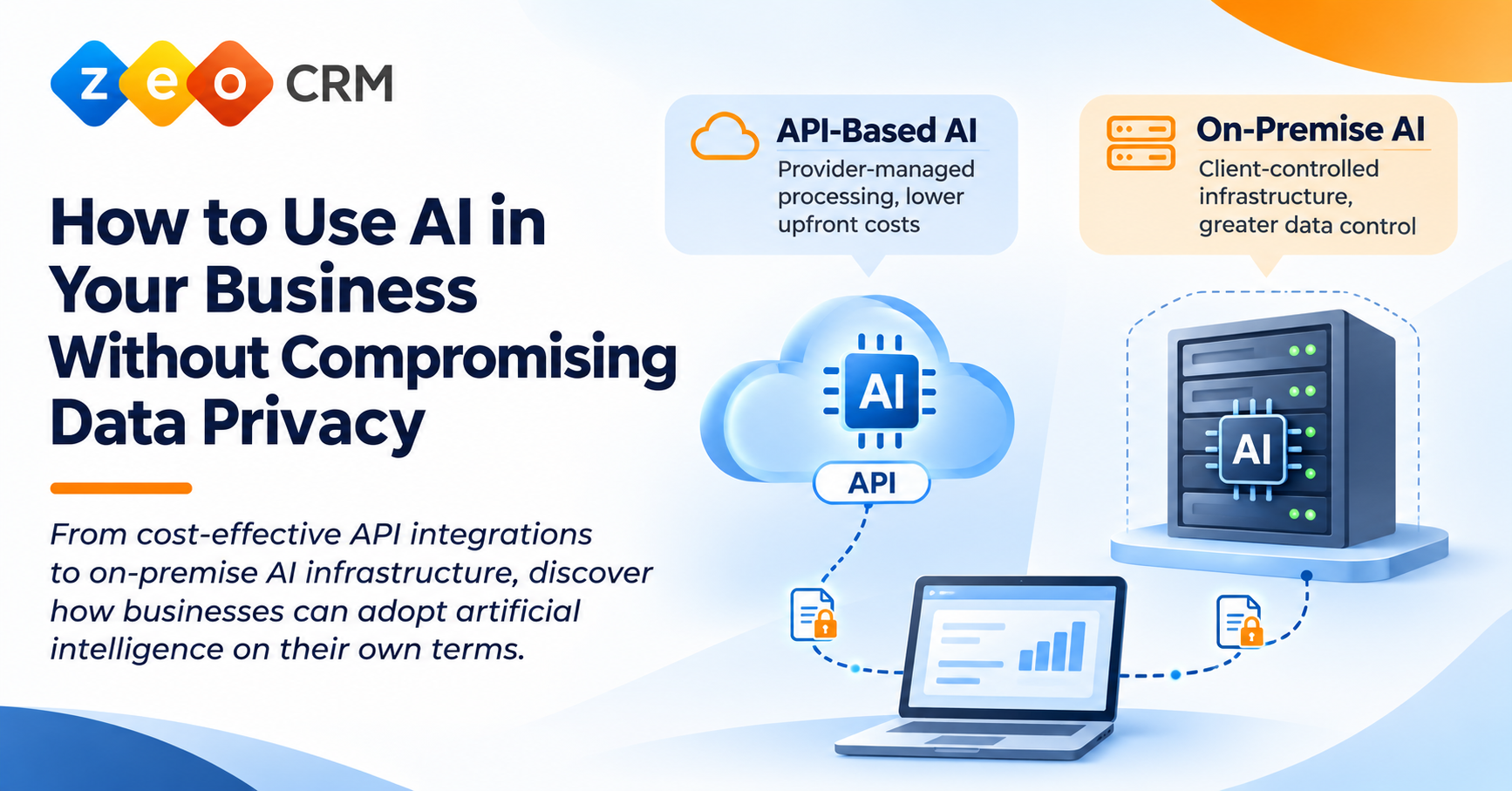
From cost-effective API integrations to on-premise AI infrastructure, discover how businesses can adopt artificial intelligence on their own terms.
Introduction: The AI Adoption Dilemma
If artificial intelligence can make your business more efficient, why should adopting it mean giving up control over your data?
Businesses now use AI for document processing, customer management, workflow automation, analytics and decision support. At the same time, they hold some of their most sensitive information in the same systems: customer records, financial documents, internal communications and personal details.
That creates a real dilemma. You want the benefits of AI, but you don’t want to lose sight of where your data goes.
The good news is that you have options. Broadly, there are two ways to bring AI into your business:
- API-based AI integration for cost-effective adoption
- On-premise AI deployment for greater data control
This guide explains both, so you can choose how AI interacts with your data.
Why Data Privacy Is Becoming a Major Concern in Business AI Adoption
Many businesses hesitate to adopt AI not because they doubt its value, but because they’re unsure what happens to their information.
Where Does Your Data Go When You Use AI?
When you use an externally hosted AI service, the relevant data is usually sent to the provider’s infrastructure for processing. The result comes back to your system. What happens to that data in between depends on the provider’s policies on storage, retention, access and model training.
What Types of Business Data Require Protection?
Most businesses handle at least some of the following:
- Customer and client information
- Financial records
- Proprietary business information
- Identity documents
- Employee records
- Confidential communications
Data Privacy Is Not the Same as Data Security
These terms are often used interchangeably, but they mean different things:
| Concept | What it means |
|---|---|
| Data privacy | Who can access and use your data |
| Data security | How your data is protected |
| Data ownership | Who holds the rights to the data |
| Data sovereignty | Which jurisdiction’s laws govern the data |
| Data control | Who manages access, processing and retention |
Understanding these differences helps you ask better questions when evaluating any AI solution.
Do Businesses Have to Share Their Data to Use AI?
Not necessarily. API-based AI services typically process relevant information on provider-managed infrastructure, so some data does leave your systems. On-premise AI solutions, on the other hand, can let you run AI workloads inside infrastructure you control.
The real answer depends on the deployment architecture, the integrations involved and the data processing arrangements you agree to. Let’s look at both models in detail.
Model 1: API-Based AI, a Cost-Effective Way to Adopt Artificial Intelligence
What Is API-Based AI?
API-based AI lets you plug AI capabilities into your existing systems, such as your CRM, without hosting the AI models yourself. Your system sends a request to the provider, the provider processes it and the result comes back.
Benefits of API-Based AI
- Lower upfront infrastructure investment
- Faster implementation
- Fewer in-house technical requirements
- Infrastructure managed by the provider
- Ongoing usage and integration support
- An easier first step into AI-powered operations
What Are the Data Privacy Considerations?
With API-based AI, the relevant data is shared with the service provider for processing. That isn’t automatically a problem, but you should understand:
- How long the provider retains your data
- Who can access it
- Whether your data is used to train models
- How data is encrypted in transit and at rest
- What contractual data protection terms apply
Who Should Consider API-Based AI?
Startups, SMEs, growing consultancies and any business that wants to start using AI without investing heavily in dedicated infrastructure. It’s a practical way to test use cases and see results quickly. ZeoCRM offers an API-based option for exactly this kind of cost-conscious adoption.
Model 2: On-Premise AI, Keeping Your Business Data Within Your Own Infrastructure
What Is On-Premise AI?
On-premise AI means deploying AI models and their processing capabilities on infrastructure your organisation controls. Your data is processed and stored within your own environment instead of being sent to an external AI provider.
Benefits of On-Premise AI
- Greater control over business data
- Less dependence on external AI processing services
- Access permissions set by your organisation
- More flexibility to apply your own data governance policies
- A better fit for stricter confidentiality requirements
- Greater control over infrastructure and deployment
What Are the Trade-Offs?
On-premise AI comes with real responsibilities. You’ll need suitable hardware, people to manage the infrastructure, technical expertise, ongoing maintenance, model updates and a plan for scaling.
It’s also worth being clear about one thing. On-premise deployment does not automatically guarantee security or regulatory compliance. It gives you more control, but you still need strong security practices and good governance.
Who Should Consider On-Premise AI?
Enterprises, universities, financial organisations, privacy-conscious consultancies and any business that handles sensitive customer information. You don’t have to start with an API-based solution first. If data control is your top priority, on-premise AI can be your starting point.
API-Based AI vs On-Premise AI: A Detailed Comparison
| Factor | API-based AI | On-premise AI |
|---|---|---|
| Initial investment | Generally lower | Generally higher |
| Infrastructure | Provider-managed | Client-controlled |
| Implementation | Typically faster | Needs dedicated setup |
| Data processing | Provider infrastructure | Client infrastructure |
| External data sharing | Required for relevant processing | Can be avoided with fully local deployment |
| Data control | Depends on service terms | Greater direct control |
| Technical requirements | Generally lower | Generally higher |
| Maintenance | Largely provider-managed | Client responsibility or agreed support |
| Support | Ongoing usage support | Initial implementation support |
| Cost structure | Recurring or usage-based | Infrastructure and operating costs |
| Best suited for | Cost-conscious adoption | Data control-first adoption |
Neither model is better in every situation. The right choice depends on your budget, infrastructure, data sensitivity and growth plans.
Your AI Strategy Can Evolve as Your Business Grows
Choosing an AI deployment model doesn’t have to be a permanent, one-time decision. Businesses tend to follow one of two journeys:
| Journey | Typical path |
|---|---|
| Cost-first adoption | Start with API, scale AI usage, then explore on-premise |
| Privacy-first adoption | Set up on-premise, adopt AI internally, then scale infrastructure |
Neither journey is mandatory. Your starting point should reflect your current needs.
Start With AI APIs and Evaluate Future Infrastructure Needs
Many businesses begin with APIs to keep costs low and prove which AI use cases actually deliver value. Once AI becomes central to operations, they can reassess whether private infrastructure makes sense.
Build a Privacy-First AI Environment From Day One
Some organisations can’t or would rather not share sensitive information with external providers. For them, starting on-premise avoids that concern from the outset.
When Should Businesses Consider Moving to On-Premise AI?
Signs it may be time to look at on-premise AI include:
- The data you process is becoming more sensitive
- Your AI usage is growing significantly
- Internal governance requirements are tightening
- Your infrastructure and team are ready to manage it
- Long-term total cost of ownership starts to favour it
Any move between models should be planned carefully with your technology partner.
Real-World AI Use Cases Where Data Privacy Matters
| Business use case | Data involved |
|---|---|
| Student recruitment and admissions | Student profiles and academic records |
| Immigration consulting | Passports, visa documents and personal information |
| Customer relationship management | Contact details and communication history |
| AI-powered document processing | Confidential business documents |
| Financial operations | Transaction and financial information |
| Business analytics | Internal performance and operational data |
| HR automation | Employee records and personal information |
Example: An Education Consultancy Adopting AI
Imagine a growing education consultancy that wants to automate repetitive CRM workflows and work more efficiently. To keep initial costs down, it chooses API-based AI.
Another consultancy handles large volumes of sensitive student records and prefers to keep everything in-house. It chooses an on-premise setup from the start.
Both benefit from AI. Their infrastructure choices simply reflect different priorities. You can read more about AI-powered workflow automation for consultancies.
7 Questions to Ask Before Choosing an AI Deployment Model
Use these questions to evaluate any AI solution:
- What type of business data will the AI system process?
- Where will the data be processed and stored?
- Who can access the data?
- Is submitted data retained or used for model training?
- What are the upfront and long-term operating costs?
- Who will manage the infrastructure, security and maintenance?
- Can the deployment model evolve with your future needs?
Clear answers to these questions will tell you far more than any feature list.
How ZeoCRM Helps Businesses Adopt AI on Their Own Terms
Your Business. Your Data. Your Choice.
At ZeoCRM, we know every business has different priorities when it comes to AI. Some want to start using AI while keeping their initial investment manageable. Others want greater control over their data and infrastructure from day one. That’s why we offer two approaches.
Cost-Effective AI Adoption Through API Integration
Our API-based option suits businesses that want:
- Lower initial infrastructure costs
- AI capabilities without hosting models themselves
- Usage and integration support
- Processing managed by the provider
To be transparent, with this option the relevant data is shared with the provider for processing.
Privacy-Focused AI Adoption Through On-Premise Deployment
Our on-premise option suits businesses that want:
- AI infrastructure under their own control
- Local processing of business data
- Greater control over data access
- Initial setup and implementation support
- An AI environment aligned with internal privacy requirements
Whether you’re taking your first step into AI or building a privacy-focused environment, you can choose the approach that fits your business. Explore our AI-powered CRM solutions.
Frequently Asked Questions
Can businesses use AI without sharing their data?
Yes. With an on-premise AI deployment, AI workloads can run inside your own infrastructure, so data doesn’t need to go to an external AI provider. API-based AI, by contrast, sends relevant data to the provider for processing.
What is on-premise AI?
On-premise AI is artificial intelligence deployed on infrastructure your organisation controls. Your data is processed and stored within your own environment rather than on an external provider’s servers.
What is the difference between API-based AI and on-premise AI?
API-based AI uses a provider’s infrastructure and usually costs less upfront. On-premise AI runs on your own infrastructure, offering more data control but needing more investment and technical resources.
Is on-premise AI more secure than cloud-based AI?
Not automatically. On-premise AI gives you more control, but security depends on how well the infrastructure is configured, maintained and governed. Cloud and API services can also be secure with the right safeguards.
Is API-based AI suitable for small businesses?
Yes. It’s often the most practical choice for small businesses because it needs less upfront investment and less in-house expertise. Just review the provider’s data handling terms first.
Can a business start with on-premise AI directly?
Yes. If data control is a priority, you can start on-premise without first using an API-based solution.
Can businesses move from API-based AI to on-premise AI?
Many businesses consider this as their AI usage and data needs grow. Plan any move carefully with your technology partner.
How can education consultants protect student data while using AI?
Understand where student data is processed, limit access to authorised staff, review provider retention and training policies and consider on-premise AI for highly sensitive records. See our guide to managing student data.
Conclusion: AI Adoption Should Not Mean Giving Up Control
AI adoption should fit your business priorities, not the other way round. Affordability and data control are both valid concerns, and the right deployment model depends on which matters most to you right now. Whatever you choose, make sure you understand exactly how your information is processed.
Ready to adopt AI without losing sight of your data privacy priorities? Whether you’re looking for cost-effective API integration or an on-premise AI environment, ZeoCRM can help you find the right approach.